

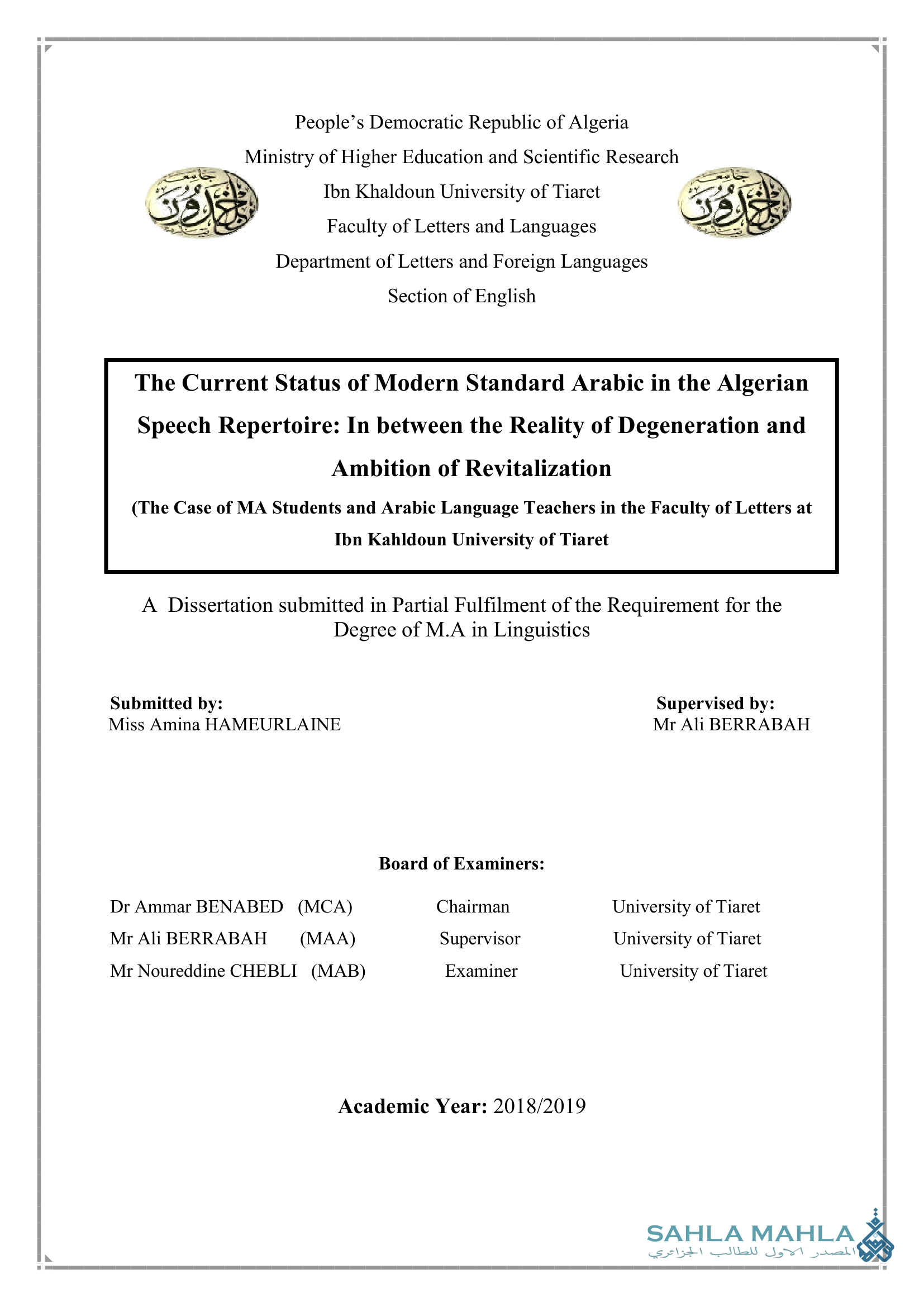
The Current Status of Modern Standard Arabic in the Algerian Speech Repertoire: In between the Reality of Degeneration and Ambition of Revitalization The Case of MA Students and Arabic Language Teachers in the Faculty of Letters at Ibn Kahldoun University of Tiaret
General Information:
Level |
Master |
Title |
The Current Status of Modern Standard Arabic in the Algerian Speech Repertoire: In between the Reality of Degeneration and Ambition of Revitalization The Case of MA Students and Arabic Language Teachers in the Faculty of Letters at Ibn Kahldoun University of Tiaret |
Specialty |
Linguistics |
Cover Page:
Outline:
General Introduction
CHAPTER ONE: Features of the Sociolinguistic Situation in Algeria
1.1 Introduction
1.2 The Sociolinguistic Situation in Algeria
1.2.1 The Arab Conquest
1.2.2. The Spanish and Turkish Invasions
1.2.3. The French occupation
1.3. The Original Language Varieties in Algeria
1.3.1. Classical Arabic
1.3.2. Modern Standard Arabic (MSA)
1.3.3. Algerian Dialectal Arabic (ADA)
1.3.4. Berber
1.4. The Co-existence between MSA and French Languages
1.5. Challenges for MSA Revitalization
1.5.1. Public Perceptions towards MSA and Foreign languages
1.5.2. The Lack of Awareness of MSA Revitalization
1.6. Conclusion
CHAPTER TWO: The History and Story of the Arabization Process in Algeria
2.1 Introduction
2.2 Early Research on Language Planning and Language Policy
2.3. Language Planning and Language Policy
2.4. Language Planning and Language Policy in Algeria
2.5. Arabization Process in Algeria
2.5.1. Arabization between External and Internal Influences
2.5.1.1. External Influences
2.5.1.1.1. French Occupation
2.5.1.1.2. Second Language Acquisition
2.5.1.1.3. Globalization
2.5.1.2. Internal Influences
2.5.1.2.1. The Diglossic Situation in Algeria
2.5.1.2.2. Bilingual Education
2.5.1.2.3. Language Contact
2.6. Language Loss, Endangerment and Language Revitaization
2.6.1. Language Revitalization
2.6.2. Language Revitalizations’ Factors and Steps
2.6.3. Language Functions
2.6.3.1. Language, Culture, Society and Religion
2.6.3.2. Language Attitude and Identity
2.7. Conclusion
CHAPTER THREE: Data Collection, Analysis and Discussion
3.1 Introduction
3.2. The Research Design
3.2.1. Target Population
3.2.2. Research Approaches and Instruments
3.3. Research Methodology, Data Collection and Finding Analysis
3.3.1. Students’ Questionnaires
3.3.2. Analysis of Students’ Questionnaires
3.3.2.1. Students’ Personal Information
3.3.2.2. Students’ Attitudes towards the Use of Modern Standard Arabic
3.3.3. Teachers’ Interviews
3.3.4. Analysis of Teachers’ Interviews
3.3.4.1. Teachers’ Professional Data
3.3.4.2. Teachers’ Perceptions of the Arabization Process
3.5. Conclusion
General conclusion
Bibliography
Maps and Illustrations
Download The Thesis:
For more
academic sources and references,
including theses and dissertations from Algerian universities,
, visit our main website.