


« UK ‘Special Relationship’ with USA and its Impact on the European Union (1945-2015) »
General Information:
Level |
PhD |
Title |
« UK ‘Special Relationship’ with USA and its Impact on the European Union (1945-2015) » |
Specialty |
Civilisation |
Cover Page:
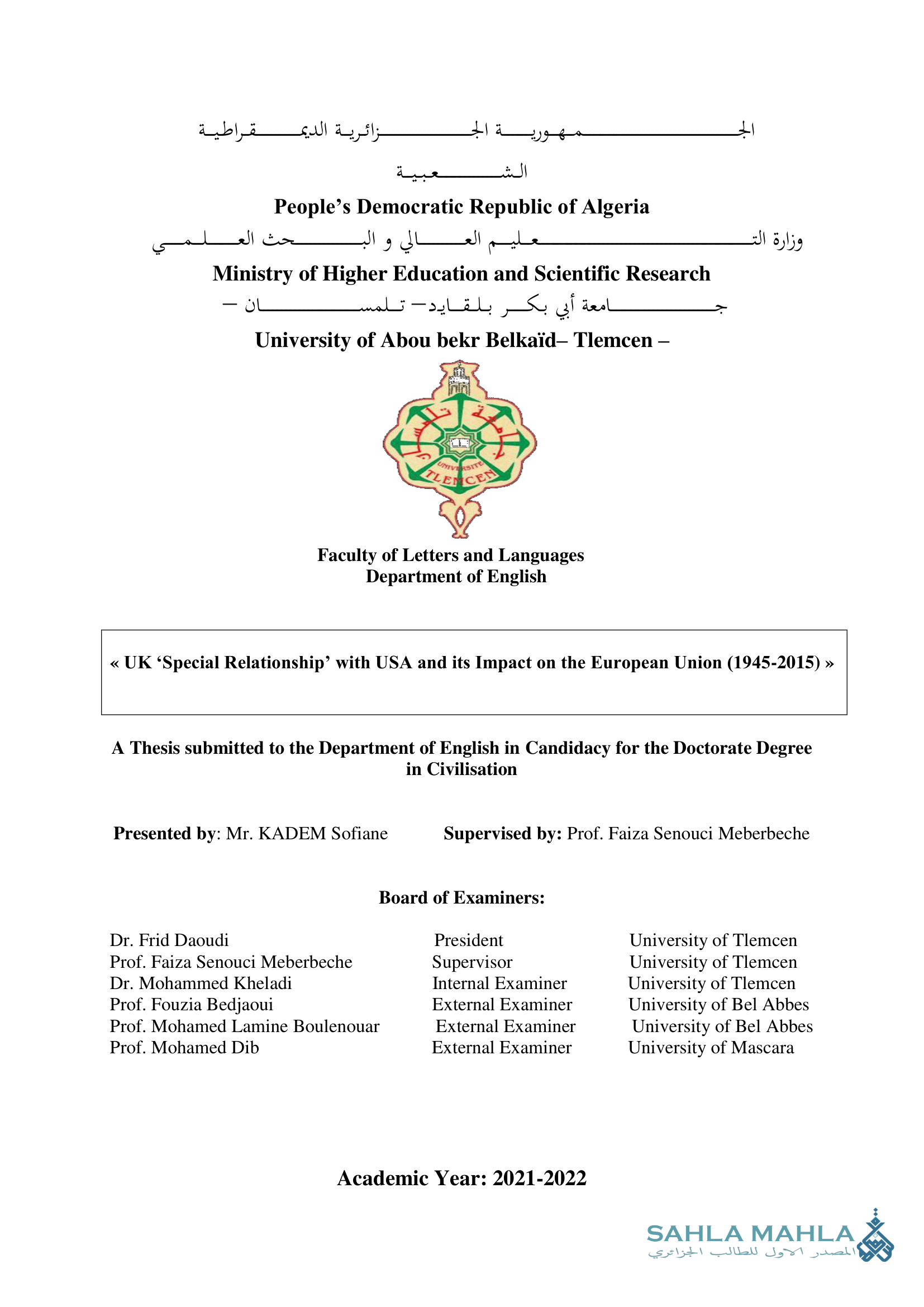
Outline:
Declaration
Acknowledgments
General Introduction
Chapter I: Background to the Anglo-American “Special Relationship” Definition and Related Theories
1. Introduction
2. Definition and Related Theories
2.1. Definition of the ‘Special Relationship’
2.2. The American View of the Relationship
2.3 Related Theories
3. Factors that Helped the Anglo-American Relations to be Special
3.1. The Historical and Cultural Ties
3.2. The Political and Legal Structure
3.3. Mutual Interests
3.4. Security and Military Aspects
3.5. Nuclear Weapons Development
3.6. Common Threat
3.7. The Related Institutions
4. The Start and the Development of the Special Relationship (1914-1935)
4.1. The Relationship during the Interwar Period
4.2. The Relationship during World War II
4.2.1. Prime Minister Churchill- President F. D. Roosevelt (1939-1945)
4.2.2. From Munich to the Fall of France
4.2.3. Privileged Relation and Suspicion
4.2.4. From a Relationship of Equals to a Dominant-to-Dominated Relationship
4.2.5. Secret Service Cooperation
4.3. The Relationship in the Immediate Post- War
4.3.1. Wilson Churchill /Atlee (1945/51) – President Harry S. Truman (1945-1947)
4.3.2. Immediate Post-War Strained Relations
4.3.3. The End of Nuclear Cooperation
4.3.4. The Palestinian Issue: the Beginning of Britain Disengagement in the World
5. Britain Trying to Fit into Europe: Macmillan to Heath (1957-74)
5.1. Accession in the EEC during Macmillan Premiership (1957-63)
5.2. Accession in the EEC during E. Heath Premiership (1970-1974)
6. Conclusion
Chapter II: Emergence and manifestations of “the special relationship” during The Cold War (1946-1990)
1. Introduction
2. The S.R. into the Cold War: (1946-1947)
2.1. The Marshal Plan (1946)
2.2. From Berlin Blockade to the North Atlantic Treaty (1948-1949)
2.3. China and the Korean War: (1950-1953)
2.4. Churchill Back – Truman and Dwight T. Eisenhower (1951-1955)
2.5. The Iran Crisis (1951)
2.6. The Indochina War (1954-1955)
2.7. The E.C.D failure and German Rearmament (1955)
2.8. The Suez Crisis: Anthony Eden and Harold Macmillan-Eisenhower (1955-1961)
2.8.1. The Context of the Crisis
2.8.2. Diplomacy and Military Preparation
2.8.3. American Attitudes and Hostilities
2.8.4. End of Crisis (1956)
2.8.5. A Lesson not to be forgotten
3. Restoring the Special Relationship: Military and Financial Dependence
3.1. Reconnection and Restoration of Nuclear Cooperation
3.2. Collaboration in the Middle East and US Support for British Nuclear Power
3.3. The New Berlin Crisis and the American Spy Affair (1958-1962)
4. A Tormented Special Relationship
4.1. Kennedy’s Confidant in a Difficult Beginning
4.2. The Cuban Missile Crisis (1962)
4.3. End of Crisis and Debates over the Special Relationship
5. The Nassau Agreement (1962)
6. First Nuclear Test Ban Treaty (1963)
7. The Special Relationship Compromised by “the Vietnam War” (1955)
7.1. A difficult Beginning for the British Prime Minister H. Wilson
7.2. The US Intervention in Vietnam: The Bone of Contention. (1955-1975)
7.3. First British Initiative in Vietnam and Rhodesia Crisis (1965)
7.4. Last British Initiative in Vietnam and British Withdrawal from East Suez (1967)
8. The Special Relationship and Europe
8.1. The Time of Indifference
8.2. Detente between the East and the West: ‘the Year of Europe’ (1973)
8.3. Better Days Back
8.4. Carter Administration and the Reinforcement of ‘the S.R.’ (1977-81)
9. Conclusion
Chapter III: The End and Post Cold War Period (1990-2015)
1. Introduction
2. Reagan – Thatcher Axe (1980-1990)
2.1. The Special Relationship Revived
2.2. Military Relations (1981-1983)
2.3. The Falklands War (1982)
3. US Intervention in Grenade (1983)
4. The American Preference: UK Choosing USA Rather than Europe: (19894-1987)
5. The ‘Special Relationship’ Less Special: M. Thatcher- George H. W. Bush (1989/90)
6. Post Cold War ‘Special Relationship’
6.1. John Major – George H. W. Bush (1990-1993)
6.2. John Major – Bill Clinton (1993-1997)
6.3. Bill Clinton (1997-2001) – Tony Blair (1997.2007)
6.4. Tony Blair (1997-2007) – George W. Bush (2001-2007)
5.5. Gordon Brown (2009-2010) / Barack Obama (2008-2015)
6.6. David Cameron (2010-2015) – B. Obama (2008-2015)
7. Conclusion
Chapter IV: European Integration and the Future of ‘the S.R.’ Challenges and Implications
1. Introduction
2. Britain’s Sceptic Relationship with Europe
3. The American Influence Regarding UK Integration
4. Britain as a EU Member Struggling to Hold on to the S.R
5. Impact of the ‘Special Relationship’ in an Atlanticised Context
6. Conclusion
General Conclusion
Bibliography
Download The Thesis:
For more
academic sources and references,
including theses and dissertations from Algerian universities,
, visit our main website.