


The Use of Movies and Songs to Enhance the Speaking Skill: The Case of First Year EFL Students at Ibn Khaldoun University of Tiaret
General Information:
Level |
Master |
Title |
The Use of Movies and Songs to Enhance the Speaking Skill: The Case of First Year EFL Students at Ibn Khaldoun University of Tiaret |
Specialty |
Didactics |
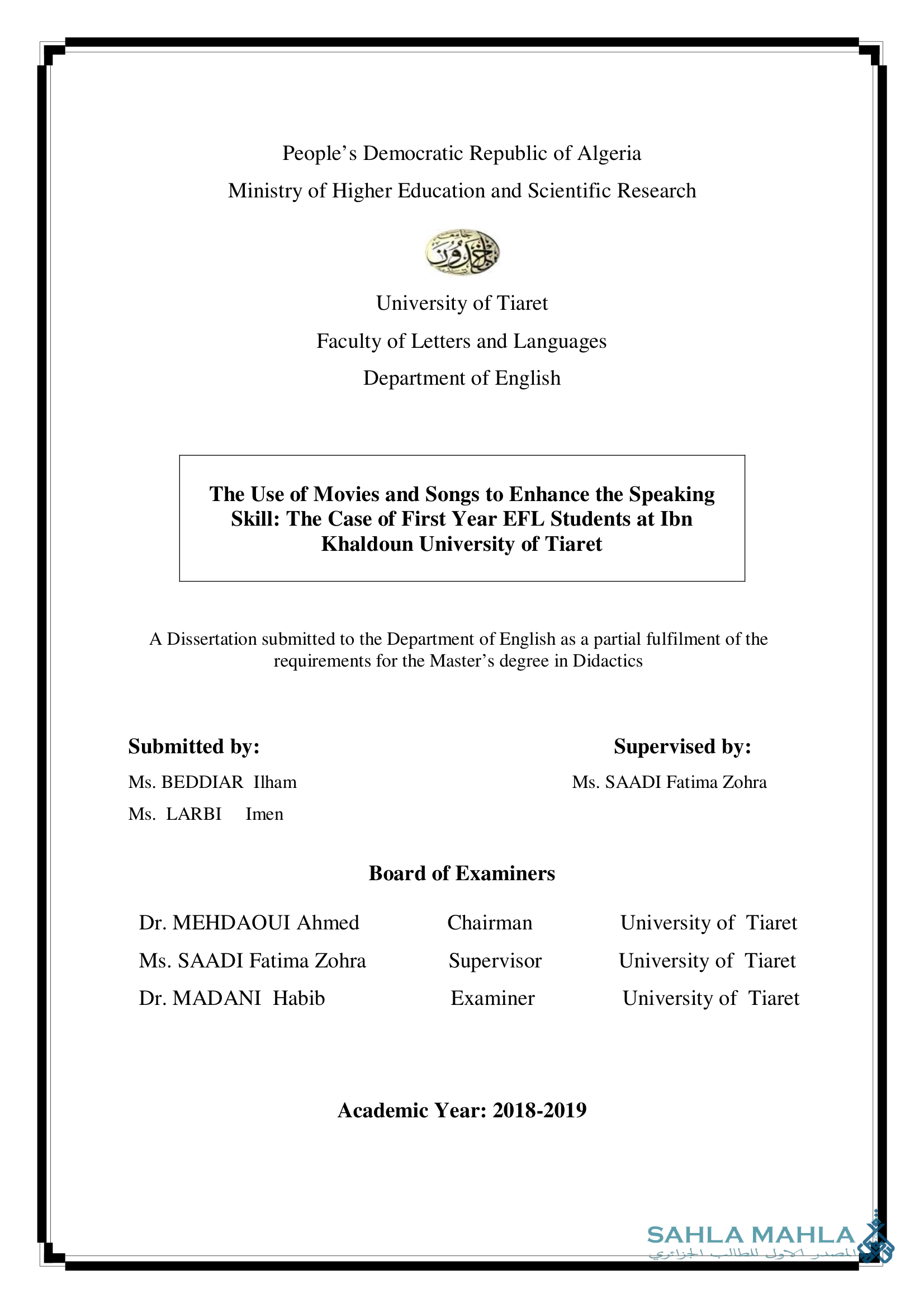
Cover Page:
Outline:
General Introduction
Chapter One: Literature Review Section One: Speaking Skill
1.1. Introduction
1.2. Definitions of Speaking
1.3. The Characteristics of Speaking
1.4.The Affective Domain
1.5Factors That Cause Speaking Difficulties to EFL Learners
1.6. Valuable Media Used for Teaching Speaking to EFL Learners
1.7. Teaching Speaking with Songs and Movies
Section Two: The Use of Movies and Songs in EFL Teaching
1.8. The Use of Movies in EFLT
1.9. Definitions of Movies
1.10. The Importance of Using Movies as a Tool in EFL Classroom
1.10.1. Authenticity
1.10.2. Motivation
1.11. Learning Culture through Movies
1.12. Movies and Brain Hemispheres
1.13. Movies in EFL Teaching
1.14. The Impact of Movies on Teaching the Speaking Skill
1.15. Types of Movies
1.16. Criteria of Using Movies in EFL Teaching
1.17. Stages Consider When Using Movies in EFL Teaching
1.18. Functions of Movies in Teaching
1.18.1 Movies as Analytical Case
1.18.2 Movies as Experiential Practice
1.18.3 Movies as Metaphor
1.18.4 Movies as Symbolism and Meaning
1.19. Benefit Sides of Movies
1.20. Drawback Sides of Movies
1.21. The Use of Songs in EFL Teaching
1.22. Definitions of Song
1.23. Structural Integration in Language and Music
1.24. Types of Songs
1.25 Characteristics of Songs
1.25.1. Pronunciation
1.25.2. Intonation
1.25.3. Vocabulary
1.26. Why Teach English Language through Songs
1.27. Criteria for the Selection of Music/Songs
1.28. The Reasons for Using Songs in EFL Classroom
1.28.1. Songs and the Linguistic Reason in L2 Classroom
1.28.2. Songs and the Affective Reason in L2 Classroom
1.28.3. Songs and the Cognitive Reason in L2 Classroom
1.28.3.1. Automatic and Fluent Output
1.28.3.2. Intelligences and Learning
1.28.3.3. Memory
1.28.4. The Social and Cultural Reason in L2 Classroom
1.29. The Stages of a Songs
1.29.1. Pre-Study Activities
1.29.2. During Studying Activities
1.29.3. Post-Study Activities
1.30. The Advantages of Songs
1.31. The Disadvantages of Songs
1.32. Conclusion
Chapter Two: Research Methodology and Design
2.1. Introduction
2.2. Research Objectives
2.3. The Sample Population and Setting
2.3.1 The Students
2.3.1.1. The Reason of choosing 1st Year EFL Learners
2.3.2. The Teachers
2.4. The Research Instruments
2.4.1 The Questionnaire
2.4.1.1. Students’ Questionnaire
2.4.1.2. Teachers’ Questionnaire
2.4.2. Classroom Observation
2.4.2.2. Description of the Observation
2.5. Data Analysis
2.5.1. Students’ Questionnaire Analysis
2.5.2. Teachers’ Questionnaire Analysis
2.5.3. Classroom Observation Analysis
2.6. Conclusion
Chapter Three: Discussion and Recommendations
3.1. Introduction
3.2. Discussion of the Main Results
3.3. Recommendations
3.4. Tips to Stimulate Students’ Speaking Inside the Classroom
3.4.1. Encourage Active Participation
3.4.2. Provide Structured Guidance
3.4.3. Provide Emotional Support
3.4.4. Give Choices and Praises
3.5 Classroom Activities
2.6. Conclusion
General Conclusion
Bibliography
Download The Thesis:
For more
academic sources and references,
including theses and dissertations from Algerian universities,
, visit our main website.