


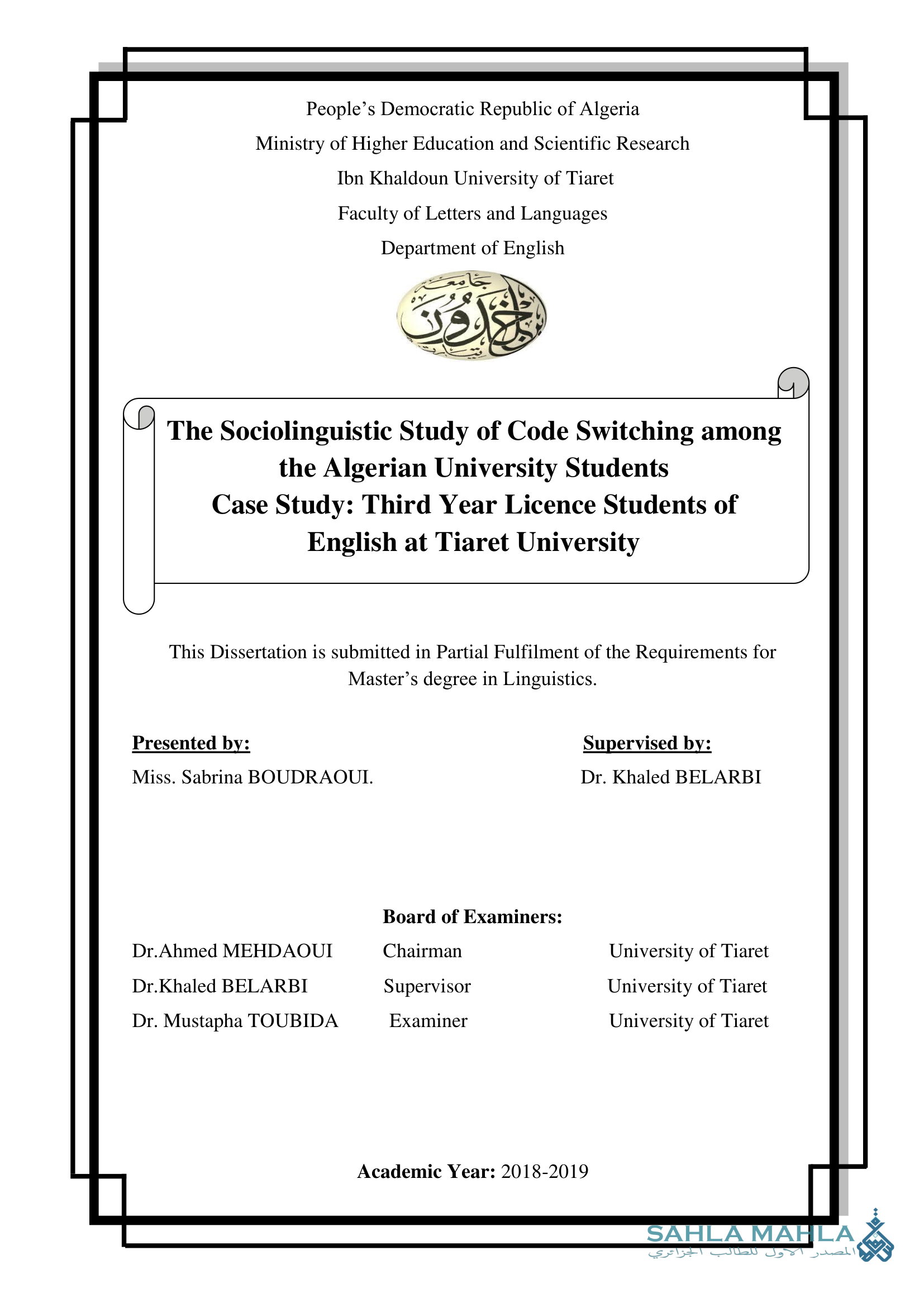
The Sociolinguistic Study of Code Switching among the Algerian University Students Case Study: Third Year Licence Students of English at Tiaret University
General Information:
Level |
Master |
Title |
The Sociolinguistic Study of Code Switching among the Algerian University Students Case Study: Third Year Licence Students of English at Tiaret University |
Specialty |
Linguistics |
Cover Page:
Outline:
Acknowledgments
Lists of Tables
Lists of Figures
General Introduction
Chapter one: The sociolinguistic situation in Algeria
I.1.Introduction
1.2.languages in contact
1.3. A Brief overview of the history of Algeria
I.4. The Algerian sociolinguistic verbal repertoire
I.4.1.Standard Arabic
I.4.2.Algerian Arabic
I.4.3.Berber
I.4.4.French
I.4.5.English
1.5. Language policy in post-independent Algeria
I.6. The Arabization policy
I.7. Languages in education
I.8. Language contact outcomes
I.8.1. Bilingualism in Algeria
I.8.2. Diglossia
1.8.3. Borrowing
I.8.4. Code Switching
I.9. Conclusion
Chapter two: Overview of Code Switching and other contact phenomena
II.1.Introduction
II.2.Bilingualism
1.3. Code
II.4. Code-Switching
II.5.Types of Code Switching
II.5.1.Situational Code Switching
II.5.2.Conventional Code-Switching
II.6. Forms of Code Switching
II.6.1. Tag Switching
II.6.2. Inter-sentential Switching
II.6.3. Intra-sentential Switching
II.7. Purposes of Code Switching
II.8. Functions of Code Switching
II.8.1. Markedness model
II.9. Code Switching as a social phenomenon
II. 10. Contexts of Code Switching
II. 11. Attitudes toward Code Switching
II. 12. Code Mixing
II. 13. Code switching and Code Mixing
II. 14. Borrowing
II. 15. Code Switching and Borrowing
II. 16. Conclusion
Chapter Three: Methodology and Data Analysis
III.1. Introduction
III.2.ResearchMethod
III.3. Sample
III.4.Description of the setting
III.5.Research tools
III.5.1.Observation
III.5.2.The questionnaire
III.6. Procedures
III.7. Data Analysis of Observation
III.8. General Analysis of Observation
III.9. The Objectives of the Questionnaire
III. 10. Type of the Questionnaire
III.11. Data Analysis of the Questionnaire
III. 12. Discussion of the results
III.13. Conclusion
General Conclusion
Bibliography
CS: Code-Switching
CM:Code-Mixing
MSA: Modern Standard Arabic
AA: Algerian Arabic
CA: Classical Arabic
BR: Berber
H: High
L: Low
L1: First Language
L2: Second Language
AF: Absolute Frequency
RF: Relative Frequency
ML: Matrix Language
EL: Embedded Language
Download The Thesis:
For more
academic sources and references,
including theses and dissertations from Algerian universities,
, visit our main website.