


Self and Tele-monitoring of Human Health System Connected with an Android Application and provided with GPS/GSM Technology
General Information:
Level |
Master |
Title |
Self and Tele-monitoring of Human Health System Connected with an Android Application and provided with GPS/GSM Technology |
Specialty |
biomedical informatics |
Cover Page:
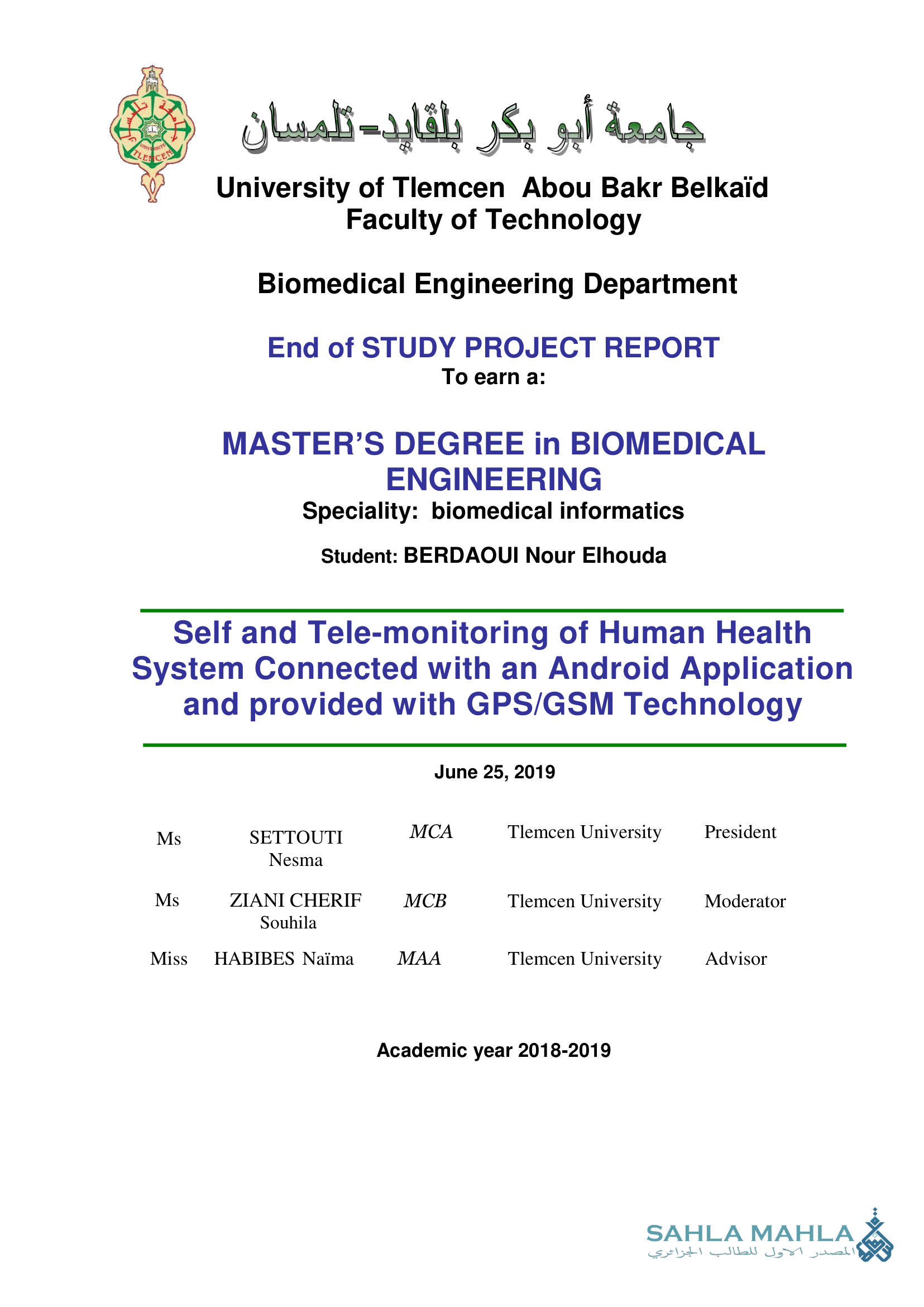
Outline:
GENERAL INTRODUCTION
CHAPTER I Generality on physiological parameters and its different measurement techniques
1 Introduction
2 Biomedical Engineering
2.1 Definition
2.2 Objectives and Roles of Biomedical engineering
2.2.1 Objectives
2.2.2 Roles
3 Arterial pressure
3.1 Definition
3.1.1 Symptoms of high blood pressure
3.1.2 Symptoms of low blood pressure
3.1.3 Healthy and unhealthy blood pressure ranges
3.2 Means and methods of measuring Arterial Blood Pressure
3.2.1 Auscultatory
3.2.2 Oscillometry
4 Body Temperature
4.1 Definition
4.2 Normal and abnormal body temperature
4.3 Scales of temperature
4.3.1 Fahrenheit Scale
4.3.2 Celsius Scale
4.3.3 Kelvin Scale
4.3.4 Rankin scale
4.4 Means and methods of measuring human body temperature
5 Blood glucose
5.1 Definition
5.2 Blood glucose chart
5.3 Means and methods of measuring blood glucose
5.3.1 Invasive methods
5.3. Non-Invasive methods
6 Heart Rate
6.1 Definition
6.2 Physiology
6.3 values of heart rate
6.3.1 Normal values of heart rate
6.3.2 Fast heart rate
6.3.3 Slow heart rate
6.4 Means and methods of measuring Heart Rate
6.4.1 Optical heart rate monitoring
Conclusion
CHAPTER II Design and implementation of the connected Non-invasive invasive device
1 Introduction
2 Physical Components used to achieve the non-invasive device
2.1 Data acquisition and gathering
2.1.1 Arduino UNO
2.2 Data transmission
2.2.1 Bluetooth
2.2.2 Module GPS GSM GPRS SIM808
2.3 Tools for the non invasive device
3 Non-Invasive Glucometer Based on Photo-acoustic Method
3.1 Definition and History
3.2 Theoretical study of the non invasive glucometer
3.3 Laser Sources
3.4 Methodology
3.4.1 Conception
3.4.2 Implementation
3.4.3 Calibration
4 Body temperature sensor
4.1 LM35
4.2 Methodology
4.2.1 Conception
4.2.2 Implementation
5 Heart Rate sensor
5.1 Definition
5.2 Methodology
5.2.1 Conception
5.2.2 Implementation
6 Sphygmomanometer
6.1 Methodology
6.1.1 Conception
6.1.2 Implementation
7 Tracker system
7.1 Global Positioning System (GPS)
7.2 Global System for Mobile Communications (GSM)
7.2.1 Composition of the network
7.2.2 Security in GSM
7.3 Methodology
7.3.1 Conception
7.3.2 Implementation
8 The final device
9 Experimental studies of the results
9.1 Study of precision
9.2 Stabilization time
9.3 Detected anomalies
10 Conclusion
CHAPTER III Creation and development of an Android Application integrated with Machine Learning
1 Introduction
2 Definition of MIT app inventor
2.1 Android App Inventor
2.2 The features of app inventor
3 Application design
3.1 Creation of a new project
Connection of the App
3.2 project structure
4 “Healthy Life” Application
4.1 Description of the application
4.1.1 UML Sequence Diagram
4.1.2 Running the application
5 Classifications
5.1 Machine Learning
5.2 Decision trees
5.2.1 Decision tree for Blood Pressure
5.2.2 Decision tree for Blood Glucose
5.2.3 Decision tree for Body Temperature
5.2.4 Decision tree for Heart Rate
5.2.5 Database collection
6 Experiments performed
7 Conclusion
GENERAL CONCLUSION
ANNEX
Annex 1
BIBLIOGRAPHY
Download The Thesis:
For more
academic sources and references,
including theses and dissertations from Algerian universities,
, visit our main website.