


Investigating Learners’ Retention of Lexical Items through the Use of Visual Aids The Case of Secondary School Pupils at Ain Dheb, Tiaret
General Information:
Level |
Master |
Title |
Investigating Learners’ Retention of Lexical Items through the Use of Visual Aids The Case of Secondary School Pupils at Ain Dheb, Tiaret |
Specialty |
Didactics |
Cover Page:
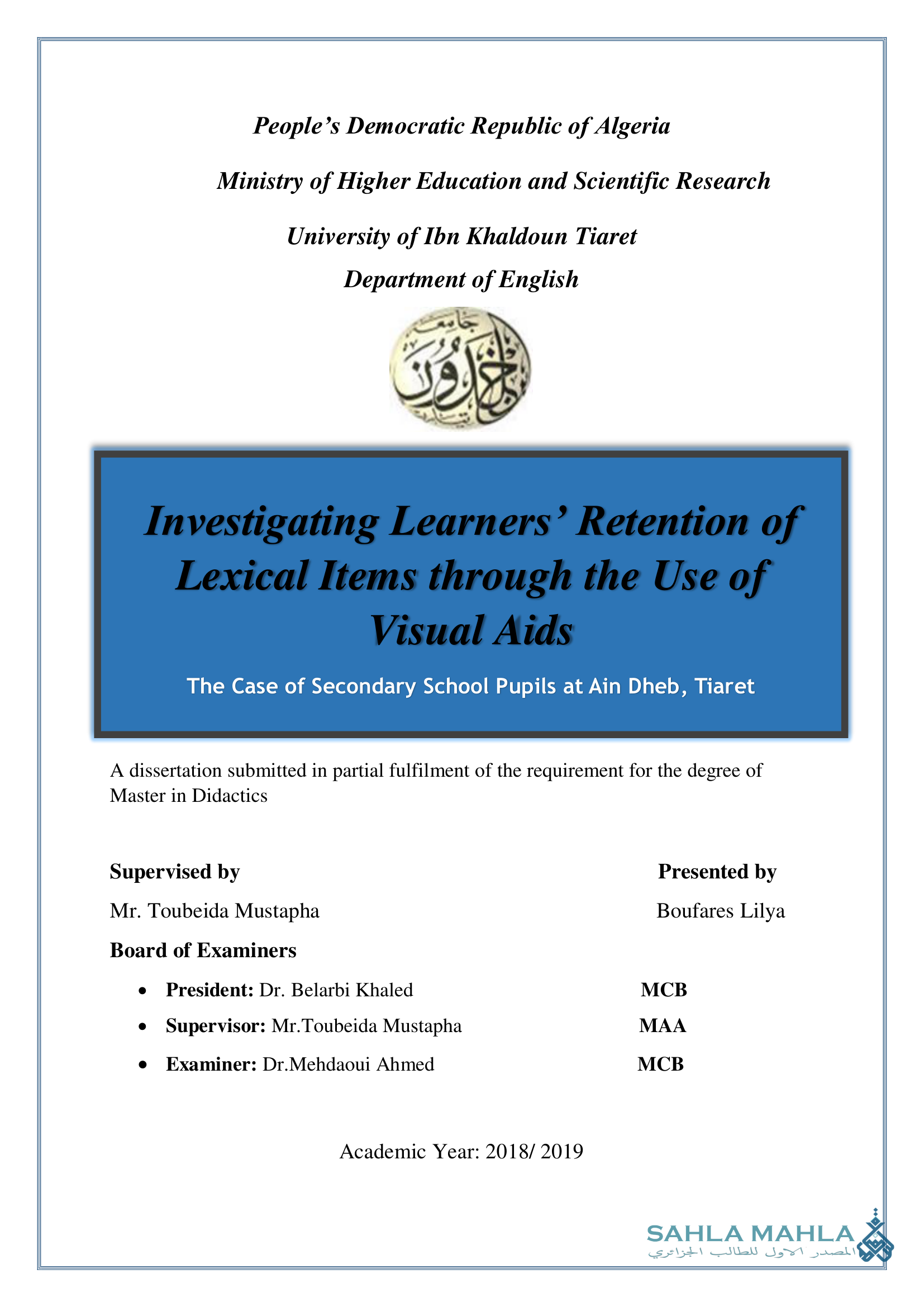
Outline:
Acknowledgments
General introduction
Chapter One: Vocabulary and its Retention Through the Use of Visual Aids
I.1. part one: Vocabulary
I.1.1. Introduction
I.1.2. Definition of vocabulary
I.1.3.Word and lexis
I.1.4. Academic vocabulary
I.1.5. Vocabulary Knowledge
I.1.6. Pronunciation and spelling
I.1.7.Grammar
I.1.8. Collocation
I.1.9. Aspects of meaning
I.1.10.Types of vocabulary
I.1.11. The Importance of Learning Vocabulay
I.1.12.EFL difficulties in vocabulary acquisition
I.1.12.1. Subcategorization
I.1.12.2.Word formation
I.1.12.3.Transfer
I.1.12.4.Recall and retrieval
I.1.12.5. Word Association
I.1.13. Techniques in Vocabulary Teaching
I.1.14. Teacher’s Effective Presentation of a New Vocabulary
I.1.15. How to involve learners in the effective vocabulary presentation
I.1.16. What happens in an effective presentation
I.2. Part two: Memory Retrieval
I.2.1. Introduction
I.2.2.Definition of memory
1.2.3. Stages of memory
1.2.3.1. Memory encoding
1.2.3.2. Storage of memory
I.2.3.3.Memory retrieval
I.2.4. Theories of memory
I.2.4.1. The multi store model
I.2.4.2. Dual coding theory
I.2.4.3. Cognitive theory of multimedia learning
I.2.5. Stages of information processing
I.2.5.1. Short term or working memory
1.2.5.2. Working memory components
1.2.5.3. Long term memory
I.2.6. Vocabulary memorization techniques
I.3. Part three: Visual Aids
I.3.1. Introduction
I.3.2. Definition of visual aids
I.3.3. The importance of visual aids in second/ foreign language acquisition
I.3.4. Visual aids’ types
I.3.4.1. Videos
I.3.4.1.1. Definition
I.3.4.1.2. Previous Findings/ research
I.3.4.1.3. Types of videos
I.3.4.1.4. Practical techniques for video implication
I.3.4.1.5.Criteria for video selection
I.3.5. Visuals used in the overhead projector
I.3.6. Pictures
I.3.7. Flash cards
Conclusion
Chapter Two: Research Methodology
II.1. Section one: Description of the area of research
II.1.1. The situation of teaching English in Algeria
II.1.2. The rationale for implementing CBA in the Algerian educational system
II.1.3. Definition of CBA
II.1.4. Characteristics of CBA
II.1.5.Attributes of CBA
II.1.5.1. Attributes of competency based teaching
II.1.5.2. Attributes of competency based learning
II.1.6. Pedagogical consideration in CBA
II.1.7. The situation of teaching English in secondary school
II.1.8. The objectives of teaching English in secondary schools
II.1.9. The situation of teaching vocabulary in the Algerian EFL context
II.2. Section Two: Research methodology
II.2.1. Research method
II.2.2. Tools and instruments
II.2.2.1. Questionnaires
II.2.2.2. Test
II.2.3. Research setting
II.2.4. Sample
II.2.4.1. Students
II.2.4.2. Teachers
II.2.5. Data collection procedures
II.2.5.1. Questionnaires
II.2.5.2. Test
II.2.5.2.1. Pre test
II.2.5.2.2. Teaching of vocabulary
II.2.5.2.3. Teaching the test group
II.2.5.2.4. Teaching the experimental group
II.2.5.2.5. post test
II.2.6. Data analysis
Conclusion
Chapter Three: Discussion of the Findings and Recommendations
III.1. Findings and data analysis
III.1.1. Analysis of questionnaire for students
III.1.2. Analysis of questionnaire for teachers
III.1.3. Pre test and post test results
III.1.3.1. Pre test scores analysis
III.1.3.2. Post test scores analysis
III.2. Discussion
III.2.1. Discussion of students’ questionnaire
III.2.2. Discussion of teacher’s questionnaire
III.2.3. Discussion of the test’s results
III.2.4. Discussion of the main findings
III.3. Recommendation
III.3.1. The objectives of using visuals in vocabulary teaching
III.3.2. How they should be used
General Conclusion
Bibliography
Download The Thesis:
For more
academic sources and references,
including theses and dissertations from Algerian universities,
, visit our main website.