


Integrating ICT in the EFL Context: Spotlight on Teacher’s Perceptions and Outlooks
General Information:
Level |
PhD |
Title |
Integrating ICT in the EFL Context: Spotlight on Teacher’s Perceptions and Outlooks |
Specialty |
Language Studies |
Cover Page:
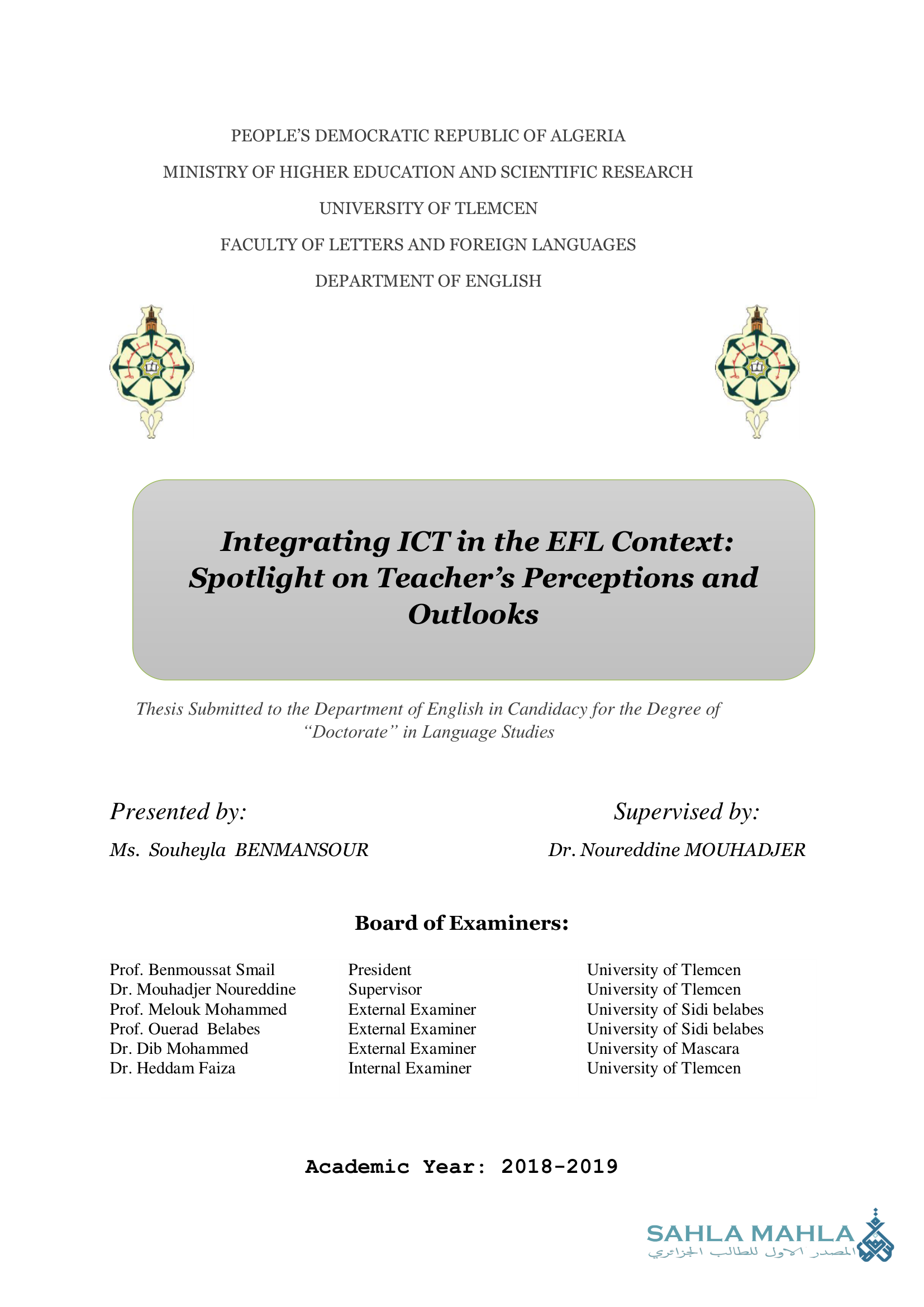
Outline:
STATEMENT OF ORIGINALITY
GENERAL INTRODUCTION
CHAPTER ONE Integrating ICT: a Step towards Change
1.1 Introduction
1.2The Concept of ICT Integration
1.3Integrating ICT: Making a Step towards Change
1.4 ICT in Today’s Education
1.5 Upshot of Integration: Focus on Learning Outcomes
1.6 The Challenging Role of ICTs in Teaching Learning Process
1.6.1 The Effect ICTs on Students’ Learning
1.6.2 Effects on Teacher’s Performance
1.7 Factors Influencing the Use of ICT in Education
1.7.1 Teachers’ Perspectives and Outlooks
1.7.2 ICT Competencies
1.7.3 ICT proficiency
1.7.4Teaching Experience
1.7.5 Gender
1.7.6 Education Level
1.7.7 Professional Improvement
1.8 Strategies to Integrating ICT in Education
1.9 Challenges and Barriers to Integrating ICT in Education
1.9.1 Students’ Related
1.9.2Technology Related
1.9.3 Teacher Related
1.10 Strategic Actions for Integrating ICT in Education
1.11 Conclusion
CHAPTER TWO Methodology and Data Collection
2.1 Introduction
2.2 Background of the Study
2.2.1 Research Settings and Participants
2.2.2 Research Problem
2.2.3 The Need for Research
2.2.4 Significance of the Study
2.2.5 Design of the Study
2.3 Definitions of the Concepts and Terms Employed in the Research
2.4 Measures of Integration
2.4.1 The Intricacy of Measurement
2.4.2 Measures and Models
2.4.3 ICT in the Algerian Context
2.4.4 ICT Environment in Algerian Education
2.5 Research Instruments
2.5.1 Instruments’ Validity
2.5.2 Instruments’ Reliability
2.5.3 External Reliability
2.5.4 Internal Reliability
2.5.4.1 Low inference descriptors
2.5.4.2 Multiple researchers/participant researchers
2.5.4.3 Peer examination
2.5.4.4 Mechanically recorded data
2.6 Reporting the Study
2.7 Methodology Overview
2.8 Data Collection
2.9 Research Instruments
2.9.1 Teachers’ Survey Questionnaire
2.9.2 Teachers’ Interview
2.10 Data Analysis
2.10.1 Validity and Reliability of the Study
2.10.2 Quantitative Data Analysis
2.10.3 Qualitative Data Analysis
2.11 Ethical Consideration
2.12Conclusion
CHAPTER THREE Data Analysis
3.1 Introduction
3.2 Participants’ Demographic
3.3. Analysis of the Data
3.3.1 Independent Variables
3.3.1.1 Gender
3.3.1.2 Taken ICT Related Courses
3.3.1.3 Taken In-service Training about ICT
3.3.2 The Dependent Variable
3.4 Results and Discussion
3.4.1 Perceptions and Competencies
3.4.1.1 Teachers’ Perceptions: Findings Related to Question 1
3.4.1.2 Teachers’ Competencies :Findings Related to Question 2
3.4.1.3 Effect on Teachers’ Performance: Findings Related to Question 3
3.4.2.Waves of Change: Effect of integrating ICT
3.4.2.1 Effect on Students’ Learning: Findings Related to Question 4
3.4.2.2 Expected Benefits: Findings Related to Question 5
3.4.2.3 Strategies of Integration: Findings Related to Question 6
3.4.3 Challenges, Measures of Endorsement and Enablers
3.4.3.1 Challenges for integrating ICT: Findings Related to Question 7
3.4.3.2 Measures of Endorsement: Findings Related to Question 8
3.4.3.3 Possible Enablers: Findings Related to Question 9
3.5 Results and Major Conclusions
3.6 Conclusion
CHAPTER FOUR Discussion, Limitations and Recommendations
4.1. Introduction
4.2 Potentials of ICTs Use in Developing Countries
4.3 Guiding Perceptions for Future Research
4.4 Implications and Suggestions for Practice
4.4. 1 Suggestion for Universities
4.4.2 Major Principles
4.4.3 Educational Initiatives
4.5 ICT Integration in EFL Context
4.5.1 Applying the strategic actions: Facts and Realities
4.5.2 ICT Integrating in the Global Understanding Program
4.5.3 Making a Cross-Cultural Podcast
4.6 Strategic Planning for ICT in Education
4.7 Implications for Research Methodology
4.8 Drawbacks of Integration
4.8.1 Major Tools Changed by the Assisting One
4.8.2 The Loss of Speaking Communication
4.8.3 The constraint of Students’ Thinking Potential
4.8.4 Abstract Thinking substituted by conceivable Thinking
4.9 Suggestions and Strategies for the Existing Problems
4.9.1 Attractive courseware is not the main objective
4.9.2 The computer screen should not replace the blackboard
4.9.3 Multimedia cannot replace student’s thinking and engagement
4.9.4 Traditional teaching tools and devices should not be disregarded
4.9.5 ICTs should not be overused
4.10 Limitations of the Study
4.11 Recommendations for Further Research
4.12 Conclusion
GENERAL CONCLUSION
REFERENCES
Download The Thesis:
For more
academic sources and references,
including theses and dissertations from Algerian universities,
, visit our main website.