

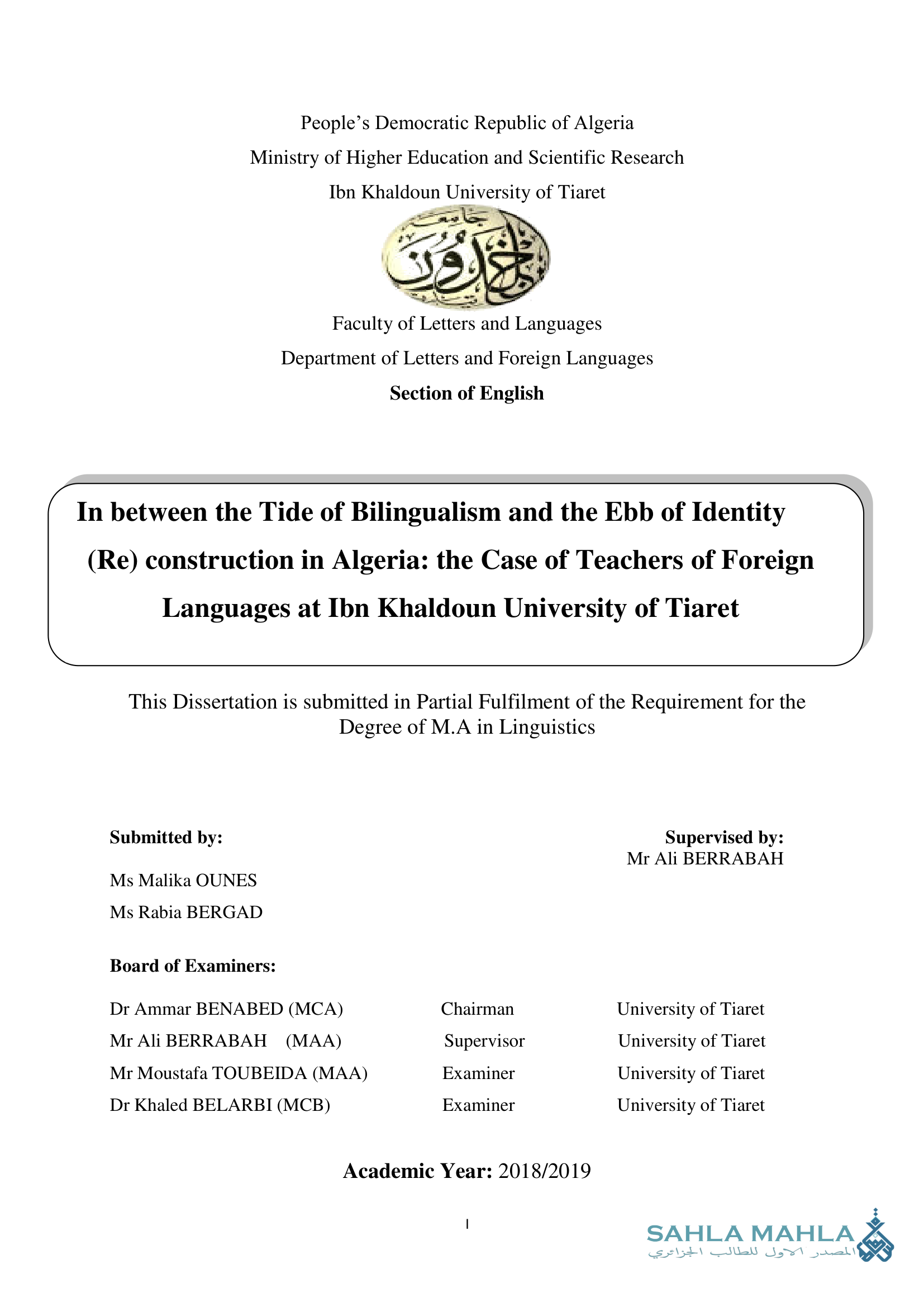
In between the Tide of Bilingualism and the Ebb of Identity (Re) construction in Algeria: the Case of Teachers of Foreign Languages at Ibn Khaldoun University of Tiaret
General Information:
Level |
PhD |
Title |
In between the Tide of Bilingualism and the Ebb of Identity (Re) construction in Algeria: the Case of Teachers of Foreign Languages at Ibn Khaldoun University of Tiaret |
Specialty |
Sociolinguistics |
Cover Page:
Outline:
General introduction
CHAPTER ONE: Features of the Sociolinguistic Situation in Algeria
1.1 Introduction
1.2 Algeria: a General Profile
1.2.1 The Geographical Location of Algeria
1.2.2 The Demographic Situation in Algeria
1.2.3 The Administrative System of the Algerian Government
1.2.4 The Ethnic Composition in Algeria
1.2.5 The Etymology of the Word Algeria
1.3 The Historical Background of Algeria
1.3.1 Algeria during the Classical Period
1.3.2 Algeria during the French Colonization
1.4 The Sociolinguistic Situation of Algeria
1.4.1 Berber
1.4.2 Arabic
1.4.2.1 Classical Arabic
1.4.2.2 Modern Standard Arabic
1.4.2.3 Dialectal Arabic
1.4.3 Turkish
1.4.4 French
1.5 Language Policies in Algeria
1.5.1 The Arabization Policy
1.5.2 The Educational Reform Policy
1.6 The Linguistic Landscape in Algeria
1.7 An Overview of the World Languages
1.7.1 The Status of the World Languages in Algeria
1.7.2 The Status of French in Algeria
1.7.3 The Status of English in Algeria
1.8 Uncontrolled Usage of the Non-Native Language Varieties in Algeria
1.9 Tiaret: The Context of the Study
1.9.1 The Geographical Location and the Etymology of the term ‘Tiaret’
1.9.2 The Administrative Division of Tiaret
1.9.3 The Historical Overview of Tiaret
1.10 Conclusion
CHAPTER TWO: Bilingual(ism): Key Related Concepts and Surrounding Issues
2.1. Introduction
2.2. Conceptual Framework
2.2.1 Language Contact
2.2.2 Types of language Contact
2.2.2.1 Language Maintenance
2.2.2.2 Language Shift
2.2.2.3 Creation of New Language
2.2.3 Outcomes of Language Contact Situations
2.2.3.1 Diglossia
2.2.3.2 Borrowing
2.2.3.3 Code Switching
2.2.3.4 Code Mixing
2.2.4 Bilingualism
2.2.5 Criteria of Bilingualism
2.2.6 Types of Bilingualism
2.2.6.1 Individual vs. Societal Bilingualism
2.2.6.2 Additive and Subtractive Bilingualism
2.2.6.3 Simultaneous vs. Sequential Bilingualism
2.2.7 Types of Bilinguals
2.2.7.1 Balanced vs. Dominant Bilinguals
2.2.7.2 Passive vs. Active Bilinguals
2.2.7.3 Compound, Coordinate and Subordinate Bilingualism
2.2.7.4 Elite Bilinguals vs. Folk Bilinguals
2.8 Bilingualism and Related Linguistic Phenomena
2.8.1 Bilingualism vs. Multilingualism
2.8.2 Bilingualism vs. Plurilingualism
2.9 Aspects of Bilingualism
2.9.1 Cognitive Aspects
2.9.2 Psychological Aspects
2.9.3 Social Aspects
2.10 Language Attitudes
2.11 Attitudes towards Bilingualism
2.12 Identity
2.13 Types of Identity
2.14 The Relationship between Language and Identity
2.15 The Effect of Bilingualism on a Bilingual’s Identity
2.16 Conclusion
CHAPTER THREE: Research Scheme, Data Collection Procedures and Findings Discussion
3.1 Introduction
3.2 Research Methodology
3.3 The Questionnaire
3.4 The participants
3.5 The Analysis of The Questionnaire Findings
3.5.1 Participants’ Personal Information
3.5.2 Participant’s Linguistic Competence
3.5.3 Reasons and Motivations for Using other Foreign Languages
3.5.4 Attitudes towards Bilinguals
3.5.5 Attitudes towards Bilingualism
3.5.6 Bilingualism versus Identity
3.6 Suggestions and Recommendation
3.7 Conclusion
General Conclusion
Bibliography
Maps and illustrations
Download The Thesis:
For more
academic sources and references,
including theses and dissertations from Algerian universities,
, visit our main website.