


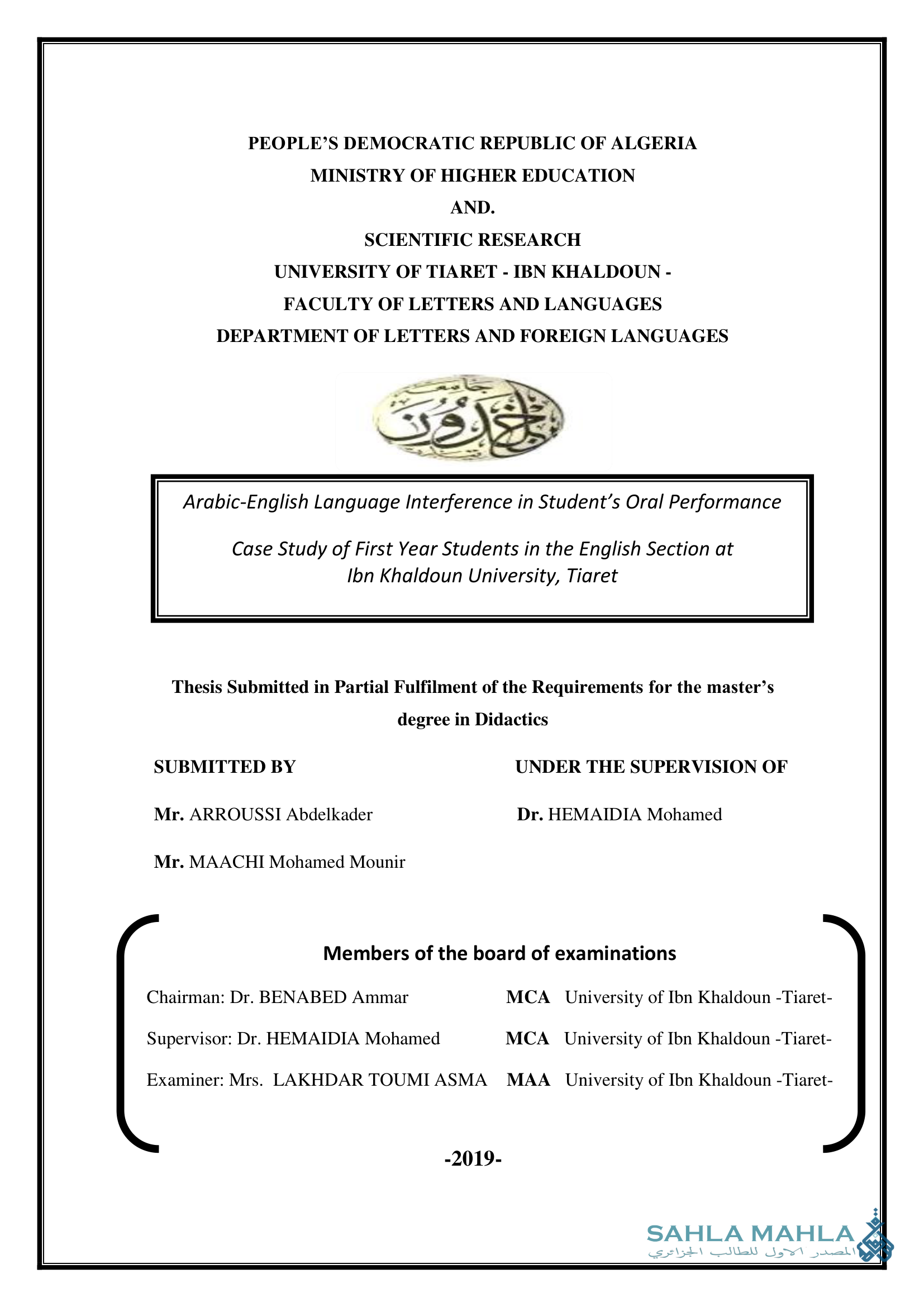
Arabic-English Language Interference in Student’s Oral Performance Case Study of First Year Students in the English Section at Ibn Khaldoun University, Tiaret
General Information:
Level |
Master |
Title |
Arabic-English Language Interference in Student’s Oral Performance Case Study of First Year Students in the English Section at Ibn Khaldoun University, Tiaret |
Specialty |
Didactics |
Cover Page:
Outline:
GENERAL INTRODUCTION.
Chapter I Theoretical Review: The Influence of First Language on Second Language
Introduction7
I. 1. Language Use in Algeria 7
I.1.1.Arabic Language Varieties8
I.1.1.1. Classical Arabic 9
I.1.1.2. Modern Standard Arabic 9
I.1.1.3. Algerian Arabic Variety 9
I.1.2.French .10
I.1.3.English 10
I.2. Language Interference 10
I.2.1.Language Interference between First and Second
language.12
I.2.1.1. Negative Transfer .14
I.2.1.2. Positive Transfer 15
I.2.2.Intralingual Interference .16
I.2.3.Interlingual Interference .17
I.3. Error Identification.18
I.4. Error and Mistake 19
I.5. Approaches to Study Errors 21
I.5.1.Contrastive Analysis Approach 22VII
I.5.2.Error Analysis Approach 23
I.6. Kinds of Errors .23
I.6.1.Speakers’ Errors 25
I.6.2.Hearers’ Errors 25
I.7. Significance of Errors in EFL Learning Process 26
Conclusion27
Chapter II: Speaking in EFL classrooms
INTRODUCTION31
II.1. .Overview of Speaking31
II.2. Definition of the Speaking Skill 32
II.3. Speaking in Foreign Language Classroom 33
II.4. Types of Classroom Speaking Performances 34
II.4.1. Imitative 34
II.4.2. Intensive35
II.4.3. Responsive .35
II.4.4. Transactional (dialogue) 35
II.4.5. Interpersonal (dialogue) 35
II.4.6. Extensive (monologue) .35
II.5. The Aspects of Speaking Skill 35
II.5.1. Accuracy36
II.5.1.1. Vocabulary36
II.5.1.2. Grammatical Structures 37
II.5.1.3. Correct pronunciation37
II.5.2. Fluency37
II.6. Factors Affecting Learners Speaking Abilities 38
II.6.1. Age or Maturational Constraints38
II.6.2. Aural Medium.39
II.6.3. Socio-Cultural Factors40
II.6.4. Affective Factors.40VIII
II.7. Speaking Sub Skills41
II.8. The Importance of Speaking .42
II.9. Factors Behind Students’ Poor Speaking 43
II.9.1. Lack of Adequate Technique of Teaching Oral .43
II.9.2. Lack of Motivation to Speak ( Internal Motivation ).44
II.9.3. Teachers as Source of Demotivation (External Motivation)45
II.10. Some Difficulties of Teaching English language in Algeria45
II.10.1. Age45
II.10.2. Social Factors46
II.10.3. Pedagogical Factors.46
II.11. Uses of Interference in the EFL Classroom 47
CONCLUSION48
Chapter three: Field Work
Introduction 51
III.1 Population51
III.1.1. Students51
III.1.2. Teachers 52
III.2.The Research Tools52
III.2.1. Students’ Questionnaire.53
III.2.2. Teachers’ Interview 54
III.2.3. Teachers’ Checklist54
III.3.Data Analysis55
III.3.1. Analysis of the Learners’ Questionnaire57
III.3.2. Analysis of the Teachers’ Interview72
III.3.3. Analysis of the Teachers’ Checklist74
III.4.Data Discussion and Interpretation.75
III.5.Recommendations and Suggestion76
III.6.Suggestions for Further Research77
Conclusion 78
General Conclusion.80IX
BIBLIOGRAPHY
Download The Thesis:
For more
academic sources and references,
including theses and dissertations from Algerian universities,
, visit our main website.