
Analyzing the Language Contact Phenomenon in the Algerian Context and its Impact on Loan Words in Communicative Situations: The teachers of English, French and Arabic as a Sample
General Information:
Level |
Master |
Title |
Analyzing the Language Contact Phenomenon in the Algerian Context and its Impact on Loan Words in Communicative Situations: The teachers of English, French and Arabic as a Sample |
Specialty |
Linguistics |
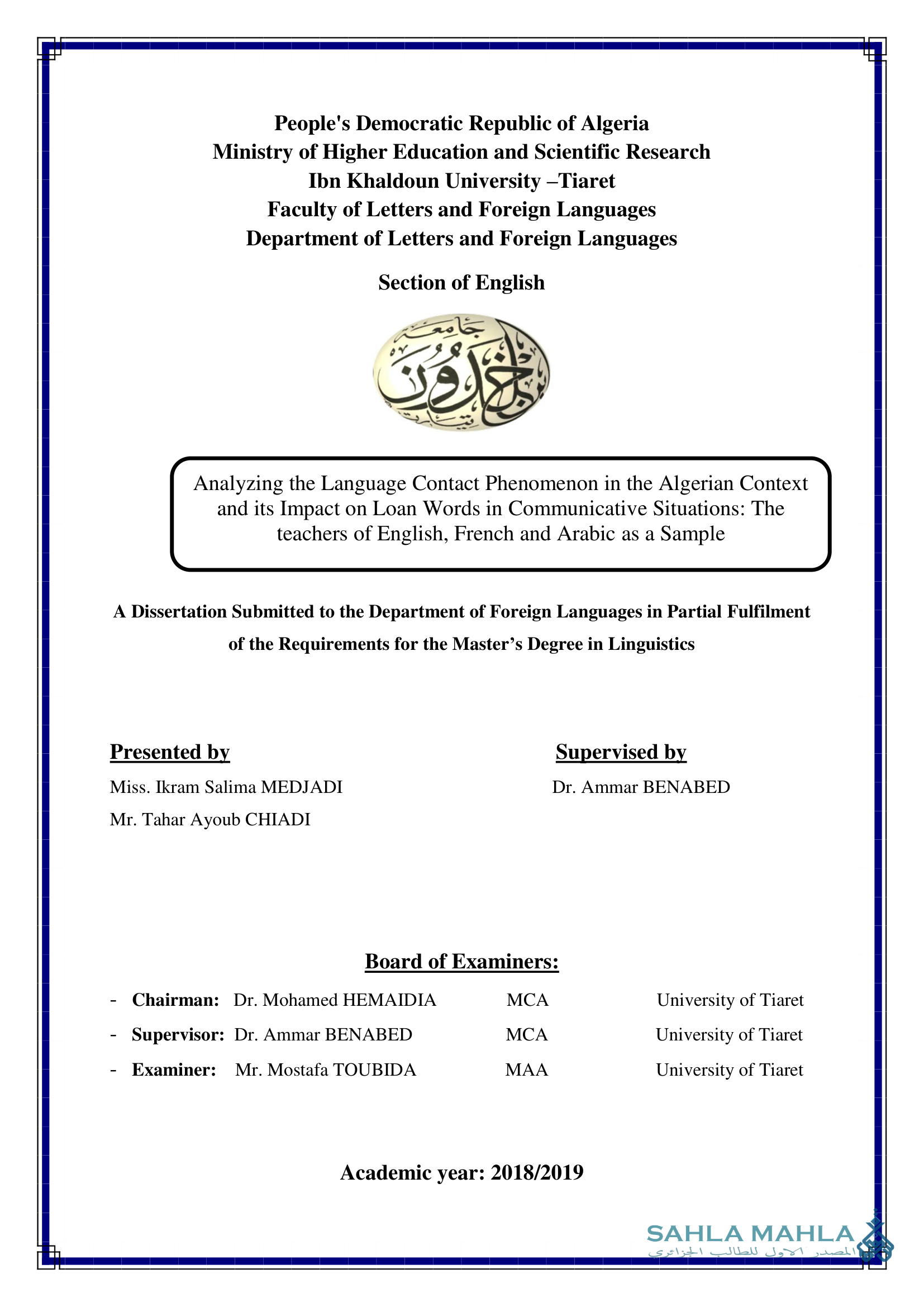
Cover Page:
Outline:
General Introduction
Chapter One: The Language in Contact
I. Introduction
1.1. The Origin of Human Language
1.1.1. Proto Language
1.1.2. Indo-European Languages
1.1.3. Afro-Asiatic Languages
1.2. Historical Background of French, English and Arabic languages
1.2.1 French Language
1.2.2 English Language
1.2.2.1. Britain before English
1.2.2.2 The Development of English Language
1.2.2.2.1. Old English
1.2.2.2.2. Middle English
1.2.2.2.3. Modern English
1.2.3 The Arabic Language
1.2.3.1 Classical Arabic
1.2.3.2 Modern Standard Arabic
1.2.3.3 Colloquial Arabic/ Algerian Dialectal Arabic
1.2.3.3. Colloquial Arabic (Ca) /Algerian Dialectal Arabic (ADA)
1.3. The Historical Contact of Arabic, French with English language
1.4. What is Language Contact
1.4.1. Types of Language contact
1.4.1.1 Language Maintenance
1.4.1.2 Language Shift
1.4.1.3 The Creation of New Languages
1.4.1.4 Language Death
1.4.2. Language Conflict
1.4.2.1 Ethnic Language Conflict
1.4.2.2 Political Language Conflict
1.5 The Outcomes of Language Contact
1.5.1 Diglossia
1.5.1.2 Extended Diglossia
1.5.2 Bilingualism
1.5.3 Pidgin and Creole
1.5.4 Code-Switching/ Code-Mixing
1.5.4.1 Forms of Code-Switching
1.5.4.2 Code Mixing
1.5.6 Borrowing
1.5.6.1 Reasons for Borrowing
1.5.6.2 The Process of Borrowing
1.5.6.3 The Assimilation of Borrowing
1.5.6.3.1 Types of Assimilation
I Conclusion
Chapter Two: The Language Contact in Algerian Context and its Impact on Tertiary System
I. Introduction
2.1 The Sociolinguistic Situation in Algeria
2.1.1 Berber
2.1.2 Arabic
2.1.3 French
2.1.4 English
2.2 The Arabization Process
2.2.1 Steps of Arabization
2.3 Language Use in Algeria
2.4 Algeria’s Sociolinguistic Report
2.4.1 Diglossia in Algeria
2.4.2 Bilingualism in Algeria
2.4.3 Code Switching in Algeria
2.4.3.1 Intra-Sentential Switching
2.4.3.2 Tag Switching
2.4.3.3 Inter-Sentential Switching
2.4.4 Attitudes Towards Code Switching in EFL Classroom Context
2.4.4.1 The Target Language Exclusivity
2.4.4.2 The Use of Code Switching in Teaching
2.4.5 Code Switching within Algerian Classroom Context
2.5 Linguistic Interference
2.5.1 Negative Transfer
2.5.1.1 Phonological Transfer
2.5.1.2 Lexical Transfer
2.5.1.3 Grammatical Transfer
2.5.2 Positive Transfer
2.5.3 Linguistic Interference in Teaching and Learning Process
2.6 Borrowing in Algeria
2.6.1 Berber Loanwords used in ADA
2.6.2 French Loanwords used in ADA
2.6.3 Spanish Loanwords used in ADA
2.6.4 Turkish Loanwords used in ADA
2.7 ADA versus MSA
2.8 Vocabulary of ADA
2.8.1 Verbs
2.8.2 Inflection
2.8.3 Verbs Infelction
2.8.3.1 The Present and Future Tenses
2.8.4 Regular Plural
2.8.4.1 Masculine Regular Plural
2.8.4.2 Feminine Regular Plural
2.8.4.3 Broken Plural
2.8.5 Syntactic Level
2.8.5.1 Declarative Form
2.8.5.2 Interrogative Form
2.8.5.3 Negative Form
II Conclusion
Chapter Three: Data Collection and Analysis
I. Introduction
3.1 Research Aims
3.2 Research Design Methodology
3.3 Population Sampling
3.4 Quantitative Method
3.5 Qualitative Method
3.6 Data Collection and Analysis
3.6.1 English Teachers’ Questionnaire Analysis
3.6.2 French Teachers’ Questionnaire Analysis
3.6.3 Interview
3.6.3.1 Analysis and Interpretation
II Conclusion
General Conclusion
Bibliography
Appendices
Appendix I: Teacher of English Questionnaire
Appendix II: Teacher of French Questionnaire
Appendix III: Transcription of Interview
Appendix VI: The Original Interview
Download The Thesis:
For more
academic sources and references,
including theses and dissertations from Algerian universities,
, visit our main website.