

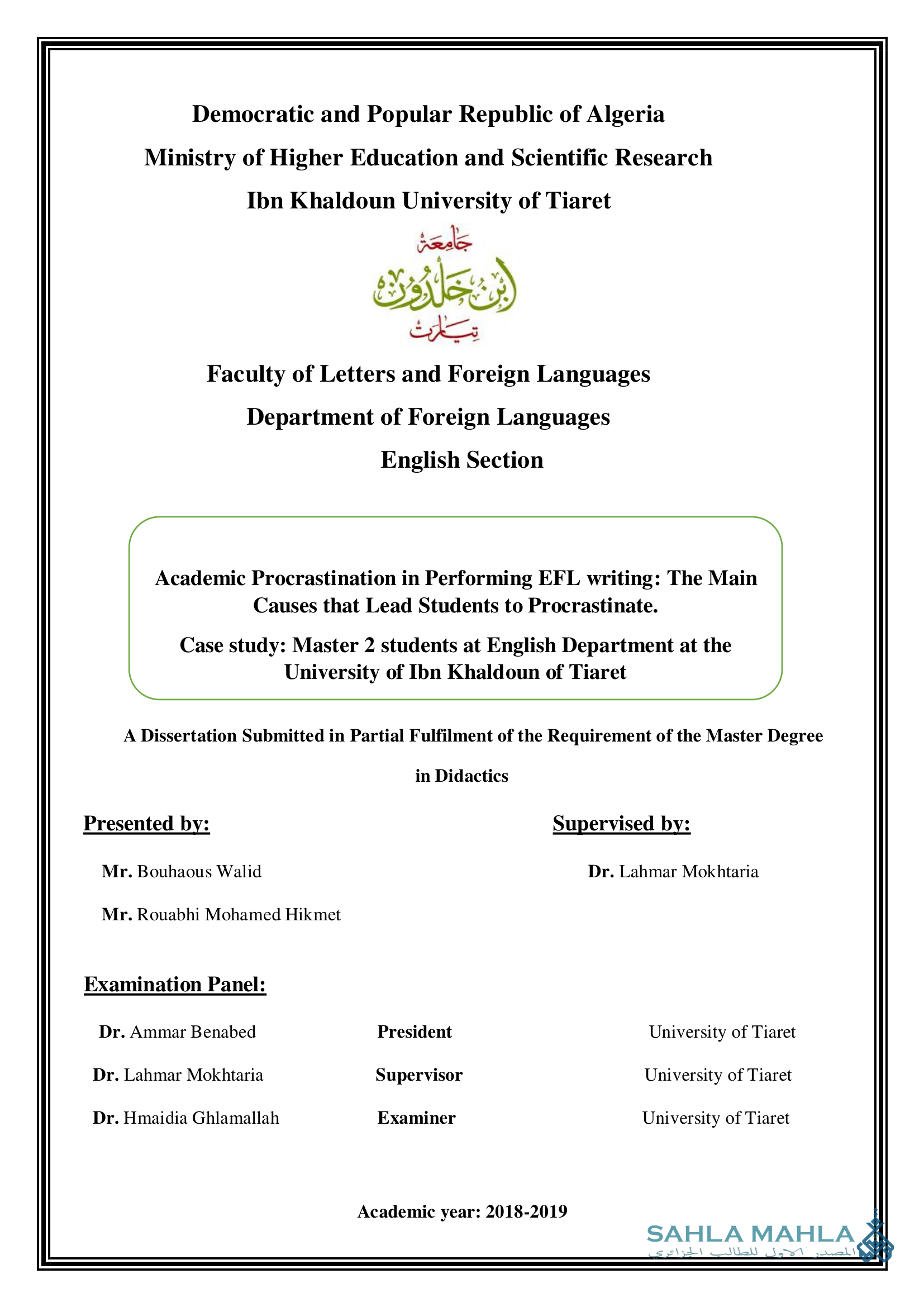
Academic Procrastination in Performing EFL writing: The Main Causes that Lead Students to Procrastinate. Case study: Master 2 students at English Department at the University of Ibn Khaldoun of Tiaret
General Information:
Level |
Master |
Title |
Academic Procrastination in Performing EFL writing: The Main Causes that Lead Students to Procrastinate. Case study: Master 2 students at English Department at the University of Ibn Khaldoun of Tiaret |
Specialty |
Didactics |
Cover Page:
Outline:
Tables of content
Glossary of Terms
General introduction
1.1. Sources of Inspiration
1.2. Statement of the Problem and Research Questions
1.3. Hypothesis
1.4. Aims of the Study
1.5. Methodology
1.6 Significance of the Study
1.7. The Organisation of the Work
Chapter one
A Brief Overview about Academic Procrastination in EFL
1.1 Introduction
Writing
Section 01: Introducing Procrastination
1.1.1. Definition of Procrastination
1.1.2. Procrastinators Typology
1.1.3. Main Theories of Procrastination
1.1.3.1. Natural Instinct Theories
1.1.3.2. Behaviouristic Theories
1.1.3.3. Cognitive Theories
1.1.3.4. Personality Traits
1.1.3.5. Time Management Theories
Section 02: Theoretical Background on Academic procrastination and EFL Writing
1.2.1. Definition of Academic Procrastination
1.2.2. Characteristics of Academic Procrastination
1.2.2.1. Psychological Beliefs About Abilities
1.2.2.2. Distraction
1.2.2.3. Social Factors
1.2.2.4. Laziness
1.2.2.5. Lack of Personal Passion
1.2.2.6. Lack of Time Management Skills
1.2.3. Academic Procrastination and Writing in EFL
1.2.3.1. Writing in EFL
1.2.3.2. The Writing Process in EFL
Section 03: Causes of Academic Procrastination
1.3.1. Causes of Academic Procrastination
1.3.1.1. Anxiety
1.3.1.2. Poor Time Management
1.3.1.3. The Effects of Poor Time Management
1.3.1.4. Self-Regulation and Academic Procrastination
1.3.1.3.1. Self-Regulated Learning
1.3.1.3.2. Self-regulation in the Writing Process
1.3.1.3.3. Self-Regulation Failure
1.5.Conclusion
Chapter Two
FIELD INVESTIGATION, RESULTS AND RECOMMENDATIONS
2.1. Introduction
Section One: Description of the Study
2.1. Research Design and Methods
2.2. Students’ Profile
2.3. Teachers’ Profile
Section Two: Results and Discussion
2.2.1. E-mail Questionnaire Results
2.2.1.1. Discussion of the Questionnaire Findings
2.2.2. E-mail Interview Results
2.2.2.1. Discussion of the Interview Results
Section 03: Limitations, Implications and Suggestions for Future Research
2.3.1. Limitations of the Study
2.3.2. Implications
2.3.3. Suggestions for Further Research
2.3.4. Recommendations
1.5. Conclusion
General Conclusion
Bibliography
Download The Thesis:
For more
academic sources and references,
including theses and dissertations from Algerian universities,
, visit our main website.