


Investigating the Effects of the Project-Based Learning in Developing Learners’ Speaking Skill in Secondary School Education: Second Year Secondary School Learners as a Sample
General Information:
Level |
Master |
Title |
Investigating the Effects of the Project-Based Learning in Developing Learners’ Speaking Skill in Secondary School Education: Second Year Secondary School Learners as a Sample |
Specialty |
Didactics |
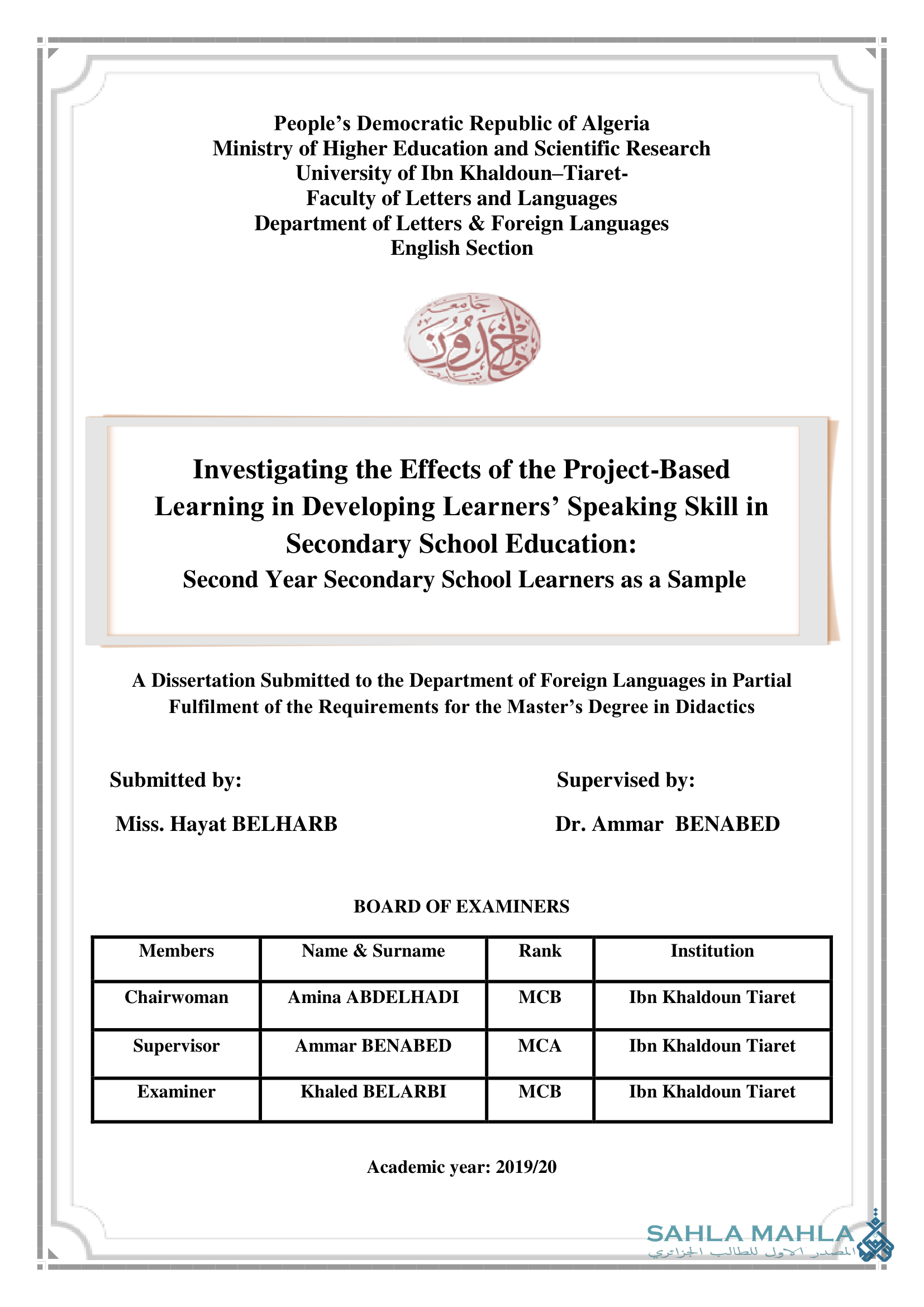
Cover Page:
Outline:
General Introduction
Background to the Research
Statement of the Problem
Research Questions
Research Hypotheses
Research Methodology & Design
Choice of the Method
Research Tools
Delimitation of the Study
Relevance/significance of the Study
Structure of the Study
Chapter One: Literature Review
I. 1. Project-based Learning
I. 1. 1. Some Key Concepts
I. 1. 1.1. The Concept of a Project
I. 1. 1.2. The Concept of PBL
I. 1. 2. Theoretical Foundation of PBL
I. 1. 2.1. Dewey’s Theory
I. 1. 2.2. Jean Piaget’s Cognitive Theory
I. 1. 2.3. Lev Vygotsky’s Social Constructivist Theory
I. 1. 3. The Rationale for Implementing PBL
I. 1. 3.1. The Six A’s of Designing Projects
I. 1. 3.1.1.Authenticity
I. 1. 3.1.2. Academic Rigor
I. 1. 3.1.3. Applied Learning
I. 1. 3.1.4. Active Exploration
I. 1. 3.1.6. Assessment Practices
I. 1. 3.2. The Four C’s of the 21st Century Skills
I. 1. 3.2.1. Critical Thinking
I. 1. 3.2.2. Creativity
I. 1. 3.2.3. Communication
I. 1. 3.2.4. Collaboration
I. 1. 4 Types of Projects
I. 1. 4.1. Structured Projects
I. 1. 4.2. Unstructured Projects
I. 1. 4. 3. Semi-structured Projects
I. 1. 5. The Stages of a Project Work
I. 1. 5.1. Establish Trust and Cooperative Relationship
1.5.1.1. Set Clear Objectives
I. 1. 5.1.2. Select a Real Life Problem/ Question
I. 1. 5.1.3. Content
I. 1. 5.1.4. Driving Question
I. 1. 5.1.5. Enquiry and Choice
I. 1. 5.1.6. Critique and Revision
I. 1. 5.1.7. Public Audience
I. 1. 5.2. PBL Components
I. 1. 5.2.1.The Teacher’s Role
I. 1. 5.2.2. The Student’s Role
I. 1. 5.2.3. The Environment’s Role
I. 1. 5.2.4. The Role of Tools and Technology
I. 1. 6. What Distinguishes PBL from Other Methods
I. 1. 6.1. PBL and Thematic Teaching
I. 1. 6.2. Project Based and Problem Based Learning
I. 1. 7. The Benefits of PBL
I. 1. 7.1. Mirroring Learners’ Needs
I. 1. 7.2. Increasing Motivation
I. 1. 7.3. Gaining Knowledge and Skills
I. 1. 7.4. Metacognitive Strategies Improvement
I. 1. 7.5. Cooperative Work Enhancement
I. 1. 7.6. Real World Skills Development
I. 1. 7.7. Learners’ Learning Quality Enhancement
I. 1. 7.8. Self-esteem Increasing
I. 1. 7.9. Real World Practice Affordance
I. 1. 7.10. Content Emphasis
I. 1. 7.11. Authentic Tasks Use
I. 1. 7.12. Integrative Learning
I. 1. 7.13. Interactive Learning Process
I. 1. 8. Project Assessment
I. 1. 9. Example of Formative Assessment (Laur, 2013)
I. 1. 10. PBL Challenges
I. 2. Speaking Skill
I. 2. 1. Definition of Speaking Skill
I. 2. 1.1. The importance of Speaking Skill
I. 2. 1. 2. Elements of Speaking
I. 2. 1. 2. 1. Language Features
I. 2. 1. 2. 2. Mental Social Processing
I. 2. 2. The Relation between Speaking and Other Skills
I. 2. 2. 1. Speaking Vs Writing
I. 2. 2. 2. Speaking Vs Listening
I. 2. 3. Students’ Problems in Speaking
I. 2. 3. 1. Inhibition
I. 2. 3. 2. Nothing to Say
I. 2. 3. 3. Low Uneven Participation
I. 2. 3. 4. Mother Tongue Use
I. 2. 4. Characteristics of Speaking Difficulties
I. 2. 5. Activities to Teach Speaking
I. 2. 5. 1. Awareness
I. 2. 5. 2. Appropriation
I. 2. 5. 2. 1. Drilling and Chants
I. 2. 5. 2. 2. Milling activities
I. 2. 5. 2. 3. Reading Aloud
I. 2. 5. 2. 4. Dialogues
I. 2. 5. 2. 5. Communication Games
I. 2. 5. 3. Autonomy
I. 2. 5. 3. 1. Presentation and Talks
I. 2. 5. 3. 2. Role-Play
I. 2. 5. 3. 3. Problem Solving
I. 2. 5. 3. 4. Discussion
I. 2. 6. Teacher’s Role
I. 2. 7. Assessing Speaking
I. 2. 7. 1. Assessments Criteria
I. 2. 8. Oral Presentations and Speaking Skill Conclusion
Chapter Two
Context of the Study
Status of English in Algerian System
Introduction
II.1. English Language Status in the Algerian Educational System
II.1. 1.Approaches to English Language Teaching in Algeria
II.1.2. Definition of an Approach
II.1.2.1. The Structuralist Approach
II.1.2.2. The Functional -Communicative Approach
II.1.2.3. The Competency Based Approach
II.1.2.3.1. Definition of Competency-based Approach
II. 1.2.3.2. The Goals of the Competency-Based Approach
II. 1.2.3.4. Interpretive Competency
II. 1.2.3.3.Interactive Competency
II. 1.2.3.5. Productive Competency
II. 1.2.3. 6. Supporting Competencies
II. 1.2.3.6. Linguistic Competency
II. 1.2.3.7. Language Strategies
II.1.2.4. Characteristics of the Competency-Based Approach
II. 1.2.6.4. 1. Action-Oriented Approach
II. 1.2.6.4. 2. Problem-solving Approach
II. 1.2.6.4. 3. Social Constructivist
II.2.1. Knowledge
II.2.2. Comprehension
II.2.3. Application
II.2.4. Analysis
II.2.5. Synthesis
II.2.6. Evaluation
II.3. Teaching English as a Foreign Language to Second Year Secondary School 55 Students
II.3.1. Linguistic Objectives
II.3.2. Methodological Objectives
II.3.3. Socio-cultural Objectives
II.4. The Teacher’s Roles
II.4.1. The Teacher as a Facilitator
II.4.2. The Teacher as a Controller
II.4. 3. The Teacher as an Organizer
II.4.4. The Teacher as an Assessor
II.4.5. The Teacher as a Prompter
II.4.6. The Teacher as a Participant
II.4.7. The Teacher as a Source
II.4.8. The Teacher as a Tutor
II.4.9. The Teacher as an Observer
II.4.10. The Teacher as a Motivator
II.5. Student’s Roles
II.5.1. The Learner as a Knowledge Processor
II.5.2. The Learner as an Effective Performer
II.5.3. The Learner as a Problem-solver
Conclusion
CHAPTER THREE
RESEARCH DESIGN, METHODOLOGY AND DATA ANALYSIS
Section One: Research Design and Methodology
Introduction
III.1. Overall Research Design
III.2. Case Study Approach
III.3. Quantitative and Qualitative Research
III.4. Sampling Technique
III.5. Research Tools
III.5.1. Teacher’s Questionnaire Description
III.5.2. Teacher’s Questionnaire Objectives
III.5.3. Teacher’s Questionnaire Structure
III.5.4. Questionnaire Piloting Procedure
III.5.5. Teacher’s Questionnaire Administration
III.6. Teacher’s Interview
III.6.1. Interview Structure
III.6.2. Interview Piloting
Section Two: Data Analysis Procedures
Introduction
III. 7. Analysis of Teachers’ Questionnaire
Section One
Personal and Professional Data
Section II: Reflection on the Use of the Project-Based Learning
Section III: Respondents’ Reflection on Learners’ Engagement/Disengagement
Teachers’ Suggestions
III.7.2. Discussion of the Findings of Teachers’ Questionnaire
III.8. Pupils’ Questionnaire
III.8. 1. Description of Pupils’ Questionnaire
III.8.1.1. Section One: General Information
III.8.1.2. Section Two: Pupils’ Attitudes towards learning through project work
III.8.1.3. Section Three: Pupils’ Engagement in project work
III.8.2. Administration of Pupils’ Questionnaire
III.8.3. Analysis of Pupils’ Questionnaire
III.8. 3.1 Section One: General Information
III.8.3.2. Section two: Pupils Attitudes towards Project Work
III.8. 3.3. Section Three: Pupils’ Engagement Part One: Behavioural Engagement
Part Two: Emotional Engagement
III. 8. 4. Discussion of the Findings of Pupils’ Questionnaire
III.9. Teachers’ Interview
III.9.1. Description of the Teacher’s Interview
III.9.2. Interview’s Analysis
III.9. 3. Data Interpretation
Conclusion
Omnibus Recommendations
For Teachers
For Learners
For Syllabus Designers
For Administration
General Conclusion
List of References
Teacher’s Questionnaire
Pupils Questionnaire
Teachers’ Interview
Summary in Arabic
Summary in French
Download The Thesis:
For more
academic sources and references,
including theses and dissertations from Algerian universities,
, visit our main website.