


Investigating Prejudice towards Tamazight Language Case study: Master Students of English Department at Ibn Khaldoun University
General Information:
Level |
Master |
Title |
Investigating Prejudice towards Tamazight Language Case study: Master Students of English Department at Ibn Khaldoun University |
Specialty |
Linguistics |
Cover Page:
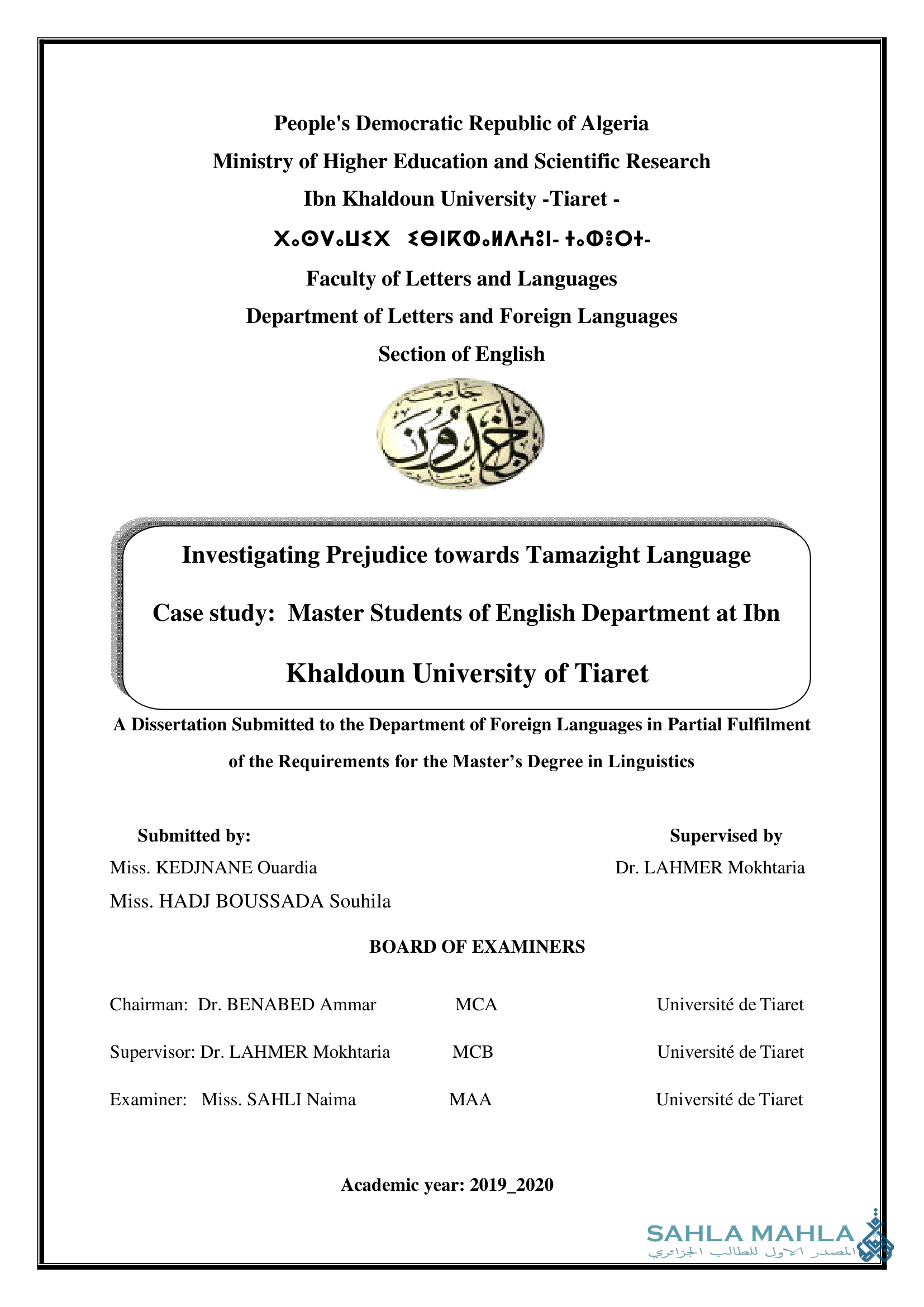
Outline:
Key to Phonemic Transcription
General Introduction
Chapter One: A General Overview about Prejudice
Section One: Sociolinguistics and Language Variation
1.1 Introduction
1.2 Language
1.2.1 Dialect
1.2.2 Culture
1.2.2.1 Language and Culture
1.2.2.2 Sapir -Whorf Hypothesis
1.2.3 Language Maintenance
1.2.4 Speech Community vs. Community of Practice
1.2.5 Majority and Minority Groups
Section Two: Linguistic Prejudice and Social Inequality
1.3.1 Prejudice
1.3.1.1 Types of Prejudice
1.3.1.2 Examples of Prejudice
1.3.1.3 Reasons for Prejudice
1.3.2 Other Related Concepts to Prejudice
1.3.2.1 Ethnic Prejudice (Ethnocentrism)
1.3.2.2 Stereotypes
1.3.2.3 Language Attitudes
1.3.2.4 Bias in Language
1.3.2.5 Language of Racism
1.3.2.6 Linguistic Discrimination
1.3.3 Sources of Prejudice
1.3.3.1 Culture
1.3.3.2 Parents
1.3.3.3 Peers
1.3.4 Theories of Prejudice
1.3.4.1 Scapegoat Theory
1.3.4.2 Aggression
1.3.4.3 Hostile Aggression
1.3.4.4 Instrumental Aggression
1.3.5 Linguistic and Social Inequality
1.3.5.1 Types of Linguistic Inequality
1.3.5.2 Linguistic Prejudice
1.3.5.2.1 Linguistic Prejudice Working in Educational System
1.3.5.2.2 Types of Linguistic Prejudice
1.3.5.2.3 Reasons for Linguistic Prejudice
1.4 Conclusion
Chapter Two: Features of the Sociolinguistic Situation in Algeria
Section one: The Context of the Study
2.1 Introduction
2.1.1 Algeria: A Country Profile
2.1.2 Ethnicity in Algeria
2.1.3 Historical and Geographical Overview of Algeria
2.1.3.1 Amazighs
2.1.3.2 Etymology of the Term Amazigh (Berber)
2.1.3.3 Names of Algerian Amazigh Cities
2.1.3.4 Arabs
2.1.3.5 Turkish and Spanish
2.1.3.6 French
Section two: Linguistics Situation in Algeria
2.2.1 Tamazight
2.2.2 Varieties of Tamazight (Berber)
2.2.2.1 Kabyle
2.2.2.1.1 Zdimoh
2.2.2.2 Tachawit
2.2.2.3 Chenoua
2.2.2.4 Mzab
2.2.2.5 Tachelhit
2.2.2.6 Touareg (Kel Tamasheq)
2.2.2.7 Kabyle Hadra
2.2.2.8 Tamazight versus Kabyle
2.2.3 Arabic Language
2.2.3.1 Classical Arabic (CA)
2.2.3.2 Modern Standard Arabic (MSA)
2.2.3.3 Algerian Dialectal Arabic (ADA)
2.2.4 Foreign Languages
2.2.4.1 French
2.2.4.2 English
2.2.4.3 Turkish and Spanish
2.2.5 Language Families
2.2.6 Language Conflict and Identity
2.2.7 Language Planning and Policy
2.2.8 Arabization Process
2.2.9 The Current Study: Tiaret
2.2.9.1 Description, Geographical Location and Etymology of the Term ‘Tiaret’
2.2.9.2 The Administrative Division of the Wilaya of Tiaret
2.2.10 Conclusion
Chapter three: Research Methodology, Data Collection and Analysis
3.1 Introduction
3.2 Methodology Adopted
3.3 Description of the Target Population
3.3.1 Sample Population
3.4 Research Instruments
3.4.1 Description of the Questionnaire
3.4.2 Description of the Interview
3.5 Students’ Email Questionnaire Analysis for non-Berber/Amazigh Speakers
3.5.1 Informants’ Personal Data
3.5.2 Attitudes towards Tamazight / Berber Language
3.5.3 The Social / Personal Prejudice Context and its Reasons
3.5.4 The Impact and Solutions of Linguistic Prejudice
3.6 Email Interview Analysis for Berber/Amazigh Speakers
3.7 The General Interpretation of the Main Findings
3.8 Suggestions and Recommendations
3.9 Conclusion
General Conclusion
Bibliography
Download The Thesis:
For more
academic sources and references,
including theses and dissertations from Algerian universities,
, visit our main website.