


Investigating English Language Teaching and Learning in Algerian Rural Areas: Learners’ Obstacles & Teachers’ Challenges. BENSENOUCI Brahim Secondary School in Rahouia as a Sample
General Information:
Level |
Master |
Title |
Investigating English Language Teaching and Learning in Algerian Rural Areas: Learners’ Obstacles & Teachers’ Challenges. BENSENOUCI Brahim Secondary School in Rahouia as a Sample |
Specialty |
Didactics |
Cover Page:
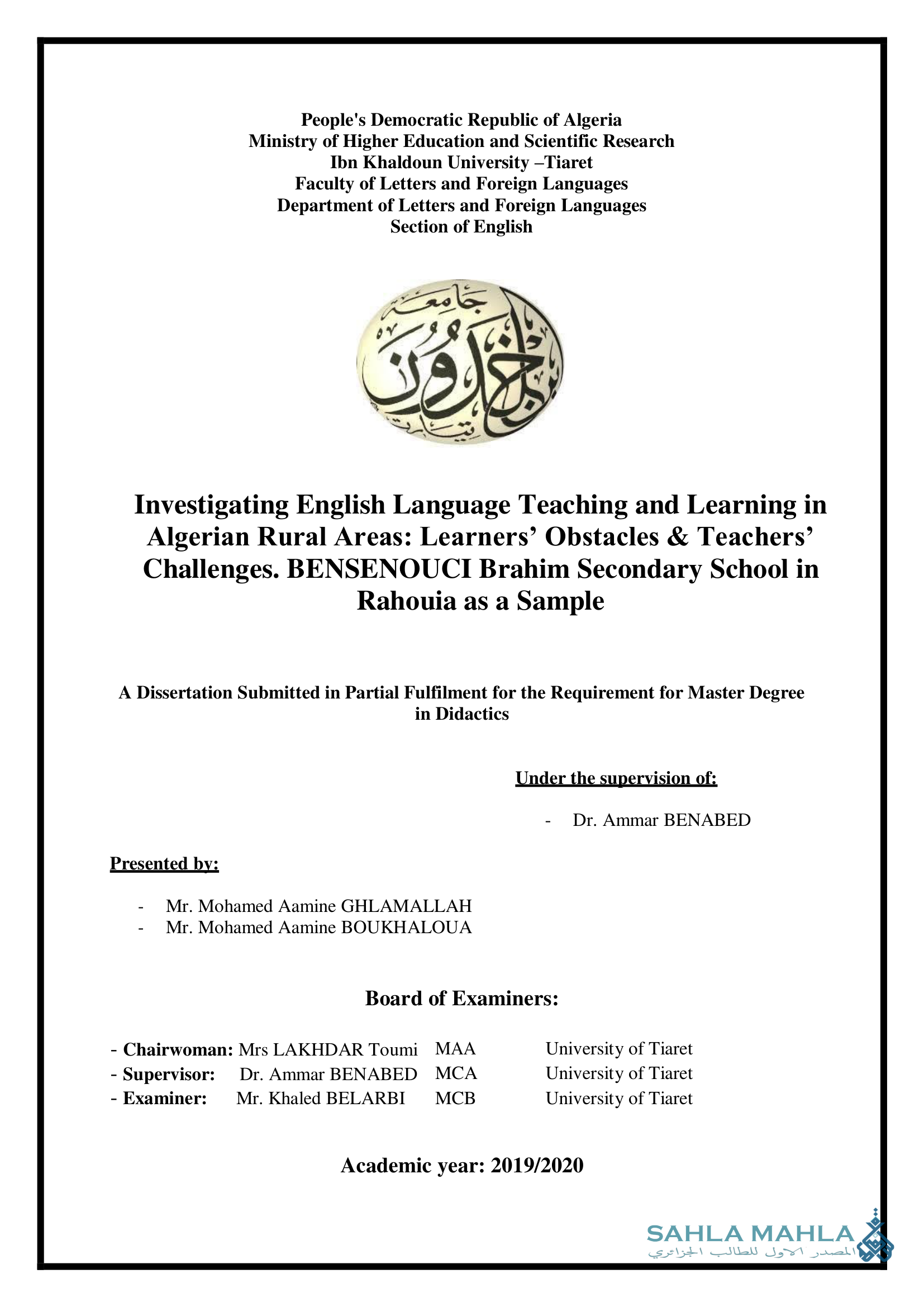
Outline:
General Introduction
Chapter One: English as a Global Language
Introduction
1.1 The Status, Role and Numbers of English
1.1.1. The Role of English
1.2 English as a Global language
1.3 The Three Circles Model
1.3.1 Circle Model
1.3.1.1 Inner Circle
1.3.1.2 Outer Circle
1.3.1.3 Expanding Circle
1.4 The History of English
1.4.1 The Development of English language
1.5 English Language Teaching and Learning
1.5.1 Countries’ Illustations of Teaching Process
1.5.2 Countries’ Illustations of Learning Process
1.6 Language Teaching Approaches
1.6.1 Grammar Translation Approach
1.6.2 The Bilingual Approach
1.6.3 The Direct Method
1.7 Implementing Strategies and Combining them with Teaching Approaches
1.8 Teaching English Language in Rural Context
1.9 Principles of English Language Teaching
1.9.1 The Performance of English Language in Rural and Urban Area
1.9.1.1 Family Factors
1.9.1.2 Financial Factors
1.9.1.3 Logistic Support
1.9.1.4 Less Qualified Teachers
1.9.1.5 Adequate Books
Conclusion
Chapter Two: The Contextualization of the research
Introduction
2.1 The Algerian Educational System: Overall and Objectives
2.2 The Competency-Based Approach (CBA)
2.2.1 The Context and Implementation of CBA
2.2.2 Objectives and Competencies of CBA
2.2.2.1 Disciplinary Objectives Targeted by the CBA
2.3 Learners’ Obstacles
2.3.1 Learning Difficulties in English
2.3.2 The Use of L1 in learning English in Algerian Context
2.3.3 Motivation versus Demotivation
2.3.3.1 Motivation
2.3.3.1.1 Factors Affecting Students’ Motivation
2.3.3.1.2 The Society We live In
2.3.3.1.3 The Teacher
2.3.3.1.4 The Method
2.3.3.1.5 Goal Setting
2.3.3.1.6 Learning Environment
2.3.3.1.7 Interesting Classes
2.3.4 Demotivation
2.3.4.1 Peer Pressure
2.3.4.2 Environments and Settings
2.3.4.3 Language Anxiety
2.3.4.3.1 Writing Anxiety
2.3.4.3.2 Reading Anxiety
2.3.4.3.3 Speaking Anxiety
2.3.4.3.4 Listening Anxiety
2.4 Teachers’ Challenges in Teaching English: Urban vs. Rural
2.4.1 Challenges of the Political Decisions and Reforms
2.4.2 Teachers Incompetency and Severe Shortage of Training
2.4.3 Lack of Exposure to the Language
2.4.4 Lack of suitable Teaching Aids and Materials
2.4.5 Limited Resource Accessibility
2.4.6 Lack of Motivation
2.4.7 Large Classes Number
2.4.8 Psychological Problems
Conclusion
Chapter Three
Research Design, Methodology, Data Collection and Analysis
Section One
Introduction
3.1. Overall Research Design
3.2. Case Study Approach
3.3. Quantitative and Qualitative Research
3.4. Sampling Technique
3.5. Research Tools
3.5.1 Learners’ Questionnaire Description
3.5.2 Learners’ Questionnaire Objectives
3.5.3 Learners’ Questionnaire Structure
3.5.4. Questionnaire Piloting Procedure
3.6.1. Structure of the Interview
3.6.2. Interview Piloting
3.7 Research Aims
3.8 Population Sampling
SECTION TWO
DATA ANALYSIS PROCEDURES
Introduction
3.9.1. Quantitative Data Analysis
3.9.1.1. The Interpretation of Learners’ Findings
3.9.1.2. Qualitative Data Analysis
3.9.1.2.1 Analysis and Interpretation
3.10. The Interplay of Research Instruments
Conclusion
Recommendations and Suggestions
General Conclusion
Appendices
Appendix 1 Learners’ Questionnaire
Appendix 2 Teachers’ Interview
Download The Thesis:
For more
academic sources and references,
including theses and dissertations from Algerian universities,
, visit our main website.