


Civil Religion in the United States of America (1967-2017)
General Information:
Level |
PhD |
Title |
Civil Religion in the United States of America (1967-2017) |
Specialty |
American Literature and Civilization |
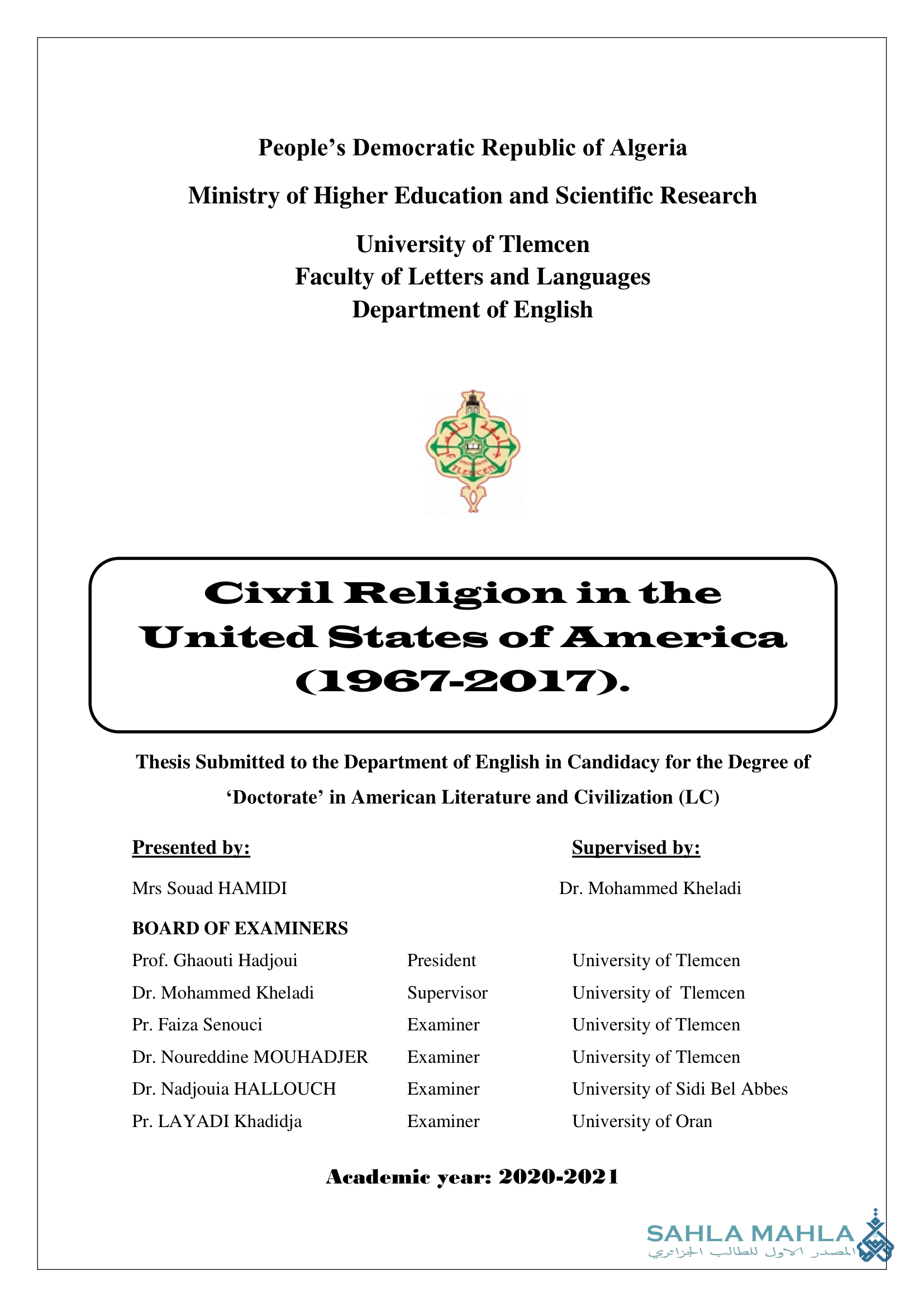
Cover Page:
Outline:
Declaration
Acknowledgments
Contents
General Introduction
Chapter one: The Origins of Civil Religion
1.1. Introduction
1.2. Rousseau’s Vision of Civil Religion
1.2.1. Rousseau’s Failure to define the Real Religion
1.2.2. Rousseau’s Type of “Civil Religion”
1.2.3. Rousseau’s Perfect Citizen
1.3. Durkheim’s Vision of Civil Religion
1.4. Civil Religion, Stability and the Government
1.5. Hobbes and Civil Religion
1.5.1. The Role of Civil Religion
1.5.2. Hobbes Definition of Civil Religion
1.6. Robert Neely Bellah and Civil Religion
1.6.1. Bellah’s Definition of Civil Religion
1.6.2. Bellah’s Influence on Civil Religion
1.6.3. Critics of Bellah’s Civil Religion
1.7. Conclusion
Chapter two: Sacramental Texts, Objects, Documents and Sites Related to the American Civil Religion
2.1. Introduction
2.2. The Significance of America
2.3. The Mayflower Compact
2.4. America, a City on a Hill
2.5. The Declaration of Independence
2.6. The Constitution
2.7. Civil Religion and the Liberty Bell
2.8. The Dollar Bill and the Great Seal
2.9. Other Symbols of Civil Religion
2.9.1. The Statute of Civil Religion and Ellis Island
2.10. God Bless America
2.11. Plymouth Rock, the Puritans, and Native Indians
2.12. America, The Beautiful
2.13. The National Anthem: The Star-spangled Banner
2.14. The Battle Hymn of the Republic
2.15. More Sacred Sites
2.15.1. Mount Rushmore
2.15.2. Disney Park
2.16. Conclusion
Chapter Three: Religious Rhetoric in Presidential Speeches
3.1. Introduction
3.2. Abraham Lincoln’s Second Inaugural Address (March 04, 1865)
3.2.1. Lincoln Second Inaugural Speech and Christianity
3.3. The Gettysburg Address, November 19, 1863
3.3.1 The Language of the Gettysburg Address
3.3.2. The Endless Mission of America
3.4. Kennedy’s Inaugural Speech, January 20, 1961
3.4.1. The New Type of Peace
3.5. Lyndon B. Johnson and Civil Religion (1963-1969)
3.5.1. Johnson’s Inaugural Address, January 1965
3.6. Civil religion and Richard M. Nixon’s First Inaugural Speech, 1969
3.7. Gerald. R. Ford and Civil Religion
3.8. Jimmy Carter and Civil Religion (1977-1981)
3.8.1. Carter’s Inaugural Speech and Civil Religion
3.8.2. The Christians Speech, December 1980
3.9. Ronald .W. Reagan and Civil Religion (1981-1989)
3.9.1. Reagan’s Inaugural Address, January 1981
3.9.2. The Religious Broadcasters’ Speech, January 1983
3.10. Bush’s Religious Rhetoric
3.10.1. George. H. Bush and Civil Religion(1989-1993)
3.10.2. Bush’s Inaugural and Civil Religion
3.10.3 National Prayer Breakfast and Civil Religion, 1989
3.11. Bill Clinton and Civil Religion 1993
3.11.1. Clinton’s Inaugural Speech
3.12. George. W. Bush’s Inaugural Speech
3.12.1. The Reality of Bush’s Religion
3.12.2. Justifying Bush’s Use of Religious Rhetoric
3.13. “God-talk” Vs. “Faith-talk”
3.13.1. “Faith-talk” in Presidential Speeches
3.14. “Mission” Vs. “Crusade”
3.15. Obama and Religious Rhetoric
3.15.1. Obama’s Civil Religion
3.16. Trump Inaugural Speech and American Civil Religion
3.17. Conclusion
Chapter Four: The Effects of Civil Religion on US Foreign Policy
4.1. Introduction
4.2. US Foreign Policy and civil Religion Throughout History
4.3. Bush Civil Religion and US Foreign Policy
4.4. Barrack Obama and the Continuation of Civil Religion
4.5. The Effects of Civil Religion on US Foreign Policy
4.6 The Dark Side of Civil Religion Use in Politics
4.7. Us Foreign Policy and the American Identity
4.8. Civil Religion and US Imperial Project
4.9. The Influence of Civil Religion on Foreign Policy
4.9.1. The Role of Civil Religion in Politics
4.10. Civil Religion after September 11
4.11. The Negative Impact of Civil Religion on US Foreign Policy
4.12. Various Civil Religious’ Impacts on our Modern Times
4.13. The author of History and the God of America
4.14. The Six Principles that Shape US Foreign Policy
4.14.1. The Theological Aspect of Progressivism and Civil Religion
4.14.2. American Civil Religion and the USA as a World Super Power
4.14.3 America as a Super Power
4.14.4. Civil Religion, the Cold War and Communism
4.14.5. Failures of the American Foreign Policy
4.14.6. The Neo-millennial ACR
4.15. Conclusion
General Conclusion
Endnotes
Works cited
Download The Thesis:
For more
academic sources and references,
including theses and dissertations from Algerian universities,
, visit our main website.