


Analysis and detection of routing attacks in the internet of Things using Deep learning
General Information:
Level |
Master |
Title |
Analysis and detection of routing attacks in the internet of Things using Deep learning |
Specialty |
Networks and Telecommunications |
Cover Page:
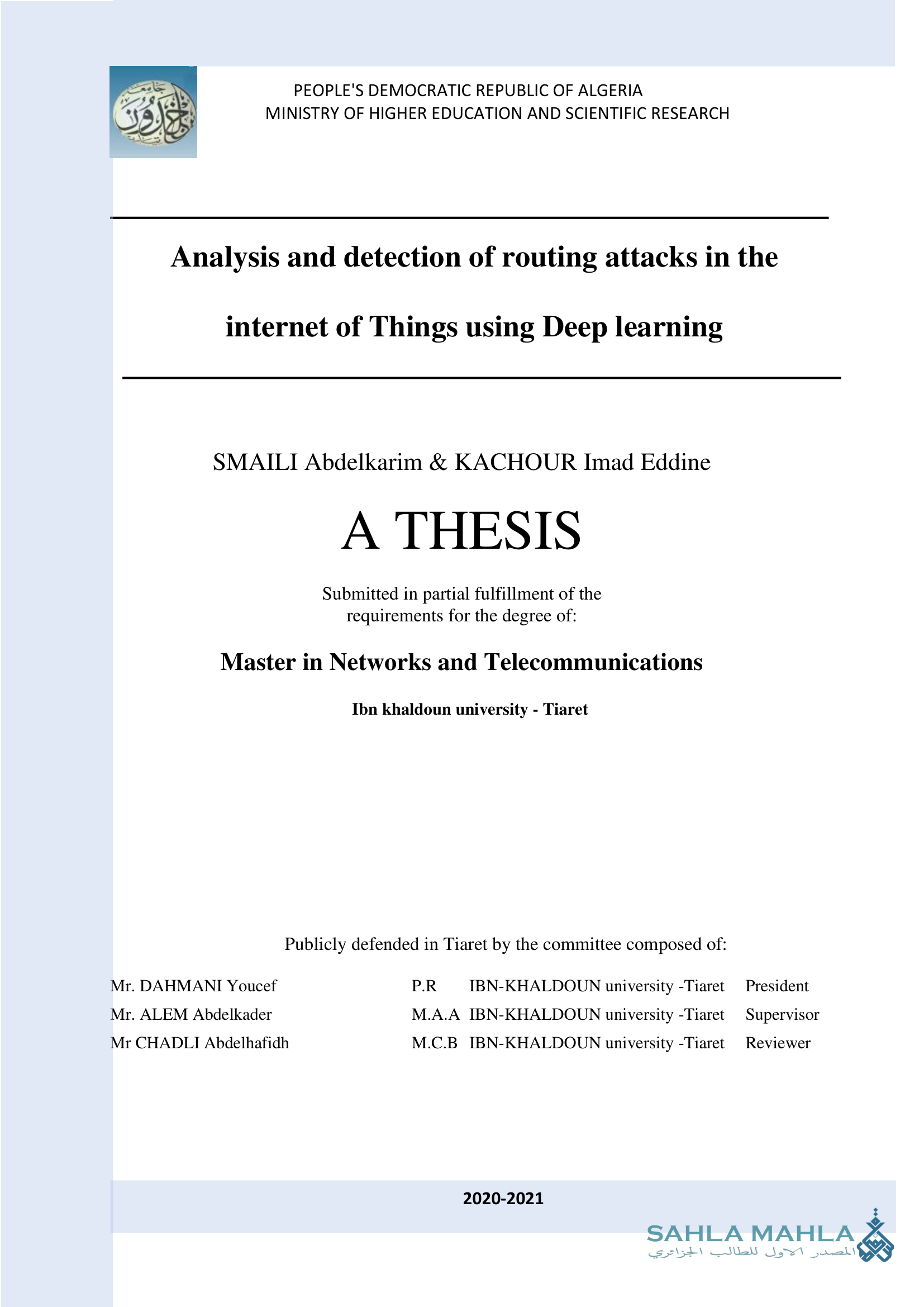
Outline:
الملخص
General introduction
1 – Background
II – Research problem
III – Research Objectives
IV – Document Outline
Chapter 1: Internet of Things Introduction
I – Definition
II – IoT connectivity models
1 – Device to device
2- Device to cloud
3- Device to gateway
4- Back-end Data-Sharing
III – IoT applications
1- Smart home
2 – Enterprise asset management
3 – Wearables
4 – Health
5- Traffic monitoring
6- Water supply
7 – Agriculture
IV-IoT Architecture
1 – Three-and Five-Layer Architectures
V – Communication protocols, standards and regulations
VI – Low-power and lossy network protocols
VII – IoT Protocols
1- IEEE 802.15.4
2-6LOWPAN
3- MQTT
4- Coap
5 – RPL
VIII – Vulnerabilities and threats in the Internet of Things
1 – Vulnerabilities of internet of things
IX – RPL Routing attacks in loT
1 – RPL Routing attacks examples
X – Security requirements in the loT
1 Confidentiality
2- Integrity
3- Availability
4 – Authentication and authorization
XI – Security Challenges in the loT
1 – Interoperability
2 Resource constraints
3 – Resilience to physical attacks and natural disasters
4- Autonomic control
5 Scalability
6 Information volume
XII – Conclusion
Chapter 2: Intrusion Detection systems
Introduction
I – Intrusion detection systems (IDSs)
II – IDS functionalities
1 – Data Collection
2 – Feature Selection
3- Analysis
4 – Action
III – IDS Architecture
IV – Taxonomy of Intrusion Detection Systems (IDSs)
1- Information (data) source
2- The analysis strategy
3- Time aspects
4- IDSS architectures
5- Detection response
V – IDSs types
1 – A host-based intrusion detection system
2- A network-based intrusion detection system
VI – Comparison between types of IDS
VII – IDSs detection techniques
1 – Misuse-based intrusion detection
2- Anomaly-based intrusion detection
VIII – IDSs: performance evaluation
IX – IDS Challenges
X – Limitations of Intrusion Detection Systems
XI – Conclusion
Chapter 3: Deep learning
Introduction
I – Difference between machine learning and deep learning
II – Deep learning applications
III – Neural Networks
– 1 Neuron
2 – Mathematical equation for neural networks
3- Cost-function equation
4 – Data path in neural networks
5- Back propagation
6- Neural networks Types
7 – Self-organizing map (SOM)
8 – Convolutional neural networks
9. Deep neural networks (DNN)
10 – Recurrent neural networks (RNN)
IV – Principles for deep learning IDS in loT
V – Conclusion
Chapter 4: Contribution in the detection of intrusions in the IOT environment
Introduction
I – Related work
II – Proposed framework
1 – Overall Architecture
2 – Training and Optimization of CNN Framework
III – Rpl routing attacks dataset
1 – Dataset generation
2- Dataset Description
3- Data balancing
4- Dataset splitting
IV – Evaluation and Metrics
1 – Comparative study
2 – Comparative study with related works
3 – Test effectiveness of final Model with NSL-KDD dataset (10%)
V – Implementation Tools
1 – Programming environment python
2 – Anaconda Integrated development environment (IDE)
3- Used Libraries
VI – Conclusion
General conclusion
Bibliography
Web Sources
Download The Thesis:
For more
academic sources and references,
including theses and dissertations from Algerian universities,
, visit our main website.