


Investigation into the situation of Red meat sector at the El-Bayad slaughterhouse
General Information:
Level |
Master |
Title |
Investigation into the situation of Red meat sector at the El-Bayad slaughterhouse |
Specialty |
Veterinary Sciences |
Cover Page:
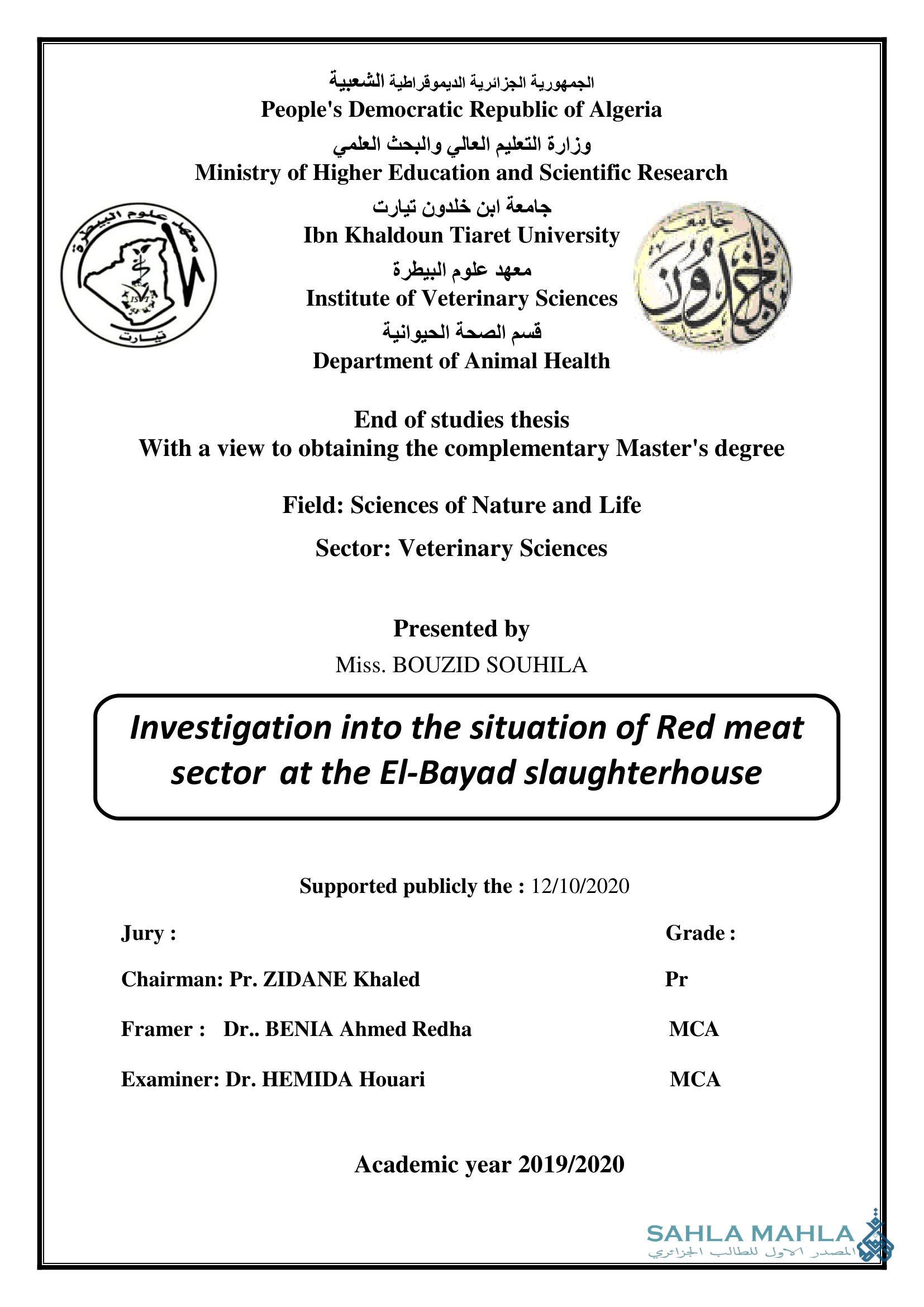
Outline:
Acknowledgments
INTRODUCTION
Bibliographic section
CHAPTER 1: LABATORY HEALTH INSPECTION TECHNIQUES
Slaughterhouses
1. Definition of slaughterhouse
2. Definition Slaughter
3. The water diet
1.2. Stages of slaughter
1.2.1 Unloading
1.2.2.Receipt / control
1.2.3 Animal care and ante-mortem inspection
1.2.5 Restraint / stunning
1.2.6.Falling/lifting
1.2.7. Bleeding
1.2.8. Animals prohibited for slaughter
1.2.9. Counting
1.2.10. Head removal
1.2.11. Slot
1.2.12. Dulling/ trimming
1.2.13. Post-mortem inspection
1.2.14. Weighing/classification / marking
1.2.15. Refrigeration of carcasses
4. Types of slaughter
5. Sanitary inspection of red meat
Definition and generalities
1.5.1. Definition of inspection
1.5.2. Goal
1.5.3. Inspection phase
1.5.3.1. Ante-mortem inspection
1.5.3.1.1. Definition
1.5.3.1.2. Purpose of ante-mortem inspection
1.5.3.1.3. Conditions and fulfillment
1.5.3.1.4 Techniques and practices
1.5.3.2. Post-mortem inspection
1.5.3.2.1. Definition
1.5.3.2.2.Purpose of post-mortem inspection
1.5.3.2.3. The conditions for carrying out the post-mortem inspection
1.5.3.2.4 Technique for performing post-mortem inspection
1.5.3.2.5. Sanction
at. Acceptance (stamping)
b.Lockout (put on hold)
CHAPTER 2: THE MAIN REASONS FOR SEIZING MEAT, OFFAL AND ESSUES
1. Definition of seizure
2. Justification of the entries
3. Classification of seizures
4. DIFFERENT GROUNDS FOR SEIZURE
4.1 SEIZURE FOR UNSALUBRITE
4.1.1 Cadaveric meat
4.1.2 MEAT FROM SPECIFIC AND ZONOTIC INFECTIOUS DISEASE ANIMALS
4.1.2.1 Tuberculosis
4.1.2.1.1 Definition
4.1.2.1.2 Recommended pipe
4.1.2.2 RABIES
4.1.2.3 BOVINE PLAGUE
4.1.2.4 Contagious bovine pleuropneumonia
4.1.2.5.BCTERIDIAN COAL
4.1.2.6 SYMPTOMATIC COAL
4.1.2.7 FOOT AND MOUTH DISEASE
4.1.2.7.1 Definition
4.1.2.7.2 Lesions
4.1.2.7.3 Recommended pipe
4.1.2.8 SALMONELLOSIS
4.1.3 MEAT FROM ANIMALS WITH SPECIFIC INFLAMMATORY DISEASES
4.1.3.1 Septicemia
4.1.3.2.MAMMITES
4.1.3.3 HEPATITIS
4.1.4 MEAT SUFFERING FROM ANIMALS SUFFERING FROM SPECIFIC PARASITIC AND ZOONOTIC DISEASES
4.1.4.1. HYDATIDIOSIS
4.1.4.1.1. Definition
4.1.4.1.2. Lesions
4.1.4.1.3. Sanction
4.1.4.2. Fascioliasis
4.1.4.2.1. Definition
4.1.4.2.2. Lesions
4.1.4.2.3. SANCTION
4.1.4.3. Cysticercosis
4.1.4.3.1. Definition
4.1.4.3.2. Lesions
4.1.4.4.3. Sanction
4.1.4.4. Respiratory strongylosis
4.1.4.4.1. Definition
4.1.4.4.2. Lesions
4.1.4.4.3. Sanction
4.1.5. TOXIC MEAT
4.1.6. HEAVY MEATS
4.1.7 PUTREFIED MEAT
4.2. SEIZURE FOR REPUGNANCE
4.2.1.ALTERED MEATS
4.2.1.1.MEAT MONTHS
4.2.1.2.MEATS BREAKED BY INSECTS
4.2.2. ABNORMAL APPEARANCE
4.2.2.1. MEAT WITH ABNORMAL COLORING
4.2.2.1.1. Meats with black coloring or melanosis
4.2.2.1.2. Meats with yellow coloring
4.2.2.2. MEAT WITH AN ABNORMAL ODOR
4.3 SEIZURE FOR INSUFFICIENCY
4.3.1.OVERMED MEATS
4.3.2. CACHECTIC MEAT
CHAPTER 3: EXPERIMENTAL PART
3.1. Goals
3.2. Materials
3.2.1. Animals and sampling
3.2.2. Bougtob slaughterhouse
3.2. Method
3.2.1. Ante mortem examination
3.2.2. Slaughter
3.2.3. Post mortem inspection
4.2.4. Weighing
4.2.5. Transport
4.2.6. Stamping
CHAPTER 4: RESULTS AND DISCUSSION
4.1. Evolution of the seizure according to the month
4.2. Evolution of seizure according to sex
4.3. Evolution according to the organ
4.4. Evolution according to the entry reason
Conclusion
Recommendation
BIBLIOGRAPHICAL REFERENCES
Download The Thesis:
For more
academic sources and references,
including theses and dissertations from Algerian universities,
, visit our main website.