


Towards a Reflective Language Learner: Enhancing Planning for Learning among Foreign Language Learners – Case Study of: Master Two Degree at the University of Ibn Khaldoun
General Information:
Level |
Master |
Title |
Towards a Reflective Language Learner: Enhancing Planning for Learning among Foreign Language Learners – Case Study of: Master Two Degree at the University of Ibn Khaldoun |
Specialty |
Didactics |
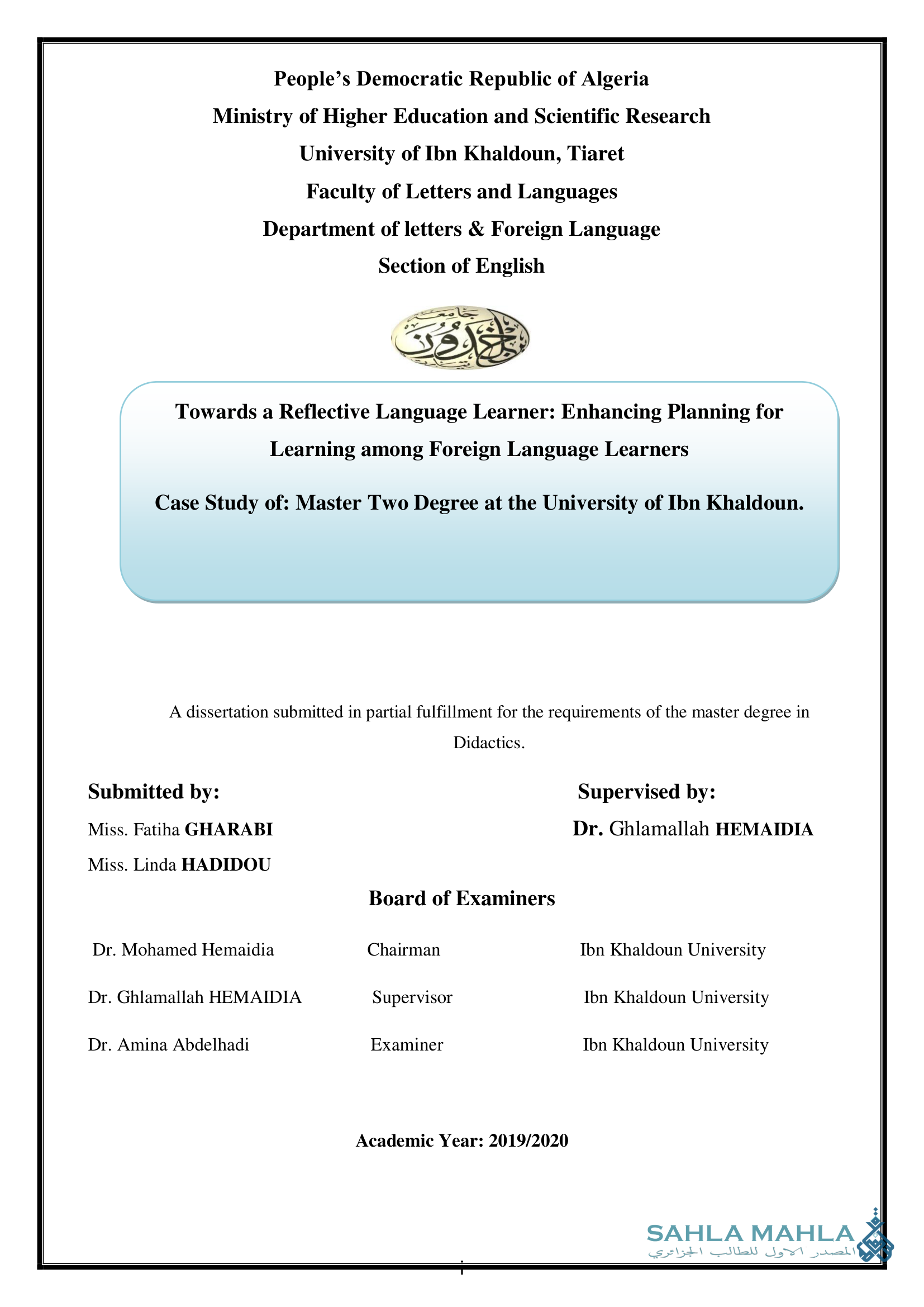
Cover Page:
Outline:
General Introduction
CHAPTER ONE: Creativity, Reflection and Metacognition in Learning
1.1 Introduction
1.2 Creativity
1.3 Critical Thinking
1.4 The Relationship between Creative and Critical Thinking
1.4.1 The Torrance Tests of Measuring Creativity
1.4.2 Bloom’s Taxonomy
1.4.3 The Revised Bloom’s Taxonomy
1.5 Reflection
1.5.1 Self-Reflection
1.6 Metacognition
1.6.1 Further Definitions
1.6.2Metacognition components
1.6.2.1 Metacognitive knowledge
1.6.2.2 Metacognitive experience
1.6.2.3 Metacognitive regulation
1.6.3 Models of the Components of Metacognition
1.6.3.1 Flavell’s Model
1.6.3.2 Brown’s Model
1.7 Conclusion
CHAPTER TWO: Metacognitive Strategies and Planning for Learning
2.1 Introduction
2.2 Metacognitive Strategies
2.2.1 Models of Planning Strategies
2.2.1.1 Advance Organizers
2.2.1.2 Directed Attention
2.2.1.3 Functional Planning
2.2.1.4 Selective Attention
2.2.1.5 Self-management
2.2.1.6 Monitoring
2.2.1.7 Self-monitoring
2.2.1.8 Regulating
2.2.1.9 Orchestrating
2.2.1.10 Evaluating
2.2.1.11 Self-questioning
2.2.1.12 Other models
2.2.2.12.1 KWL strategy
2.2.2.12.2 PQ4R strategy
2.2.2.12.3 IDEAL strategy
2.2.3 Planning for Learning
2.2.4 classification of learning strategies in second language acquisition
2.4.1 Classification/Verification
2.4.2 Monitoring
2.4.3 Memorization
2.4.4 Guessing/inductive inferencing
2.4.5 Deductive reasoning
2.4.6 Practice
2.4.7 Creates opportunities for practice
2.2.5 The Importance of Metacognitive Strategies and Planning For Learning
2.2.6 The effect of metacognitive strategies on the learners’ receptive skills
2.2.7 The classification of metacognitive strategies
2.2.7.1 Planning as a metacognitive strategy
2.2.7.2 Monitoring as a metacognitive strategy
2.2.7.3 Evaluation as a metacognitive strategy
2.8 Conclusion
CHAPTER THREE: Field Work
3.1 Introduction
3.2 Research design
3.2.1 Students- addressed questionnaire
3.2.1.1 Questionnaire in details
3.2.1.2 Questionnaire sample
3.2.1.3 Pilot study
3.2.1.4 Questionnaire results
3.2.2 Teachers -addressed interview
3.2.2.1 Interview in details
3.2.2.2 Interview sample
3.2.2.3 Interview results
3.2.3 Results discussion
3.2.3.1 Questionnaire discussion
3.2.3.2 Interview discussion
3.3 Limitations of the study
3.4 Call for further investigation
3.5 Conclusion
General Conclusion
REFERENCES
Download The Thesis:
For more
academic sources and references,
including theses and dissertations from Algerian universities,
, visit our main website.