


POWER RELATIONSHIP BETWEEN MEN AND WOMEN IN THE ALGERIAN PROVERBS CASE STUDY TISSEMSILT SPEECH COMMUNITY
General Information:
Level |
Master |
Title |
POWER RELATIONSHIP BETWEEN MEN AND WOMEN IN THE ALGERIAN PROVERBS CASE STUDY TISSEMSILT SPEECH COMMUNITY |
Specialty |
linguistics |
Cover Page:
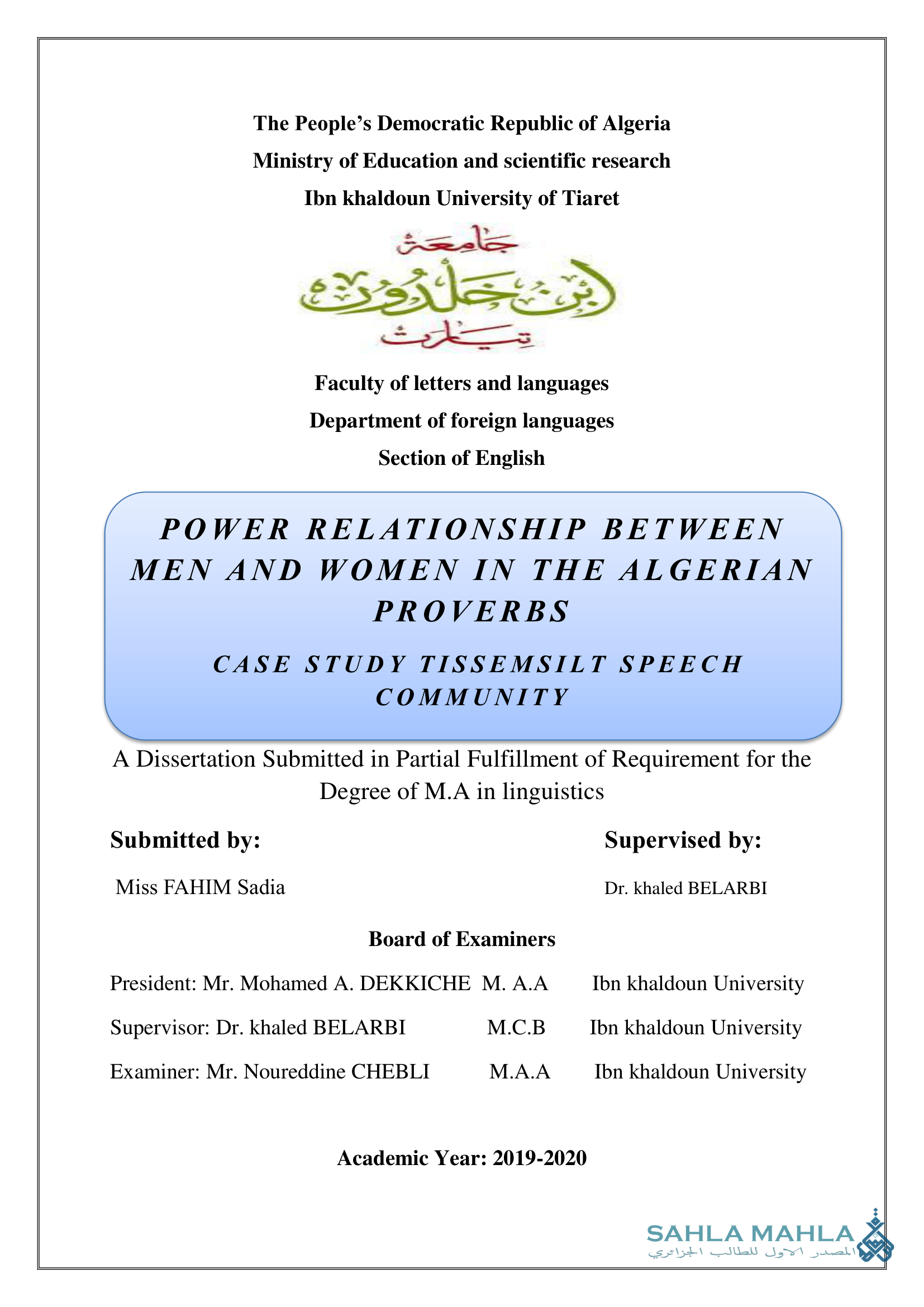
Outline:
General Introduction
Chapter one: An overview of the related literature
I.1. Section one: An Overview about Gender Studies
I.1.1. Introduction
I.1.2. Gender Studies
I.1.3. Gender
I.1.3.1. The Development of Gender as Field of Study
I.1.4. Gender and Language
I.1.5. Theories of Gender Studies
I.1.5.1. The Deficit theory
I.1.5.2. The Dominance Model
I.1.5.3 The Difference Theory
1 – 2.3.3.1. Status vs. Support
I.1.6. Main Distinction in Gender Studies
I.1.6.1. Gender vs. Sex
I.1.6.2. Gender vs. Power
I.1.6.3. Gender vs. Age
I.1.7. Sexism Language
I.1.8. Gender Discrimination
1.2. Section Two: Gender Stereotype and Proverbs
1.2.1. Gender Role
1.2.2. Gender Stereotypes
I.2.2.1. Effects of Stereotype
I.2.2.2. Definition of Gender Stereotype
I.2.2.3. Common Gender Stereotypes of Men
I.2.2.4. Common Gender Stereotype of Women
I.2.3. Femininity and Masculinity
I.2.4. Gender Inequality
I.2.5. Androcentric
I.2.6. Definition of proverbs
I.2.6.1. The origin of proverbs
I.2.6.2. Features of Proverbs
I.2.6.3. Functions of Proverbs
1.2.6.3.1. Literary Function
1.2.6.3.2. Practical Function
I.2.7. Gender Representation in Proverbs
I.2.8. Conclusion
Chapter two: Discourse analyses
II.1. Introduction
II.2. Language
II.3. discourse and discourse analyses
II.4. Definition of discourse analyses
II.5. The advantages and limitations of discourse analysis
II.6. Approaches to discourse analysis
II.7. Non-critical approaches to discourse analysis
II.7.1. Harris
II.7.2. Speech act approach
II.7.3. Pragmatic approach
II.7.4. Sinclair and Coulthard
II.7.5. Conversational Analysis
II.8. Critical Discourse Analysis
II.8.1. why critical
II.9. Research in Critical Discourse Analysis
II.9.1.Gender inequality
II.9.2. Media Discourse
II.9.3. Political Discourse
II.9.4. Ethnocentrism, Anti-semitism, Nationalism, and Racism
II. 10. Feminist Critical Discourse Analysis (FCDA)
II.11. Ontology and Epistemology of Feminist Critical Discourse Analysis
II.12. Key concept
II. 12.1. Power and hegemony
II. 12.2. Discourse
II. 12.3.Discursive repertoire
II. 12.4. Gender
II.13Conclusion
Chapter Three: Data Collection and Result’s Iterpretation
III.1. Introduction
III.2. Research Design
III.3. Presentation of the Participants
III.4. Research Instruments
III.4.1. A Questionnaire
III.4.2. The Interview
III.5. The Analyses of the Results
III.5.1. The Questionnaire
III.5.1.1. Participant’s Background
III.5.1.2. Respondent’s point of view about proverbs
III.5.1.3. Participant Knowledge about Proverbs
III.5.2. The Interview
III.5.2.1. The Use of Proverb
III.5.2.2. Interviewee Knowledge about Proverbs
III.5.2.3. Gender Representation in Algerian Proverbs
III.5.2.4. Gender Inequality in the Algerian Proverbs
III.5.2.5. The Negative Representation of Males and Females in Proverbs
III.5.2.6. The Impact of Proverbs on the Younger Generation
III.6. The interpretation of the result
III.7. Discourse Analyses using The Theory of Representation
III.7.1. Hegemonic Masculinity and Femininity
III.8.1. Gender Representation in Proverbs
III.9. Representation of Hegemonic Masculinity and Femininity in Algerian Proverbs
III.9.1. Women’s Beauty vs. Men’s Beauty
III.9.2. Women as Evil creature vs. Men as Good Creatures
III.9.3. Women’s Brain vs. Men’s Brain
III.9.4. Men’s Power vs. Women’s Inferiority
III.9.5. Marriage and Divorce in Proverbs
III.10. Conclusion
General conclusion
References
Download The Thesis:
For more
academic sources and references,
including theses and dissertations from Algerian universities,
, visit our main website.