


A Sociolinguistic Study of Communication and Language Barriers among Foreign and Algerian Students at Ibn Khaldoun University
General Information:
Level |
Master |
Title |
A Sociolinguistic Study of Communication and Language Barriers among Foreign and Algerian Students at Ibn Khaldoun University |
Specialty |
Linguistics |
Cover Page:
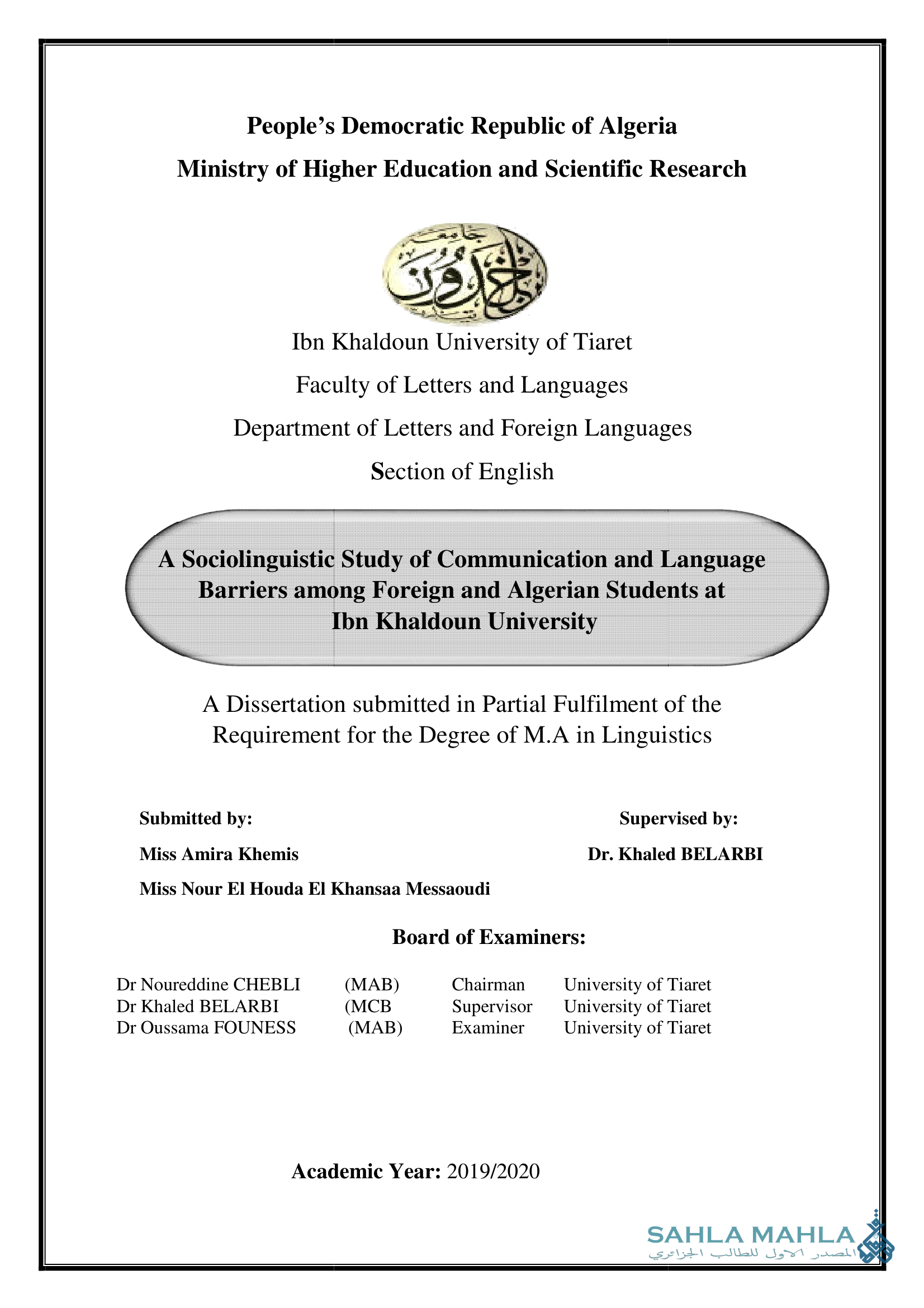
Outline:
CHAPTER ONE: Introduction to Communication
I.1. Introduction.
I.2. Definition of Communication
1.3. Nature of communication
1.5. Process of Communication
1.6. Elements of Communication
I.6.1. Source
I.6.2. Message
I.6.3. Channel
1.6.4. Receiver
I.6.5. Encoding and Decoding
I.6.6. Noise
I.6.7. Feedback
I.7. Models of Communication
I.7.1. Aristotel’s Model.
I.7.2. Laswell’s Model
I.7.3. Shannone and Weaver’s Model
I.7.4. Schramm and Osgood’s Model
I.8. Types of Communication
I.8.1. Based on channel.
a) Verbal Communication.
b) Non-Verbal Communication
1.8.2. Based on Purpose and Style
a) Formal Communication
b) Informal Communication
I.9. Theories of Communication
I.9.1. The Bullet Theory
I.9.2. The Agenda Setting Theory
I.10. Barriers of Communication
I.10.1. Process Barriers
1.10.2. Physical Barriers
I.10.3. Semantic Barriers
I.10.4. Personal Barriers
I.10.4 Cultural Barriers
I.11. Importance of communication
I.12. Conclusion
Chapter II: Features of the Sociolinguistic Situation in Algeria
II.1. Introduction
II.2. Algeria: General Overview
II. 2.1. Name
II. 2.2. Geography.
II.3. Historical background of Algeria
II.3.1. Algeria during the classical period
II.3.1.2. Cartage and Berbers.
II.3.1.3. The Roman Era
II.3.1.4. Vandals and Byzantines.
II.3.1.5. Islam and the Arabs(642-1830) a.Fatimids.
b. Almoravids.
c. Almohads.
d.Zayanids
e. Marbouts.
f.European Offensive g.Privoteers.
h. Ottoman Rule
II.3.1.6. France in Algeria (1830-1962)
II.4. The language repertoires of Algeria
II.4.1. The Arabic Language.
A. Classical Arabic
B. Modern Standard Arabic
C. Dialectal Arabic
II.4.2. The Berber Language and its Varieties
II.5. Language Contact Phenomenon in Algeria and its Outcomes.
II.5.1. Bilingualism
II.5.1.2. Bilingualism in Algeria.
II.5.2.2. Diglossia in Algeria
II.5.3.1 Borrowing.
II.5.3.2. Borrowing in Algeria
II.5.4.1 Code switching
II.5.4.2. Code switching in Algeria.
II.4.3. French
II.4.4. English
II.5.2.1. Diglossia
II.5.2.2. Diglossia in Algeria.
II.6. Conclusion
Chapter III. Research Sheme, Data Collection Procedures and Findings Disscution
III.1. Introduction
III.2. Population.
III.2.1 Foreign Students
III.2.2. Algerian Students
III.3. The research Tools
III.3.1 Students questionnaire.
III.4. Data Analysis
4.1. Analysis of the Algerian Student’s Questionnaire.
4.2. Analysis of the Foreign Student’s Questionnaire
III.5. Data Discussion and Interpretation
III. 7Conclusion
General Conclusion
Bibliography
Download The Thesis:
For more
academic sources and references,
including theses and dissertations from Algerian universities,
, visit our main website.