


Using Cooperative Learning to Bridge the Achievement Gap in Oral Expression: The Case of 2nd Year EFL Students at Khenchela University
General Information:
Level |
PhD |
Title |
Using Cooperative Learning to Bridge the Achievement Gap in Oral Expression: The Case of 2nd Year EFL Students at Khenchela University |
Specialty |
English Language and Education |
Cover Page:
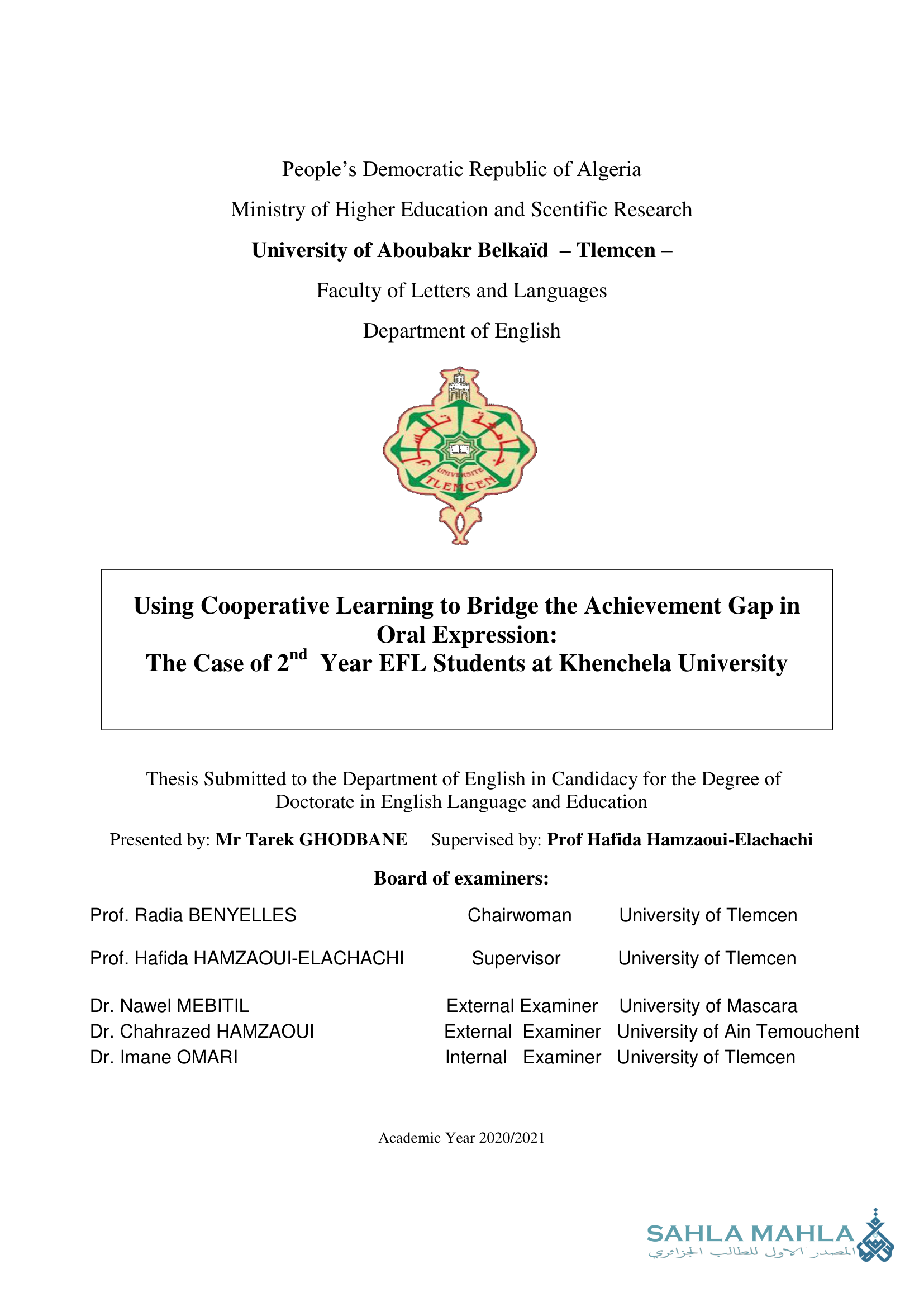
Outline:
Statement of Originality
GENERAL INTRODUCTION
CHAPTER ONE: Attitude and Achievement Motivation
1.1 Introduction
1.2 Attitude
1.2. 1 The Birth of Attitude Studies
1.2.2 The Definition of Attitude and Related Concepts
1.2.3. Development of Attitude
1.2.4. Measuring Attitudes
1.2.5. Language Learning Attitude
1.2.5.1. Attitude in the language Classroom
1.2.5.2. Language Attitude and Achievement gap
1.3 Achievement Motivation
1.3.1 Definition of motivation
1.3.2 Types of Motivation and Self-determination
1.3.2.1 Intrinsic Motivation
1.3.2.2. Extrinsic motivation
1.3.3. Language Learning and Motivation
1.3.3.1. Gardner’s Integrative Motive
1.3.3.2. Gardner’s Socio-Educational Model of Motivation
1.3.3.3. Motivational Conglomerates
1.3.4. Motivation, Attitude and Language Achievement
1.3.5. Motivation and the Achievement Gap
1.4. Conclusion
CHAPTER TWO: Cooperative Learning and Oral Expression
2.1 Introduction
2.2 Cooperative Learning
2.2.1 Definition of Cooperative Learning
2.2.1.1. Individual Accountability
2.1.1.2. Positive interdependence
2.2.1.3. Face-to-Face Promotive Interaction
2.2.1.4. Interpersonal and small-Group Skills
2.2.1.5. Group-Processing
2.2.2. Types of Cooperative Learning
2.2.3. Cooperative and Individual Effort
2.2.4. Cooperative Learning and Achievement Motivation
2.2.4.1. Cooperative learning and Self-Efficacy
2.2.4.2. Cooperative Learning and Self-Worth
2.2.4.3. Cooperative Learning and Zone of Proximal Development
2.2.5. Cooperative Learning Methods and Achievement
2.3.1. Definition of Speaking
2.3.2. The Process of Speaking
2.3.3. Speaking as a Productive Skill
2.3.4. Communication Strategies
2.3.5. Oral Expression Models
2.3.5.1. Rivers and Temperley’s Diagram
2.3.5.2. Littlewoods Model
2.3.6. Cooperative Learning and Oral Expression
2.3.7. Cooperative Learning and the Oral Expression Achievement Gap
2.4. Conclusion
CHAPTER THREE: Research Design
3.1. Introduction
3.2. Situation Analysis
3.3. English as a Foreign Language in the Algerian University
3.4. Research Methodology
3.4.1. Research Design
3.4.2. Variables of the study
3.4.3. Sample Population
3.4.4. Methods of Data Collection
3.4.4.1. The Pretest and the Posttest
3.4.4.2. The Questionnaire
3.4.4.3. The Interview
3.4.5. Data Analysis
3.4.6. The Intervention
3.4.6.1. Task Design
3.4.6.2. Task Components
3.4.6.3. Notes about the Intervention
3.5. Conclusion
CHAPTER FOUR: Data Analysis and Discussion
4.1. Introduction
4.2. Tests Results
4.2.1. Experimental Group
4.2.1.1. Measuring the Experimental Group Achievement Gap in the Pretest
4.2.1.2. Measuring the Experimental Group Achievement Gap in the Posttest
4.2.1.3. Interpretation of the Experimental group results
4.2.2. Control Group
4.2.2.1. Measuring the Control Group Achievement Gap in the Pretest
4.2.2.2. Measuring the Control Group Achievement Gap in the Posttest
4.2.2.3. Interpretation of the Control group results
4.3. The Students’ Questionnaire Results
4.3.1. Participants
4.3.2. Analysis of the Questionnaire Data
4.3.3. Interpretation of the Results
4.4. The Teachers’ interview
4.4.1. Analysis of the Interview
4.4.2. Interpretation of the Results
4.5. Discussion
4.6. Conclusion
CHAPTER FIVE: Recommendations
5.1 Introduction
5.3.Building a Cooperative community
5.3.1. Esprit-de-Corps
5.3.2. Fostering positive Interdependence
5.3.3. Equalizing Interaction
5.3.3.1. Multiple-Abilities Treatment
5.3.3.2. Assigning Competence to Low-Status Students
5.4.The Teacher as a Group Work Instructor
5.4.1. The Teacher as a Democratic Leader
5.4.2. The teacher as a Facilitator
5.4.3. Specific Teacher’s Roles in the Cooperative Learning Classroom
5.5.Students in Cooperative Language Learning
5.5.1. Students’ Demands in Group Interactions
5.5.2. Access to the Learning Task
5.5.3. Participation in Group Interactions
5.5.4. Demonstrating Intellectual Competence and Growth
5.5.5. Specific Roles for Students in Cooperative leaning
5.6.Conclusion
GENERAL CONCLUSION
Bibliography
Download The Thesis:
For more
academic sources and references,
including theses and dissertations from Algerian universities,
, visit our main website.