


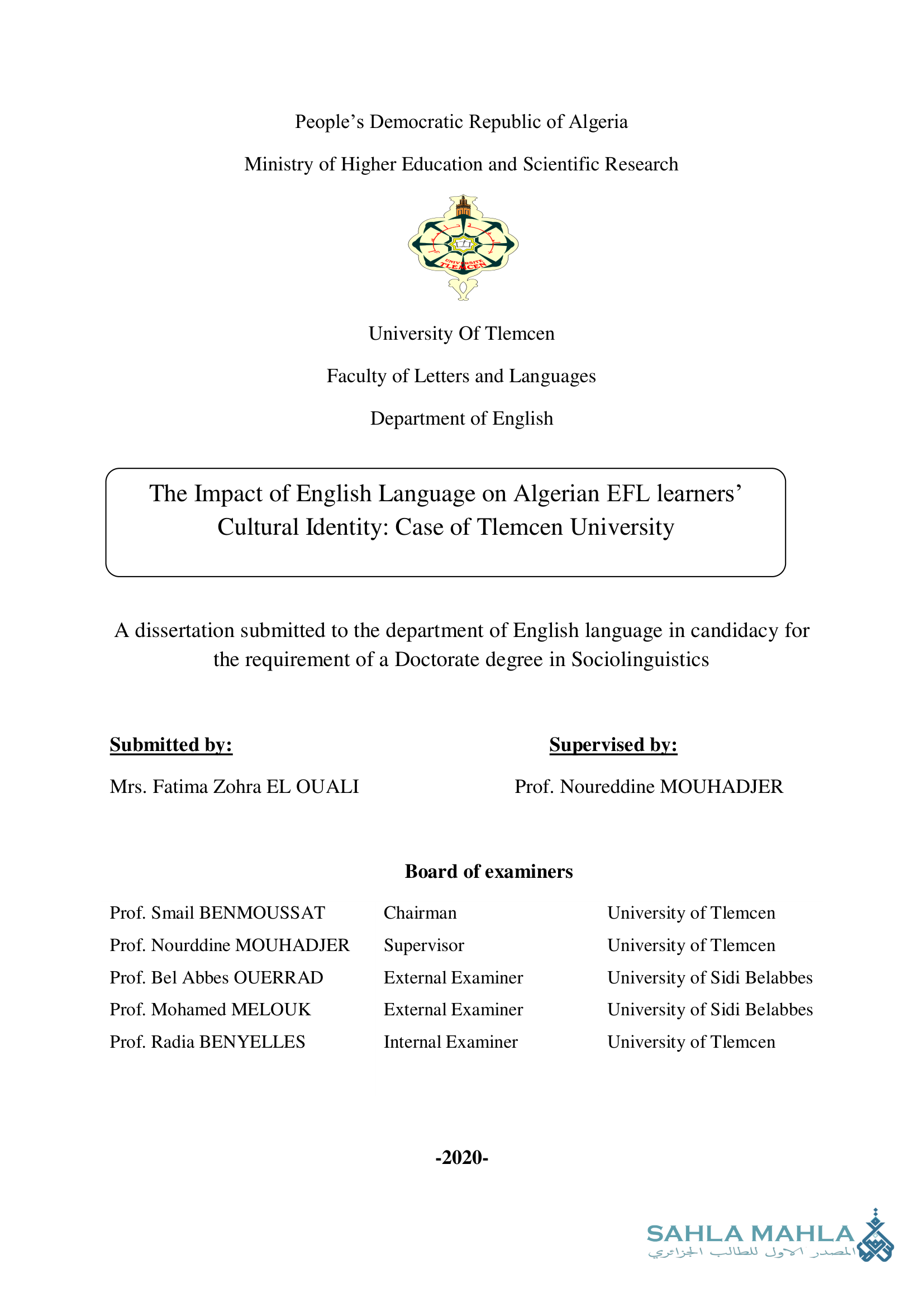
The Impact of English Language on Algerian EFL learners’ Cultural Identity: Case of Tlemcen University
General Information:
Level |
PhD |
Title |
The Impact of English Language on Algerian EFL learners’ Cultural Identity: Case of Tlemcen University |
Specialty |
Sociolinguistics |
Cover Page:
Outline:
Statement of Originality
Acknowledgment
General Introduction
Chapter One: Theoretical Background and Review of Literature
1.1. Introduction
1.2. Foreign Language Learning
1.2.1. Types of Learning
1.3. Definition of Culture
1.3.1. Culture and Identity Issues
1.3.2. Culture and Language Learning
1.3.3. Culture Elements
1.3.3.1. Beliefs
1.3.3.2. Values
1.3.3.3. Language
1.4. Cultural Values Models
1.5. Identity
1.6. Identity Categories
1.6.1. Personal Vs Social Identity
1.6.2. Religious Identity
1.6.3. Ethnic Identity
1.6.4. Gender Identity
1.6.5. Cultural Identity
1.6.5.1. Globalization and Cultural Identity
1.6.5.2. Cultural Identity and Language
1.7. Foreign Language Learning and Cultural identity
1.7.1. Learner’s Identity
1.7.2. Linguistic Practices
1.8. Situation Analysis
1.8.1. English Status in Algeria
1.8.2. Globalization in Algeria
1.8.3. Comparison of Cultural Profiles
1.9. Language Learning and Identity Studies
1.9.1. Social Identity Theory and Language Learning
1.9.2. Social Identity Theory and SLA/EFL
1.9.3. Poststructuralist Approach to Identity and Language Learning
1.9.4. Cultural Identity Theory and Language Learning
1.10. Significance of our Study
1.11. Conclusion
Chapter Two: Methodological Procedures and Research Design
2.1. Introduction
2.2. Purpose of the Study
2.3. Worldviews
2.4. Motivations of the Study
2.5. Preliminary Study
2.5.1. Unstructured Interview
2.5.2. Observation
2.6. Research Approaches
2.6.1. Qualitative Vs Quantitative
2.6.2. Mixed Method Approach
2.7. Research Design
2.7.1. The Present Research: Case Study
2.7.2. Sample Population
2.7.3. Selection of Participants
2.8. Data Collection Instruments
2.8.1. Questionnaire
2.8.2. Semi-structured Interview
2.8.3. Likert Scale Questionnaire
2.8.4. Observation
2.8.5. Focus Groups
2.8.6. Recordings
2.9. Reflection on the Chosen Methods
2.10. Data Analysis
2.10.1. Quantitative Data Analysis
2.10.2. Qualitative Data Analysis
2.11. Ethical Considerations
2.12. Conclusion
Chapter Three: Questionnaire and Semi-structured Interviews Analysis
3.1. Introduction
3.2. Part One: Questionnaire Results
3.2.1. Section One: Demographic Data
3.2.2. Section Two: Language and Culture
3.2.3. Section Three: Language Learning
3.3. Part Two: Interview’s Results and Findings
3.3.1. Theme1: The Developed Skills and their Influence on Students’ CI
3.3.1.1. Cultural Knowledge
3.3.1.2. Personal Development
3.3.1.3. Academic Skills Development
3.3.2. Theme2: The Importance of Learning the Target Culture
3.3.2.1 Perspectives about the Target Culture
3.3.2.2. Ignorance of the Target Culture Learning
3.3.3. Theme 3: Cultural Values Learning
3.3.3.1 Beliefs about the Importance of Learning Cultural Values
3.3.3.2. Morality as an Alternative of Cultural Norms
3.3.3.3. Resisting New Cultural Values
3.3.4. Theme4: From Language Contact to Culture Contact
3.3.4.1. Experiences are Stronger than Classroom Learning
3.3.4.2. Outcomes of Local and Global Experiences
3.3.5. Theme 5: Changes in the Algerian Culture
3.3.5.1. Culture is a Polemical Banner
3.3.5.2. Cultural Change and Globalization
3.3.5.3. New Cultural Markers
3.3.5.4. Cultural Transition as a Step towards Evolution
3.3.6. Theme 6: From Cultural Transition to Identity Change
3.3.6.1. Foreign Languages Learners are the most Influenced
3.3.6.2. We Are Different
3.3.6.3. We Keep Our Identity
3.3.6.4. Rejection of the Projected Identity
3.3.7. Theme7: Native-like Accent Vs Correct Pronunciation
3.3.7.1. General Beliefs about Pronunciation
3.3.7.2. The Importance of Native Speaker Standards
3.3.7.3. Correct Pronunciation Serves Better than NS Accent
3.4. Part Three: Likert Scale Questionnaire Results
3.4.1. Section One: Value Dimensions and Cultural Beliefs
3.4.2. Section Two: Cultural and Linguistic Practices
3.5. Conclusion
Chapter Four: Focus Groups and Recordings Analysis
Introduction
4.2. Part One: Focus Groups Data Analysis
4.2.1. Findings Related to Group A
4.2.1.1. Theme One: EFL Learners’ CI is Influenced by English Learning
4.2.1.2. Theme Two: EFL Students Do not Look Like Their Identity Claim
4.2.1.3. Theme Three: Learning another Language Means Having a New CI
4.2.2. Findings Related Group B
4.2.2.1. Theme One: EFL Learners’ CI is Influenced by English Learning
4.2.2.2. Theme Two: EFL Students Do not Look like their Identity Claim
4.2.2.3. Theme Three: Learning another Language Means Having a New CI
4.2.3. Findings Related Group Group C
4.2.3.1. Theme One: EFL Learners’ CI is Influenced by English Learning
4.2.3.2. Theme Two: EFL Students Do not Look like their Identity Claim
4.2.3.3. Theme Three: Learning another Language Means Having a New CI
4.2.4. Findings Related Group Group D
4.2.4.1. Theme One: EFL Learners CI is Influenced by English Language
4.2.4.2. Theme Two: EFL Students Do not Look like their Identity Claim
4.2.4.3. Theme Three: Learning another Language Means Having a New CI
4.2.5. Analyzing the Linguistic Practices
4.2.6. Comparing Focus Groups Data
4.2.6.1. Comparing Students’ Linguistic Behaviour
4.2.6.2. Comparing Students’ Cultural Behaviour
4.3. Part Two: Analyzing Results of Recordings
4.3.1. Code switching as a Habit
4.3.2. Using English to Communicate Positive Attitudes
4.3.3. Using English to Express Politeness/ Indirect Attitudes
4.3.4. Using English as a Defensive Strategy
4.3.5. Using English to Maintain Power
4.3.6. Using English to Perform Authentic English Speakers
4.4. Conclusion
Chapter Five: Data Interpretation and Research Conclusions
5.1. Introduction
5.2. Part One: Results Interpretation
5.2.1. Interpreting Results Related to Q1
5.2.1.1. Students’ Motivation
5.2.1.2. Academic Skills Development
5.2.1.3. Personal Skills Development
5.2.1.4. Cultural Knowledge Development
5.2.1.5. The Impact of Informal Learning on Students’ CI
5.2.2. Interpreting Results Related to Q2
5.2.2.1 Level of Study
5.2.2.2 Field of Study
5.2.2.3. Beliefs about the TC
5.2.2.4. Globalization
5.2.2.5. Students’ Perception of Identity
5.2.3. Interpreting Results Related to Q3
5.2.3.1. New Cultural Values
5.2.3.2. New Cultural Behaviours
5.2.3.3. New Linguistic Practices
5.2.4. Interpreting Results Related to Q4
5.2.4.1. Identity Negotiation
5.2.4.2. Identity Changes
5.2.4.3. The Negotiated Aspects of Cultural Identity
5.3. Part Two: Research Conclusions
5.3.1. Results Achieved and Conclusions
5.3.2. Limitations of the Study
5.3.3. Suggestions for Future Research
5.4. Conclusion
General Conclusion
Bibliography
Download The Thesis:
For more
academic sources and references,
including theses and dissertations from Algerian universities,
, visit our main website.