


Study of the Deformation of an Entangled Polymer Chain using a Molecular Dynamic Program
General Information:
Level |
Master |
Title |
Study of the Deformation of an Entangled Polymer Chain using a Molecular Dynamic Program |
Specialty |
Physique des Polymères |
Cover Page:
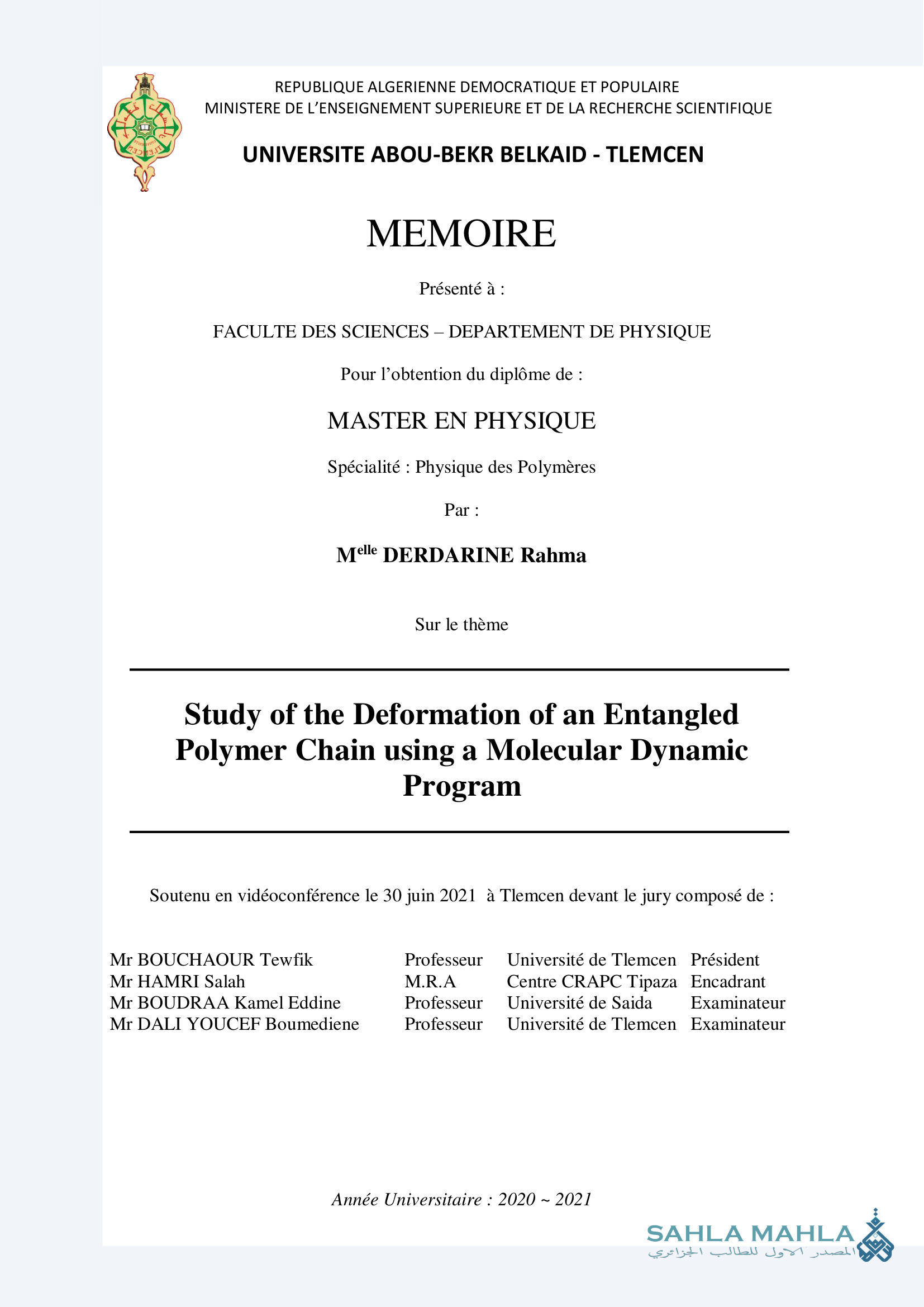
Outline:
General introduction
Chapter I: General concept of polymers
1. Definitions
1.1. Definition of polymer
1.2. Macromolecules
1.3. Covalent bond
1.4. Monomer
1.5. Unit of polymer
2. Types of polymers
2.1. Homopolymer
2.2. Copolymer
2.3. Alternating copolymer
2.4. Random copolymer
2.5. Block copolymer
2.6. Graft copolymer
3. Classification of polymers
3.1. Classification of polymers based on the source of availability
3.1.1. Natural polymers
3.1.2. Semi-synthetic polymers
3.1.3. Synthetic polymers
3.2. Classification of polymers based on the structure of the monomer chain
3.2.1. Linear Polymers
3.2.2. Branched-chain polymers
3.2.3. Cross-linked polymers
3.3. Classification based on the types of polymerization
3-3.1. Addition polymerization
3.3.2. Condensation polymerization
3.4. Classification based on monomers
3.4.1. Homopolymer
3.4.2. Heteropolymer or co-polymer
3.5. Classification based on molecular forces
3.5.1. Elastomers
3.5.2. Fibres
3.5.3. Thermoplastics
3.5.4. Thermosetting polymers
4. Mechanical properties
4.1. Strength
4.2. Percent elongation to break (Ultimate elongation)
4.3. Young’s modulus (Modulus of elasticity or tensile modulus)
4.4.Toughness
5. Uses of polymers
Chapterll: Molecular dynamics simulation
1. Introduction
2. Aim of molecular dynamics simulation
3.Concepts
4. Molecular interaction and force field
5. Periodic boundary conditions
6. Steps of molecular dynamis simulation
6.1. Initialization
6.2. The energy of interactions
6.3. Force calculation
6.4. Integrating the equations of motion
7. Conclusions
Chapterlll: Results and discussion
1.introduction
2-software
a-.Avogadro
b-.Lammps
3-Monomer and model
a-Acrylamide
b-Polyacrylamide
c-Model proposition
4- The Lennard-Jones potential
5-Energy minimization
6-Deformation
a- Plastic deformation
b- Elastic deformation
c- Fracture
6.1. Stress-strain curve of polyacrylamide
a-Stress
b- Strain
7-Conclusion
General conclusion
Download The Thesis:
For more
academic sources and references,
including theses and dissertations from Algerian universities,
, visit our main website.