


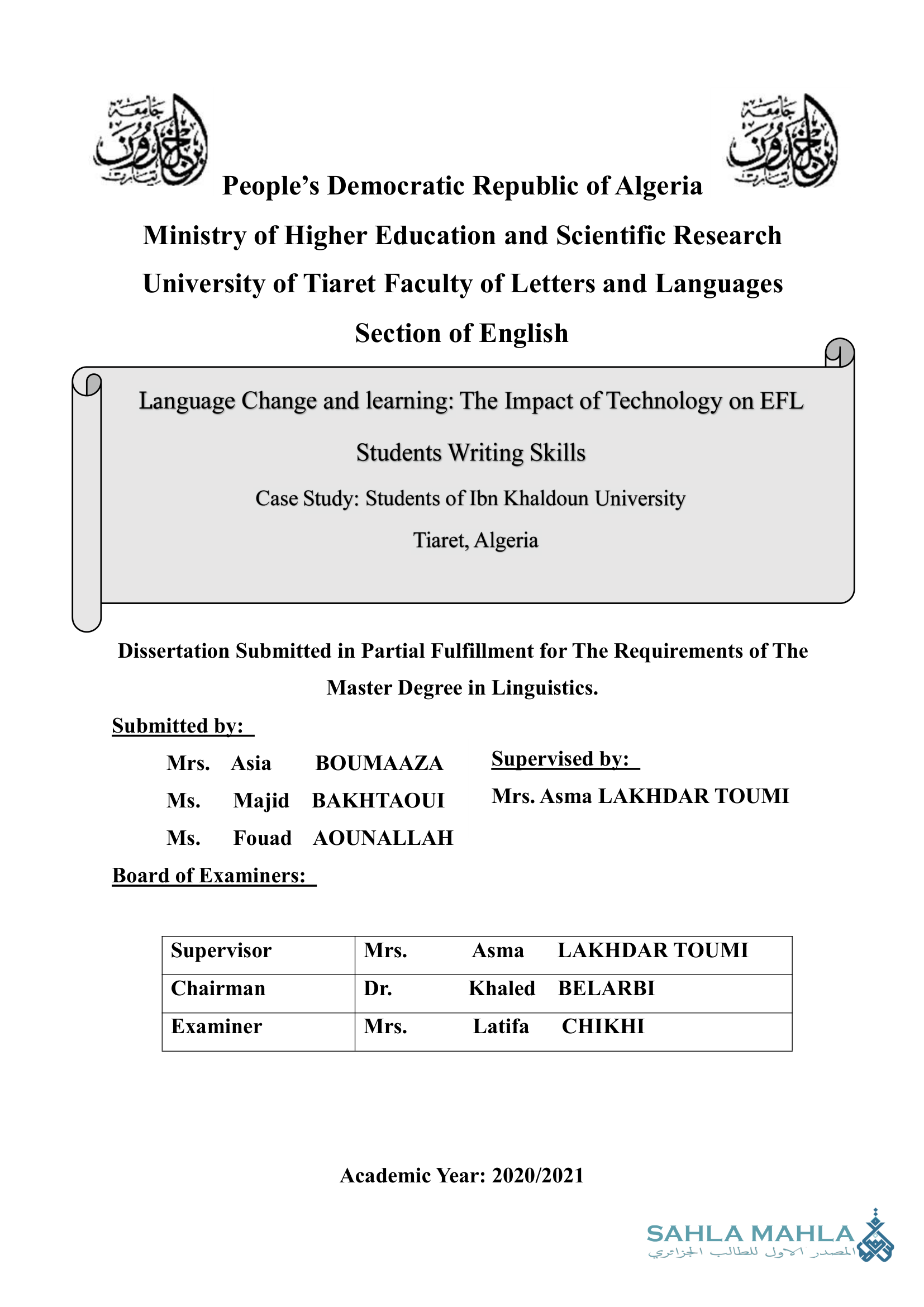
Language Change and learning: The Impact of Technology on EFL Students Writing Skills Case Study: Students of Ibn Khaldoun University Tiaret, Algeria
General Information:
Level |
Master |
Title |
Language Change and learning: The Impact of Technology on EFL Students Writing Skills Case Study: Students of Ibn Khaldoun University Tiaret, Algeria |
Specialty |
Linguistics |
Cover Page:
Outline:
Declaration
Acknowledgments
General Introduction
1. Statement of The Problem
2. Theory
3. Research Questions
4. Hypothesis
5. Objectives
6. Structure of The Dissertation
Chapter One: Theoretical Background
1.1. Introduction
1.2. Language Contact
1.3. The Outcomes of Language Contact
1.3.1. Language Shift
1.3.2. Language Death
1.3.3. Language Change
1.3.3.1. Internal Changes
1.3.3.1.1. Lexical Changes
1.3.3.1.2. Semantic Change
1.3.3.1.3. Syntax Change
1.3.3.1.4. Phonological Change
1.3.3.1.5. Spelling Change
1.3.3.2. External Change
1.3.3.2.1. Political Factor
1.3.3.2.2. Social Factor
1.3.3.2.3. Technology Factor
1.4. Information and Communication Technology (ICT)
1.5. The Concept of Communication
1.6. Types of ICT Communication
1.6.1. SVC or Social Virtual Communication
1.6.2. EC or E-Communication
1.7. ICT in Education
1.8. Types of ICTs Used in Education
1.8.1. E-Learning
1.8.2. Blended Learning
1.9. The Influence of ICT on The English Language Usage and learning
1.10. Conclusion
Chapter Two: Contextualization of The Study
2.1. Introduction
2.2. The Usage of Information and Communication Technology (ICT) in Algeria
2.3. The Influence of ICT on Algeria’s EFL students
2.4. Social Networking Sites (SNS) in Algeria
2.4.1. SNS usage in Algeria
2.5. Facebook as a Popular SNS in Algeria
2.5.1. Facebook as a language Learning Tool
2.6. The writing Skill of a Language
2.7. Types of Writing
2.7.1. Formal Writing
2.7.1.1. Academic Writing
2.7.2. Informal Writing
2.7.2.1. Slang Writing
2.8. “Net-speak” The Digital Age of Writing
2.9. Features of Digital Writing
2.9.1. Computer Mediated Communication CMC
2.9.2. Texting
2.9.3. Abbreviation
2.9.3.1. List of Common Abbreviations and Acronyms Used in Texting
2.9.3.2. List of Common Emoticons Used while Texting
2.10. Mechanics of Writing (Sentence Level Mechanics)
2.10.1. Grammar
2.10.2. Vocabulary
2.10.3. Punctuation
2.10.4. Capitalization
2.11. Elements of Good Writing
2.11.1. Organization
2.11.2. Clarity
2.11.3. Coherence
2.11.4. Words Choice
2.12. The Impact of SNS on EFL Students Writing Skill
2.12.1. Advantages of SNS on EFL Students Writing
2.12.1.1. Learning Online
2.12.1.2. Interaction
2.12.1.3. Self Marketing and Improvements
2.12.2. Disadvantages of SNS on EFL Students Writing
2.12.2.1. Distraction and Social Media Addiction
2.12.2.2. Net-speak
2.12.2.3. Academic Literacy
2.13. Conclusion
Chapter Three: Data Analysis and Findings
3.1. Introduction
3.2. Methodology
3.3. Target Sample
3.4. Instruments of Data Collection
3.4.1. Questionnaire
3.4.1.1. Description
3.4.1.2. Design and settings
3.4.2. Interview
3.4.2.1. Description
3.4.2.2. Design and Settings
3.5. Data Collection Producers
3.6. Data Analysis and Discussion Design Plan
3.7. Data Analysis
3.7.1. Questionnaire (Analysis and Interpretation)
I. Part One: Demographic Questions
II. Part Two: Participants Attitude and Behaviour
III. Part Three: EFL students’ perspective on the effect of Tech on English change, use, and learning
3.7.2. Interview Results (Analysis and Comments)
I. Part One: Language Change
II. Part Two: The effects of tech on EFL standard writing skill
III. Part Three: The Experiment
3.9. Discussion Design
3.11. Discussion
3.12. Conclusion
3.13. Limitations and Recommendations
General conclusion
References
Download The Thesis:
For more
academic sources and references,
including theses and dissertations from Algerian universities,
, visit our main website.