


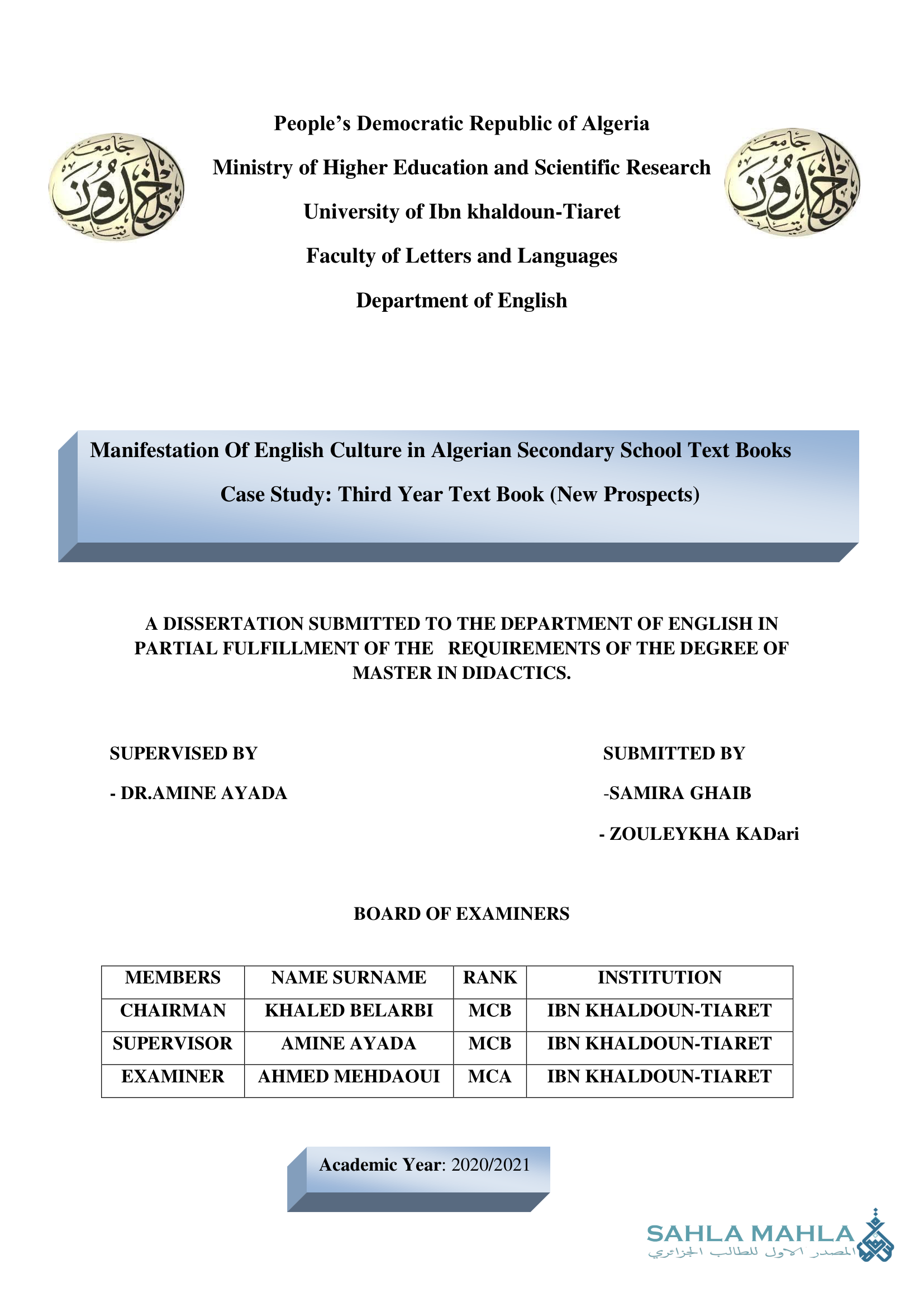
Manifestation Of English Culture in Algerian Secondary School Text Books Case Study: Third Year Text Book (New Prospects)
General Information:
Level |
Master |
Title |
Manifestation Of English Culture in Algerian Secondary School Text Books Case Study: Third Year Text Book (New Prospects) |
Specialty |
Didactics |
Cover Page:
Outline:
General introduction
1. Problem statement
2. Aims of the study
3. Research questions
4. Research hypothesis
5. Research methodology and design
5.1. Research method
6. Data collection
7. Structure of the study
8. Structure of The Dissertation
Chapter One: Teaching English as a second language
Introduction
1. Second language Teaching
2. Objectives of second language teaching
2.1. Practical objective
2.2. Educational objectives
2.3. Cultural objectives
3. Methods for teaching second language teaching
3.1. Grammar translation method
3.2. Direct method
3.3. Audio-lingual method
3.4. Communicative language teaching
4. Teaching English as a second language
4.1. The status of English in Algerian secondary schools
4.2. Finalities of teaching English in Algeria
4.3. Difficulties in ESL teaching
5. The role of the teacher in ESL classroom
5.1. Facilitator
5.2. Resource
5.3. Controller
5.4. Prompter or motivator
5.5. Participant
5.6. Tutor
5.7. Organizer
Conclusion
Chapter Two: Culture in ESL classroom
Introduction
1. Definition of Culture
2. Types of culture
2.1. Big C culture
2.2. Small C Culture
2.3. Visible culture
2.4. Invisible Culture
3. Cultural identity
3.1. Nationality
3.2. Ethnicity
3.3. Religion
3.4. Education
4. Relationship between language and culture
5. Cultural awareness and cross-cultural awareness
5.1. Cultural shock
5.2. Cultural Imitation
6. The Impact of Culture in Teaching and Learning ESL
6.1. The importance of teaching culture in ESL classroom
6.2. Culture in Text Books
7. What’s the textbook
7.1. The role of The Text Book in the Classroom
7.2. Importance of text book evaluation
7.3. Criteria for text book evaluation
Conclusion
Chapter Three: Evaluation of New Prospect Text Book
Introduction
1. Research methodology
1.1. An overview of new prospect text book
2. New Prospect Content
3. General description of units’ content
4. The cultural analysis of units’ illustrations and texts
4.1. Unit1: Exploring the past (Ancient civilizations)
4.2. Unit 2: Ethics in business (ill gotten -never prosper)
4.3. Unit 3: Schools: different and alike
4.3.1. The cultural content of pictures
4.3.2. Getting started rubric
4.3.3. The objective of pictures
4.3.4. The cultural content of the listening script
4.3.5. Read and consider rubric
4.3.6. The cultural content and objective of the text
4.3.7. Listening and speaking rubric
4.3.8. The listening script
4.3.9. The cultural content of the script
4.4. Unit 4: Safety first
4.5. Unit 5: It is great giant for mankind
4.6. Unit 6: Emotions and feelings
5. The distribution of the big c and small c culture in the new prospect units
5.1. Big C Culture
5.1.1. Economy
5.1.2. Education
5.1.3. History
5.1.4. Geography
5.1.5. Literature
5.1.6. Architecture
5.1.7. Government
5.1.8. Society norms
5.1.9. Music
5.2. Small c culture
5.2.1. Food
5.2.2. Customs
5.2.3. Hobbies
5.2.4. Living styles
5.2.5. Beliefs and values
5.2.6. Holidays
6. Exploring the intercultural communicative competence in new prospect
7. A Text book Evaluation Checklist
7.1. Results and discussion
8. The description of teachers’ questionnaire
8.1. Analysis of the questionnaire
8.1.1. Section one: personal information
8.1.2. Section two: Text book content
8.1.3. Section three: the cultural components of new prospect
9. Discussion of results
9.1. Limitations of the study
9.2. Recommendations and suggestions
10. Conclusion
General Conclusion
List of references
Download The Thesis:
For more
academic sources and references,
including theses and dissertations from Algerian universities,
, visit our main website.