


Investigation L1 Transfer through Error Analysis Procedure: A Case Study of First Year EFL Learners’ Grammatical Errors in Writing.
General Information:
Level |
Master |
Title |
Investigation L1 Transfer through Error Analysis Procedure: A Case Study of First Year EFL Learners’ Grammatical Errors in Writing. |
Specialty |
Didactics |
Cover Page:
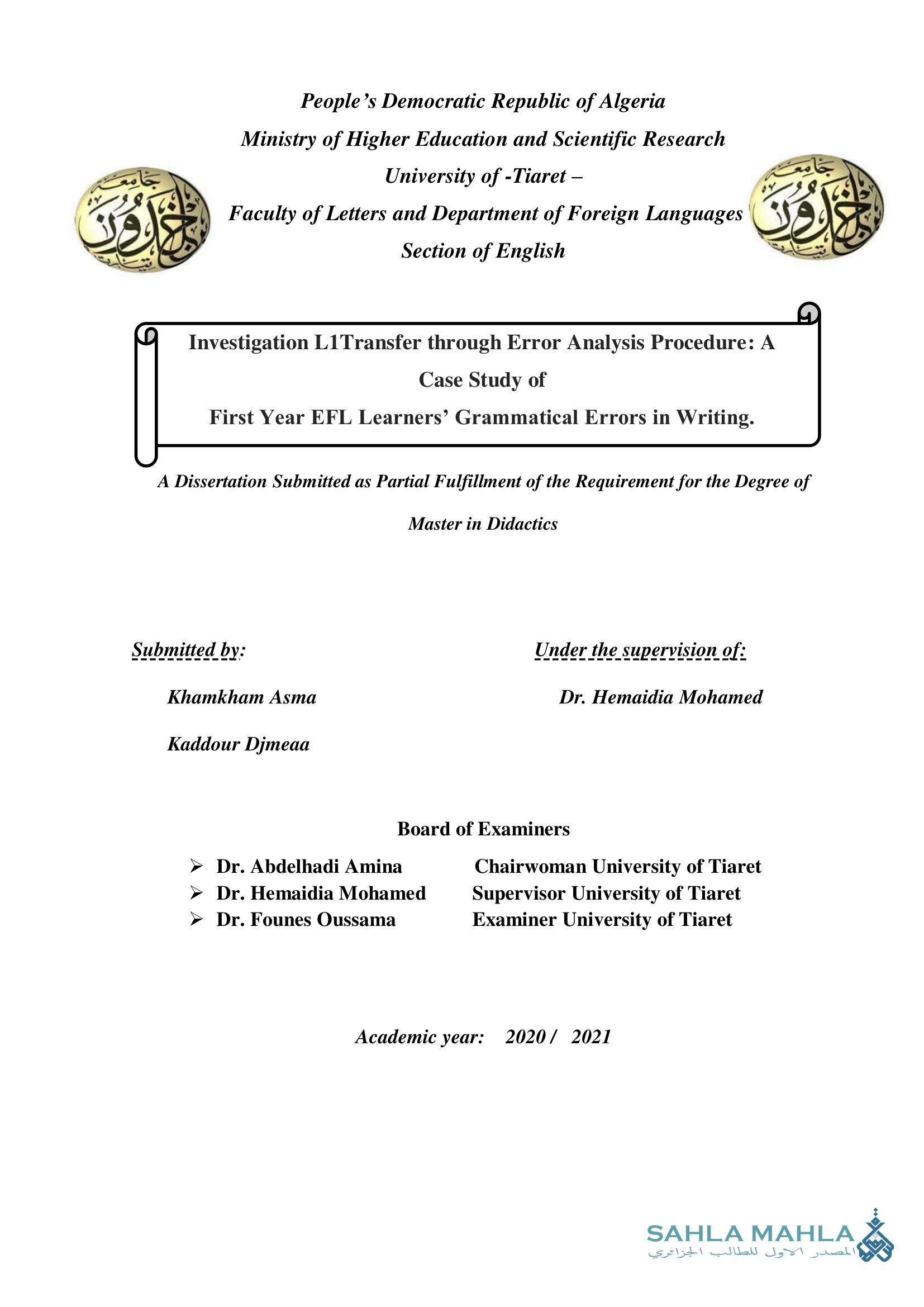
Outline:
General Introduction
Chapter One: Theoretical Approaches to Language Transfer
Introduction
I.1 Definition of Errors
I.2 Language Transfer
I.2.1 Definition of Transfer
I.2.2 Types of Transfer
I.2.2.1 Positive Transfer
I.2.2.2 Negative Transfer
I.3 Approaches to the Study of Errors
I.3.1 Contrastive Study Approach
I.3.1.1 Some Grammatical Differences Between Arabic and English
I.3.2 Error Analysis Approach
I.4 Models for Error Analysis (steps in error analysis)
I.4.1 Collection of a sample of learner language
I.4.2 Identification of Errors
I.4.3 Description of Errors
I.4.4 Explanation of Errors
I.4.5 Evaluation of Errors
I.4.6 Error Correction
I.5 Sources of Errors
I.5.1 Interlingual Errors
I.5.2 Intralingual Errors
a. Overgeneralization
b. Ignorance of Rule Restrictions
c. Incomplete Application of Rules
d. False Concepts Hypothesized
I.6 Classification of Errors
Conclusion
Chapter Two: Writing Skills
Introduction
II.1 Definition of Writing
II.2 Second Language writing
II.3 The Importance of Writing
II.4 The most approaches for teaching writing
II.4.1 The product Approach
II.4.1.1 Familiarization Stage
II.4.1.2 The Controlled Writing
II.4.1.3 Guided Writing
II.4.1.4 Free Writing
II.4.2 The Process Approach
II.4.2.1 Planning
II.4.2.2 Drafting
II.4.2.3 Editing
II.4.3 The Genre Approach
II.4.3.1 Modeling
II.4.3.2 Construction
II.4.3.3 Independent Construction
II.4.4 Creative Approach
II.4.5 Cooperative Approach
II.5 Types of Writing
II.5.1 Personal Writing
II.5.2 Study Writing
II.5.3 Public Writing
II.5.4 Creative Writing
II.5.5 Social Writing
II.5.6 Institutional Writing
II.6 Factors Behind Students’ Poor Writing
II.6.1 Lack of Adequate Techniques for Teaching Writing
II.6.2 Teacher as a Source of De-motivation (External Motivation)
II.6.3 Lack of Motivation to Write (Internal Motivation)
II.6.4 Lack of Reading
II.6.5 The Influence of the First language on Writing in English
II.7 Teachers’ Roles
II.7.1 Providing Students with Enough Information
II.7.2 Helping Students to Get Ideas
II.7.3 Knowing Students’ Needs
II.7.4 Responding and Evaluating Students’ Writing
II.7.5 Building the Writing Habit
Conclusion
Chapter Three: Data Interpretation and Analysis
Section one: Teacher’s Questionnaire (Analysis and Discussion)
Introduction
III.1 The Teachers’ Questionnaire
III.1.1 Administration of the Questionnaire
III.1.2 Description of the Questionnaire
III.1.3 Analysis of the Questionnaire
III.1.4 Discussion of the Results
Section Two: Students’ Written Test (Analysis and Discussion)
III.2 Administration of the Students’ Written Test
III.2.2 Data Collection Procedure
III.2.3 Data Analysis
III.2.4 Analysis of the Written Test
III.2.5 Discussion of the Results
Conclusion
General Conclusion
Recommendations
Limitation of the Study
List of References
Appendices
Abstract
General Introduction
Download The Thesis:
For more
academic sources and references,
including theses and dissertations from Algerian universities,
, visit our main website.