


Feminism Expansion from Womanism in Morrison’s The Bluest Eye and Beloved to Afropolitanism in Adichie’s Americanah
General Information:
Level |
PhD |
Title |
Feminism Expansion from Womanism in Morrison’s The Bluest Eye and Beloved to Afropolitanism in Adichie’s Americanah |
Specialty |
Comparative Literature |
Cover Page:
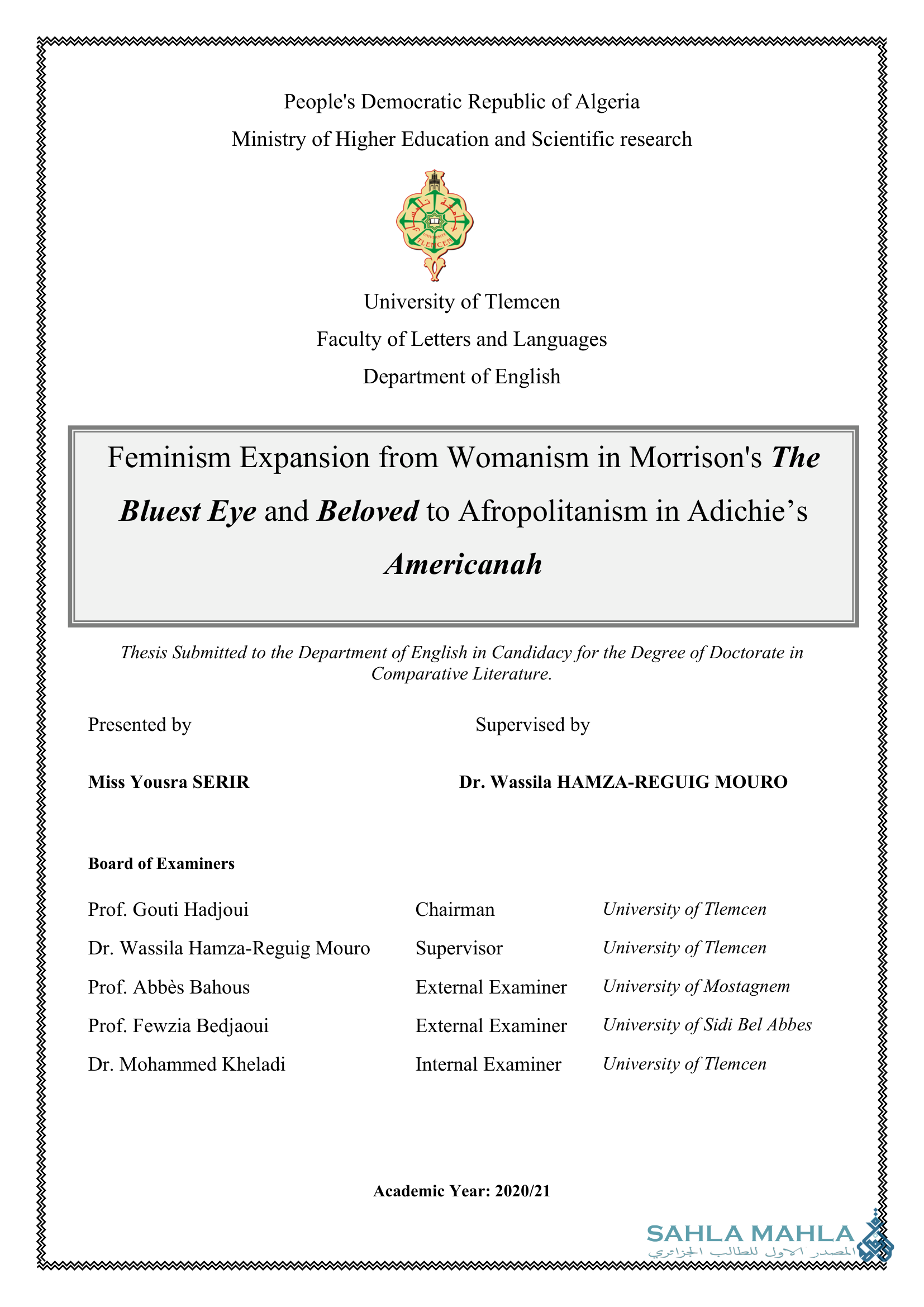
Outline:
Statement of Originality
General Introduction
Chapter One: Theoretical Framework
1.1. Introduction
1.2. African American Literature
1.2.1. African American literature evolution
1.2.1.1. The Pre Harlem Movement
1.2.1.2. Harlem Renaissance
1.2.1.3. Post Modern Era
1.2.2. Themes and Concerns
1.2.3. Slave Narratives
1.3. Women’s Writing
1.4. Feminism
1.4.1. The First Wave Feminism
1.4.1.1. First wave feminism and Wollstonecrafts
1.4.1.2. Epistemological Insights on 1st wave feminism
1.4.1.3. The suffrage Leaders’ Contribution
1.4.1.3.1. Elizabeth Cady Stanton
1.4.1.3.2. Emmeline and Christabel Pankhurst
1.4.1.4 The WSPU (Women’s Social and Political Union)
1.4.2. The Second Wave Feminism
1.4.2.1. Women’s Liberation Movement
1.4.2.2. Simone De Beauvoir
1.4.3. The Third Wave Feminism
1.5. Feminist Theories
1.6. Intersecionality in Feminist Thought
1.7. What is Womanism
1.8. Feminism or Womanism in Afro American Literature
1.9. Womanism and Black Feminism
1.10. Afropolitan Feminism
1.11. Conclusion
Chapter Two: Exploration of Cultural, Racial and Gender Segregation in The Bluest Eye and Beloved.
2.1. Introduction
2.2. Feminism is a French Origin
2.3. Rhetoric
2.4. Global View of Feminism and Womanism in the African American Criterion
2.4.1 Womanism as a Complementary Revolution to Feminism
2.5. Feminism in The Bluest Eye and Beloved
2.5.1. Dimensions of Oppression Through Pecola and Sethe
2.5.2. Feminism through the Pictorial Lenses of Pecola and Sethe
2.6. The Role of Characters as Feminine and Women
2.6.1. Femininity and Women in The Bluest Eye
2.6.1.1. Hardship in The Bluest Eye.
2.6.1.2. Racial Oppression in The Bluest Eye
2.6.2. Femininity and Women in Beloved
2.6.2.1. Slavery in Beloved
2.6.2.2. Representation of Women’s Sacrifice in Beloved
2.7. Beloved a Neo Slave Narrative
2.8. Rhetorical Representation of Slavery in Beloved
2.8.1. Colour: A History of Dehumanisation in Beloved
2.8.2. Women Slaves in Beloved
2.8.2.1. Incarcerated Black Women in Beloved
2.9. The Coloured Victims of Racial and Sexual Exploitations in Beloved and The Bluest Eye
2.10. Blackness as a Pictorial Trope of Racial Discrimination in The Bluest Eye and Beloved
2.11. Intersectional Issues in Morrison’s Beloved and The Bluest Eye
2.11.1 Unspoken Trauma of Slavery and Racism in Beloved
2.11.2 Racism and Sexism Sequels in The Bluest Eye
2.11.2.1. Upshots of Racial Discrimination on Women and Children in The Bluest Eye
2.11.2.2. Carby’s Outlook of Male Suppression in The Bluest Eye
2.11.2.3. Landscapes of Women’s Agony in The Bluest Eye
2.12. Musical Rhetoric via the Blues in The Bluest Eye
2.13. Call and Response Pattern in The Bluest Eye and Beloved
2.14. Conclusion.
Chapter Three: The Intersectionality of Gender, Race and the Quest for Identity in Morrison’s The Bluest Eye and Beloved and Adichie’s Americanah.
3.1. Introduction
3.2. Americanah, an Overview
3.3. The “Other” in the African American Society
3.3.1. The Viewpoint of the Black Women Writers Background of Blacks by Morrison and Adichie
3.4. Black in America Via Americanah
3.5. Gender Discrimination in Americanah
3.6. Racial Inequality towards Black Women in Americanah
3.7. The Quest of Self and Identity
3.8.1. Ifemelu’s Black Personality Construction
3.8.2. Stages of Ifemelu’s Maturity and Identity Development
3.8.2.1. Through Experience with Obinze
3.8.2.1.1. Learning of Being Responsible.
3.8.2.1.2. Ifemelu’s Africaness in her Surroundings.
3.8.2.2 Through White Privilege with Curt
3.8.2.2.1. Uncovered Discrimination with Curt
3.8.2.2.2. Renewal of Ifemelu’s Thoughts
3.8.2.3 Through Education with Blaine
3.8.2.3.1. Ifemelu’s Conscioussness with Blaine
3.9. Afropolitan Feminism in Americanah
3.10. The Anatomy of African American Progress Through Time
3.11. Conclusion
Chapter Four: The Continuation of the Conflict in Morrison’s and Adichie’s Politicized Accounts.
4.1. Introduction
4.2. Systematic Data about Race, Ethnicity and Wealth Discrimination in the American Society
4.3. Ecological Feminism from Morrison to Adichie
4.3.1. Women and Nature in the Bluest Eye and Beloved
4.3.1.1 In The Bluest Eye
4.3.1.2 In Beloved
4.3.2. General Examination of the Relation between Ecofeminism and the Environmental Changes
4.3.2.1. Ecological Feminism in Americanah
4.4. Trauma, Slavery and the Reconstruction of the Self in the TBE, Beloved and Americanah
4.4.1. Trauma
4.4.2. Slavery
4.4.3. The Reconstruction of the Self.
4.4.3.1. In The Bluest Eye
4.4.3.2. In Beloved
4.4.3.3. In Americanah
4.5. Feminism from Morrison to Adichie
4.6. Morrison and Adichie: Representatives of Black Identity
4.6.1. A Trail of Indictments in Morrison’s Narratives
4.6.1.1. Racial Intonations in The Bluest Eye
4.6.1.2. Revisited History in Beloved
4.6.2. The Ubiquitous Influence of Adichie
4.7. Conclusion
General Conclusion
Bibliography.
Download The Thesis:
For more
academic sources and references,
including theses and dissertations from Algerian universities,
, visit our main website.