


Designing and Implementing an ESP Course for 3rd Year Licence Students in Technology of Communication at Moulay Tahar University, Saida
General Information:
Level |
PhD |
Title |
Designing and Implementing an ESP Course for 3rd Year Licence Students in Technology of Communication at Moulay Tahar University, Saida |
Specialty |
Applied Linguistics and ESP |
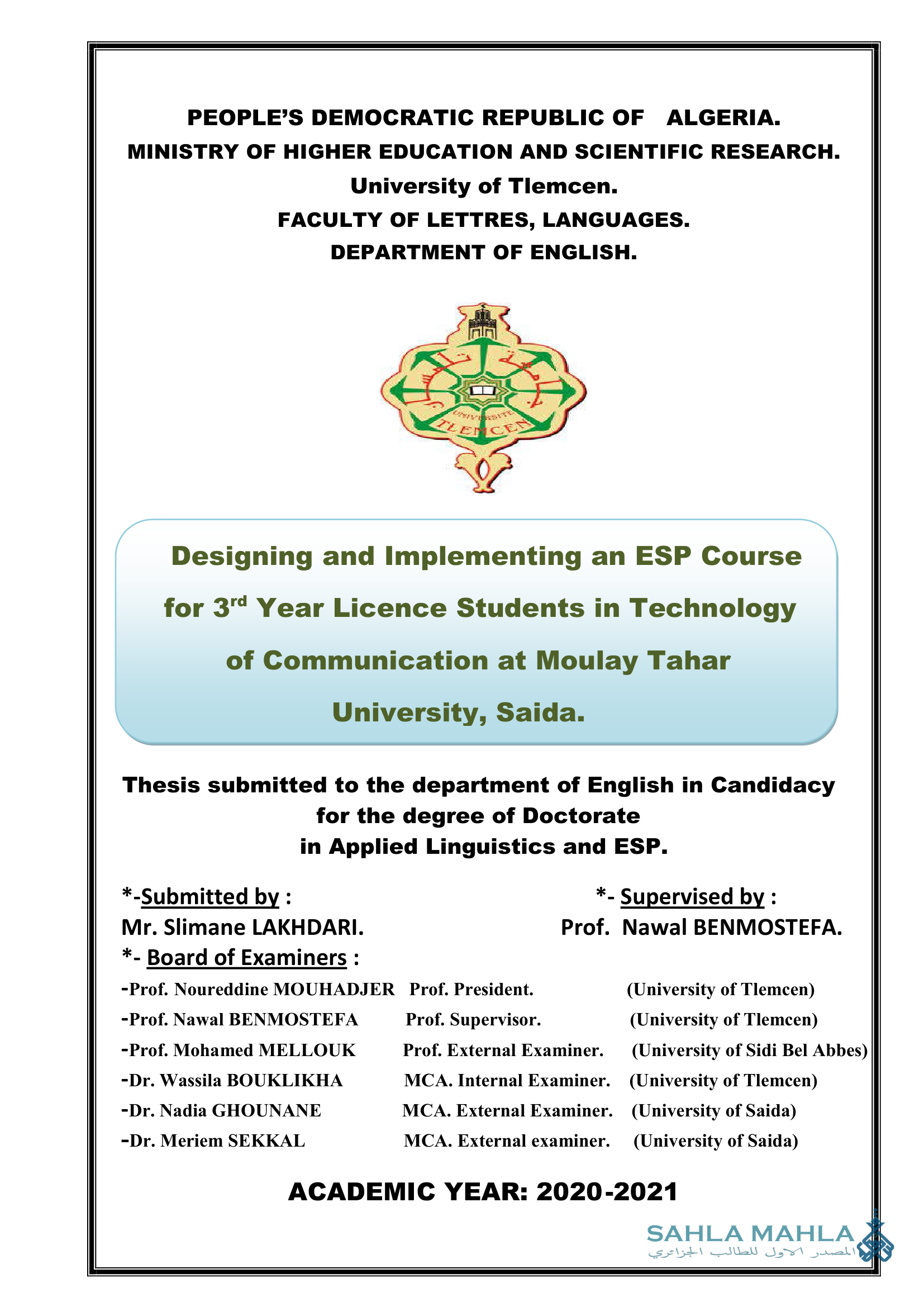
Cover Page:
Outline:
General Introduction
Chapter One Literature Review
1.1. Introduction
1.2. The History of the ESP and its Origins
1.3. The Definition of ESP
1.4. The Major Branches of ESP
1.5. The Difference between EAP and EOP
1.6. Needs Assessment
1.6.1. Target Situation Analysis (TSA)
1.6.2. Present Situation Analysis (PSA)
1.6.3. Learning Situation Analysis (LSA)
1.7. The Needs Analysis in EAP
1.8. The Necessity for Needs Assessment
1.9. Steps in Needs Assessment
1.10. The Principles of Needs Analysis
1.11. The Different Types of Needs Analysis
1.12. The Approaches to Needs Analysis
1.12.1. Philosophies of Needs Analysis
1.12.2. The Methodologies of Needs Analysis
1.12.3. The Instrument Types of Needs Analysis
1.13. Needs Analysis and Course Design
1.14. ESP Syllabus and Course Design
1.15. The Definition of «Syllabus Design» for ESP
1.16. The Difference between a «Curriculum»> and a <
1.17. Syllabus Design for ESP
1.18. Types of a Syllabus
1.19. The Needs for Syllabus Design
1.20. The Development of the ESP Material
1.21. The Major Steps in Course Design Process
1.22. Conclusion
Chapter Two: The Learning Situation and Research
2.1. Introduction
2.2. English Language Position and ESP Teaching
2.2.1. Backround of the Study
2.2.2. Aim of the study
2.2.3. Statement of the Problem
2.2.4. Research Questions and Hypotheses
2.2.5. Limitations of the Study
2.2.6. English Position in the World
2.2.7. English Language Areas of Use
2.2.8. English and ELT at the Tertiary Level in Algeria
2.2.9. The ESP Teaching Situation at Saida University
2.2.10. EST Teaching at the Sciences and Technology Faculty
2.3. Research Methodology, Participants, and Research Tools
2.3.1. The Research Conduct Process
2.3.2. Participants
2.3.3. Instruments
2.3.3.1. Classroom observation
2.3.3.2. Questionnaires
2.3.3.2.1. Preparing a sample of questionnaire
2.3.3.2.2. Piloting the sample of the questionnaire
2.3.3.2.3. Administering the questionnaire
2.3.3.3. Interview
2.3.5. Procedure
2.3.6. Data Analysis
2.4. Conclusion
Chapter Three: Data Analysis
3.1. Introduction
3.2. Data Analysis Procedure
3.3. Analysis of Classroom Observation
3.3.1. Course Content and Conduct
3.3.2.Teachers problems
3.4. Analysis of Students’ Questionnaire
3.4.1. Analysis of the Questions
3.5. Analysis of Teachers’ Questionnaire
3.5.1. Analysis of the Questions
3.6. Analysis of the Structured Interview
3.6.1. Analysis of the Questions
3.7. Conclusion
Chapter Four: A Tentative Solution Toward Designing An ESP Syllabus
4.1.Introduction
4.2. The shortcomings of the teaching/learning process
4.2.1. The negative attitudes of the institution toward the ESP Subject
4.2.2.Pedagogical considerations
4.3. Suggestions for improvements
4.3.1. The Pre-requisite of an ESP Practitioner
4.3.2. The Change in the Students’ Attitudes towards English Teaching
4.3.3. The Change in ESP Course
4.3.4. The Role of the Institution
4.3.5. The Role of the ESP Course
4.3.6. The Role of the ESP Practitioner
4.3.7. The Role of the ESP Learner
4.3.8. Conclusion
4.4.The Necessity to a New ESP Course Book Design
4.4.1.ESP Course Design
4.4.2. Approaches to Course Design
4.4.2.1. Language Centered Course Design
4.4.2.2. Skills Centered Course Design
4.4.2.3. A Learning Centered Approach
4.4.3. Preparing an ESP Course Book
4.4.4. Diagnozing the Learners’ Needs
4.4.5.Parameters of the ESP Course Design
4.4.6.The Academic Steps in Course Design Process
4.4.6.1. Needs Analysis
4.4.6.2. Conducting a Needs Analysis Procedure
4.4.6.3. Formulating Goals and Objectives of the Course
4.4.6.4. Conceptualizing the Context
4.4.6.5. Developing Materials and Activities
4.4.6.6. Organizing the Course
4.4.6.7. Designing an Assessment Plan
4.4.7. The ESP Course Content
4.4.8. The ESP Course Goals and Objectives
4.5. ESP Syllabus Design
4.5.1. Definition of Syllabus
4.5.2. The Syllabus Design Process
4.5.3. The Different Types of the Syllabi
4.5.3.1. Product Oriented Syllabus
4.5.3.2. Process Oriented Syllabus
4.5.4. Practical Guidelines to Syllabus Choice and Design
4.5.5. Implications of an ESP Syllabus
4.5.6. Subject Matters and the Integrative Teaching
4.6. Conclusion
Chapter Five: Unit Design
5.1.Introduction
5.2.The ESP Unit Design
5.3. The Theoretical Study of How to Teach The Four Skills
5.3.1. How to Teach Listening
5.3.2. How to Teach Reading
5.3.3. How to Teach Speaking
5.3.4. How to Teach Writing
5.4.The Theoretical Study of How to Teach the Sub-Skills
5.4.1.How to Teach Grammar
5.4.2.How to Teach Vocabulary
5.4.3.How to Teach Pronunciation
5.5. The Designed Unit and Its Contents
5.5.1. Developing Skills (Part One)
5.5.1.1. Listening
5.5.1.2. Reading
5.5.2. Discover the Language
5.5.2.1. Grammar
5.5.2.2. Vocabulary
5.5.2.3. Pronunciation
5.5.3. Developing Skills (Part Two)
5.5.3.1. Speaking
5.5.3.2. Writing
5.6. Relax
5.7. Assessment
5.8. Conclusion
General Conclusion
Bibliography and References
Download The Thesis:
For more
academic sources and references,
including theses and dissertations from Algerian universities,
, visit our main website.