


TEACHING LITERARY TEXTS: CASE OF FIRST-YEAR (LMD) STUDENTS AT THE UNIVERSITY OF TLEMCEN
General Information:
Level |
Magister |
Title |
TEACHING LITERARY TEXTS: CASE OF FIRST-YEAR (LMD) STUDENTS AT THE UNIVERSITY OF TLEMCEN |
Specialty |
T.E.F.L and Applied Linguistics |
Cover Page:
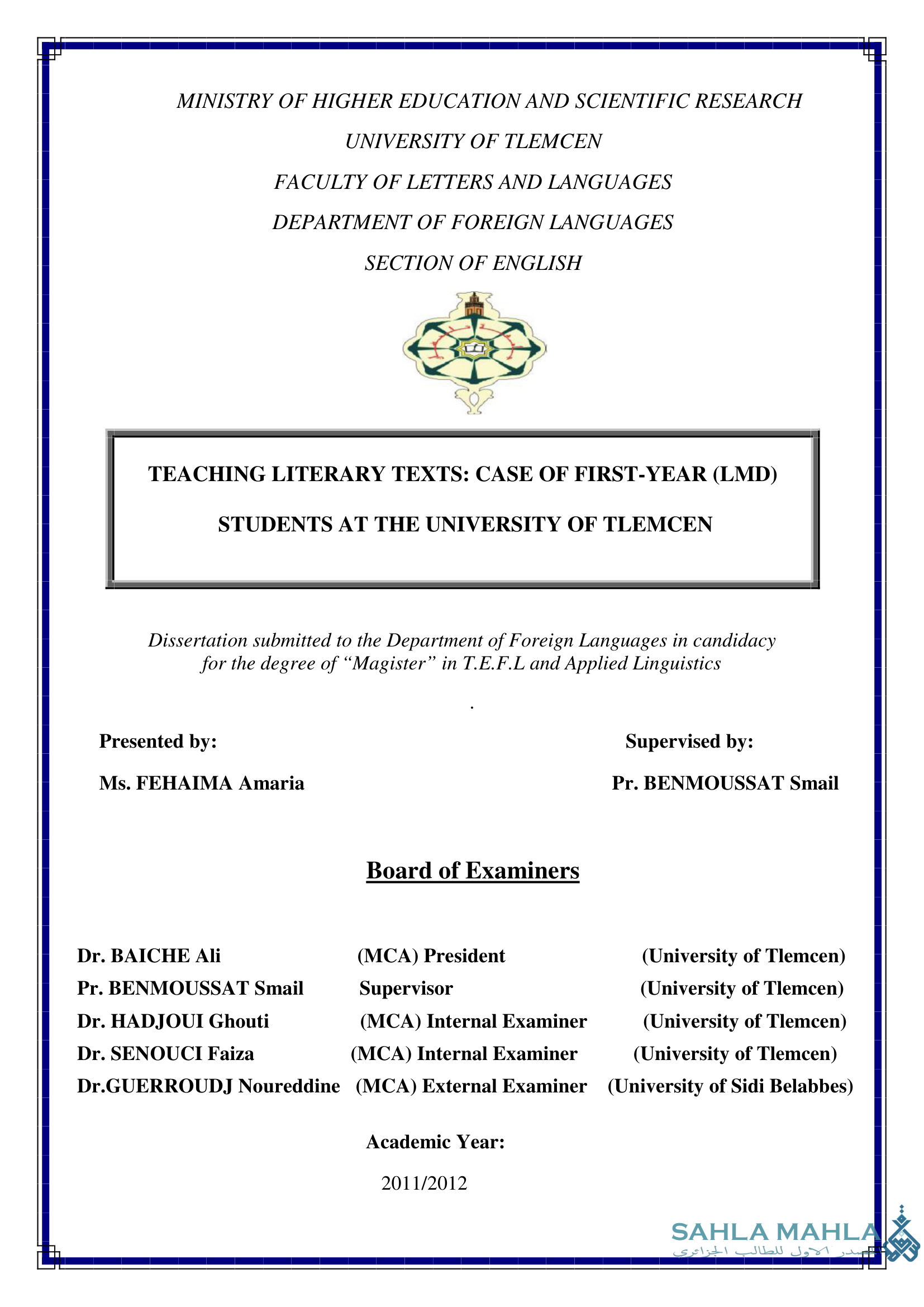
Outline:
GENERAL INTRODUCTION
CHAPTER ONE: LITERATURE REVIEW
1.1. Introduction
1.2. Literature Defined
1.2.1. Literature and Foreign Language Teaching/Learning
1.2.2. Types of Discourse
1.2.3. Literature and Teaching Objectives
1.2.4. Reasons for Using Literature
1.3. Approaches to Teaching Literature
1.3.1. Rational for Using models
1.3.2. Reasons for Using models
1.3.3. The Linguistic Description
1.3.4. Story Grammar Approach and Reader-response Approach
1.3.4.1. The Story Grammar Approach
1.3.4.2. Elements of Analysis
1.3.4.3. The Reader-Response Approach
1.3.4.4. The Developmental model of Reader-Response Approach
1.4. Literature Learning Objectives
1.4.1. Goals and Learning Objectives
1.4.2. Learning Objectives
1.5. Teaching Literature in an EFL Context: Some Underlying Issues
1.6. Conclusion
CHAPTER TWO: SITUATION ANALYSIS
2.1. Introduction
2.2. The Target Department
2.2. 1.The Status of Literature in the English Department
2.2.2. The Importance of Literature Teaching in the Department
2.2.3.Objectives of Teaching Literature in the Department
2.2.3.1. Teaching Outcomes
2.2.3.2. Some Elements as Learning Feedback Strategy
2.2.3.3. Eliciting Knowledge of Context
2.3. The Programme
2.4. Sampling
2.4.1. The Teacher’s Profile
2.4. 2.The Student’s Profile
2.5. Conclusion
CHAPTER THREE: DATA COLLECTION, ANALYSIS AND INTERPRETATION OF RESULTS
3.1. Introduction
3.2. Research Method and Procedure
3.2.1. Research Instruments
3.2.1. 1.Questionnaire
3.2.1. 2.Semi-Structured Interview
3.2.1.3. Classroom Observation
3.2. 2.Data Analysis Methodology
3.2.2.1 Qualitative And Quantitative Data Rationale
3.3. Data Analysis
3.3.1. Surdents’ Questionnaire Analysis
3.3.2. Students’ Semi-structured Interview Analysis
3.3.3. Teachers’ Semi Structured Interview Analysis
3.4. Data Interpretation
3.5. Conclusion
CHAPTER FOUR: SOME PRACTICAL SUGGESTIONS AND RECOMMENDATIONS
4.1. Introduction
4.2. Some Practical Recommendations
4.2.1. Developing Independent Reading
4.2.2. The Importance of Text Selection
4.2.3. Reading Practice
4.3. Strategy Use in Reading
4.3.1. Monitoring Reading
4.3.2. Intra/Internet Availability
4.3.3. Listening Practice
4.3.4. Listening And Lecture Comprehension
4.3.5. Lecture Planning
4.4. Curriculum And Course Design Planning
4.4.1. A Suggested Curriculum Model
4.4.2. A Proposed Course Design
4.4.3. Curriculum Aims
4.4.4. Cognitive Aims
4.4.5. Working the Cognitive Learners ‘Skills
4.5. Teacher Educational and Developmental Course
4.5.1. Course Content
4.5.2 Workshop
4.5.3. General Instruction for Students
4.6. Conclusion
General Conclusion
Bibliography
Download The Thesis:
For more
academic sources and references,
including theses and dissertations from Algerian universities,
, visit our main website.