


Teaching EFL Grammar in the Algerian Secondary School (The Case of 3AS Classes)
General Information:
Level |
Magister |
Title |
Teaching EFL Grammar in the Algerian Secondary School (The Case of 3AS Classes) |
Specialty |
TEFL and Applied Linguistics |
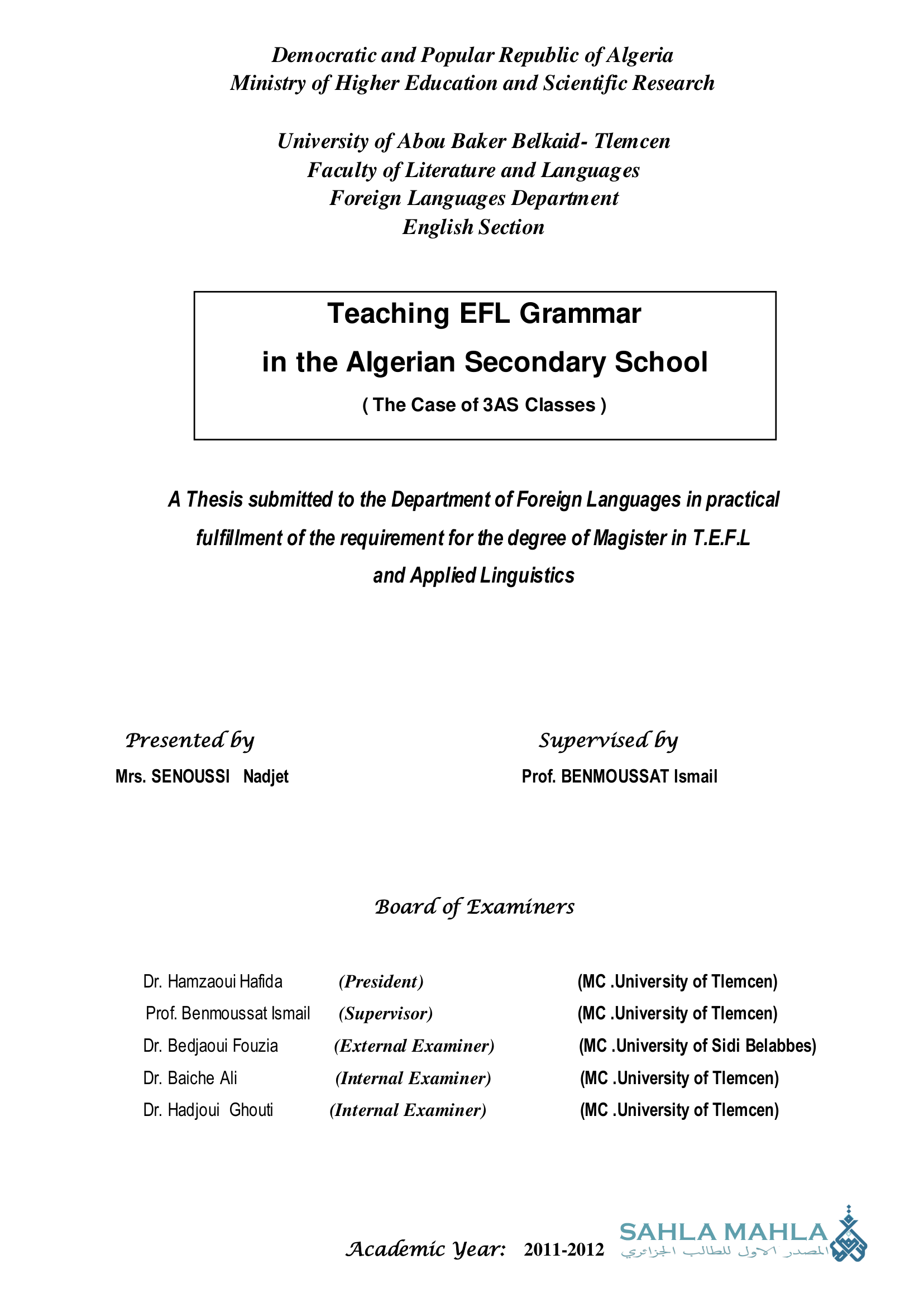
Cover Page:
Outline:
Contents
Key to Abbreviations
General Introduction
Chapter One: Review of Literature
1.1 Introduction
1.2.Defining Grammar
1.3. Attitudes to Grammar Teaching in English Language Learning
1.4. Possessing a knowledge about Grammar of a Language
1.4.1. Grammatical Knowledge
1.4.2. Grammatical Ability
1.4.3. Metalinguistic Knowledge
1.5. Pedagogical Grammar
1.6. Presenting and Explaining Grammar in the Classroom
1.6.1. Teaching and Presenting Grammar as Rules
1.6.2. Teaching and Presenting Grammar as Form
1.6.3. Teaching and Presenting Grammar as a Meaning Resource
1.7. Approaches to Teaching Grammar in the Classroom
1.7.1.Deductive Approach
1.7.2. Inductive Approach
1.8. Instructional Techniques in Teaching Grammar
1.8.1.Form-Based Techniques
1.8.2. Input -Based Techniques
1.8.3. Feedback-Based Techniques
1.8.4.Practice-based techniques
1.9. Learning Strategies
1.9.1. Definition of Learning Strategies
1.9.1.1. Grammar Learning Strategies
1.9.1.1.1. Cognitive Strategies
1.9.1.1.2. Compensation Strategies
1.9.1.1.3. Metacognitive Strategies
1.9.1.1.4. Social/Affective Strategies
1.10.Conclusion
Notes to Chapter One
Chapter Two: Description of the Teaching/Learning Situation
2.1. Introduction
2.2. English in the Curriculum
2.2.1. EFL at the Secondary School
2.2.2. The Approach: The Competency-Based Approach (CBA)
2.2.2.1. The Pedagogical Objectives of the CBA Approach
2.2.2.2. Facts about the Introduction of the CBA in the Algerian Secondary School
2.3. Description of the Teaching/ Learning Situation
2.3.1. School
2.3.2. Time Load
2.3.3. Teaching Materials
2.3.3.1. The Textbook
2.3.3.1. 1. New Prospects Design
2.3.3.1.2. Grammar in New Prospects
2.3.4. Teachers’ Profile
2.3.5. Teaching Conditions
2.3.6. Learners’ Profile
2.4. Data Collection Methods
2.4.1. Research Instruments and Research Design
2.4.1.1. The questionnaires Description
2.4.1.1.1. Learners’ Questionnaire
2.4.1.1.2. Teachers’ Questionnaire
2.4.1.2. Classroom Observation
2.5. Conclusion
Notes to Chapter Two
Chapter Three: Data Analysis and Interpretation
3.1. Introduction
3.2. Analysis of the Questionnaires
3.2.1. Learners’ Questionnaire
3.2.1.1. Interpretation of Results
3.2.2. Teachers’ Questionnaire
3.2.2.1. Interpretation of Results
3.3. Classroom Observation: Analysis of the Results
3.3.1. Learners’ Attitudes Visa-a Vis the Learning Situation
3.3.1.1. Learners’ Lack of Motivation
3.3.1.2. The Learners’ Previous Negative Learning Experience
3.3.1.3. The English Language Low Coefficient
3.3.1.4. The Good Learners’ Dominance of the Classroom Activities
3.3.2. The Teacher’s Methodology and used Materials
3.3.2.1. The Teacher’s Domination of the Classroom Talk
3.3.3. The Teaching Challenges Facing the Teacher
3.3.3.1. The size of the class
3.3.3.2. The Difficulty of Applying the CBA Approach
3.3.4. Interpretation of Results
3.4. Conclusion
Chapter Four: Perspectives on Grammar Teaching / Learning Development
4.1. Introduction
4.2. Pedagogical Implications
4.2.1. Implications for Teaching and Teacher Training
4.2.2. Teacher’s Development
4.2.3. Teaching Methodology
4.2.3.1. The Need for a Communicative Grammar Teaching
4.2.3.2. The Need for Adapting an Eclectic Approach
4.2.4. The Role of the Teacher
4.2.4.1. Creating an Effective Grammar Learning Atmosphere in the Classroom
4.2.4.2. Increasing Learners’ Motivation
4.2.4.3.Teacher’s Awareness about his Learners’ Differences in Learning Style and Abilities
4.2.4.4. Developing Language Awareness in Learners
4.2.4.5. Using Strategies for Enhancing Learners’ Grammar Learning
4.2.4.6. Selecting the Appropriate Out put Practice Grammar Activities for Learners
4.2.5. The Learner
4.2.5.1. The Need for Reflective Learning
4.2.5.2. Grammar Learning Strategies
4.2.5.3. Collaborative Learning
4.2.5.4. Learner-Centred Grammar Instruction
4.2.6. Applying New Trends for Teaching Grammar in the Classroom
4.2.6.1. Teaching Informal Pedagogical Grammar
4.2.6.2. Teaching Grammar in Context
4.2.6.3. Grammar Consciousness- Raising
4.2.6.4. Problem Solving Procedure
4.2.6.5. The Grammaring Process
4.2.6.6. Ellis Approach to Grammar Teaching
4.2.7. The Need for Criteria for the Selection of Communicative Tasks
4.3. Conclusion
Notes to Chapter Four
General Conclusion
Bibliography
Download The Thesis:
For more
academic sources and references,
including theses and dissertations from Algerian universities,
, visit our main website.