


Investigating Gender-related Use of Language in Maghnia Speech Community
General Information:
Level |
Magister |
Title |
Investigating Gender-related Use of Language in Maghnia Speech Community |
Specialty |
Language Contact and Sociolinguistic Variation |
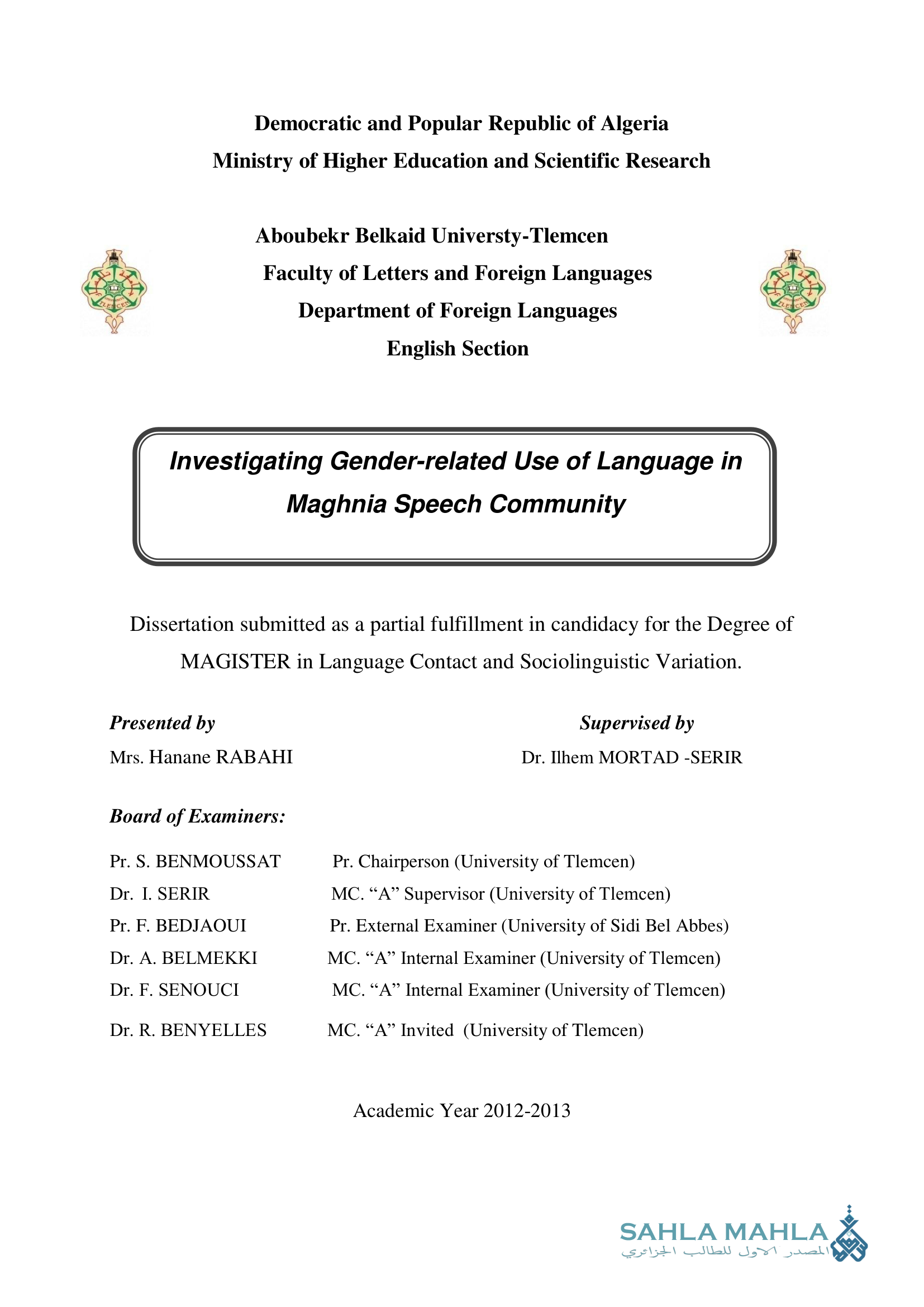
Cover Page:
Outline:
French Transcription
Contents
General Introduction
Chapter One: A Theoretical Background about Language and Gender
1.1- Introduction
1.2- Language and Speech Community
1.3- Sex and Gender
1.4- A Brief Review of Gender and Language
1.5- Approaches to Gender Studies
1.5.1- The deficit theory
1.5.2- The Dominance Theory
1.5.3- The Difference Theory
1.5.4- The Reformist Theory
1.5.5- The Cultural Model
1.5.6- The Social Constructivist Theory
1.5.7- The Community of Practice Framework
1.6- Gender Differences at Linguistic Levels
1.6.1- Gender Differences in Spoken Language
1.6.2- Gender Differences in Written Language
1.7- Gender Variation in Language
1.8- Gender and Language Change
1.9- Gender and Identity
1.10- Gender and Politeness
1.11- The Myths and Stereotypes about Language and Gender
1.12- Women’s and Men’s Language Attitudes
1.13- Conclusion
Chapter Two: An Attitudinal Account of Gender Differences in Language Use in Algerian context
2.1- Introduction
2.2- The Socio-Cultural and Linguistic Contexts of Algeria
2.3- Maghnia History and Language
2.4- Gender Group in Algeria
2.5- Factors Affecting Gender Differences
2.6- Gender and Linguistic Variation in Algerian Arabic
2.7- Studies on Language and Gender in the Arab Societies
2.8- Algerian Women and Discourse Strategies
2.9- Oral Literature and Algerian Females
2.10- Gender and Language Choice in Algeria
2.11- Stereotypes Related to Gender’s Language Use
2.12- Terms of Address and Gender in Algeria
2.13- Sexism Language and Algerian Culture
2.14- Naming Differences in Algerian Arabic
2.15- Attitudinal Approach and Gender in the Algerian Context
2.16- Conclusion
Chapter Three: Research Methodology and Data Interpretation
3.1 Introduction
3.2- Defining Research
3.3- Ethical Consideration in Research
3.4- Data Collection Methods
3.4.1- Quantitative Data
3.4.2- Qualitative Data
3.4.3- The Questionnaire
3.4.4- The Interview
3.4.5- Participant Observation
3.5- Population and Sampling
3.6- Data Analysis, Interpretation and Presentation
3.6.1- Questionnaire Analysis
3.6.2- Interview Analysis
3.7- Conclusion
General Conclusion
Bibliography
Download The Thesis:
For more
academic sources and references,
including theses and dissertations from Algerian universities,
, visit our main website.