


The Use of ICTs to Enhance EFL Learners’ Oral Language Proficiency: The Case of First-Year LMD Students at Tlemcen University
General Information:
Level |
Master |
Title |
The Use of ICTs to Enhance EFL Learners’ Oral Language Proficiency: The Case of First-Year LMD Students at Tlemcen University |
Specialty |
Language Science |
Cover Page:
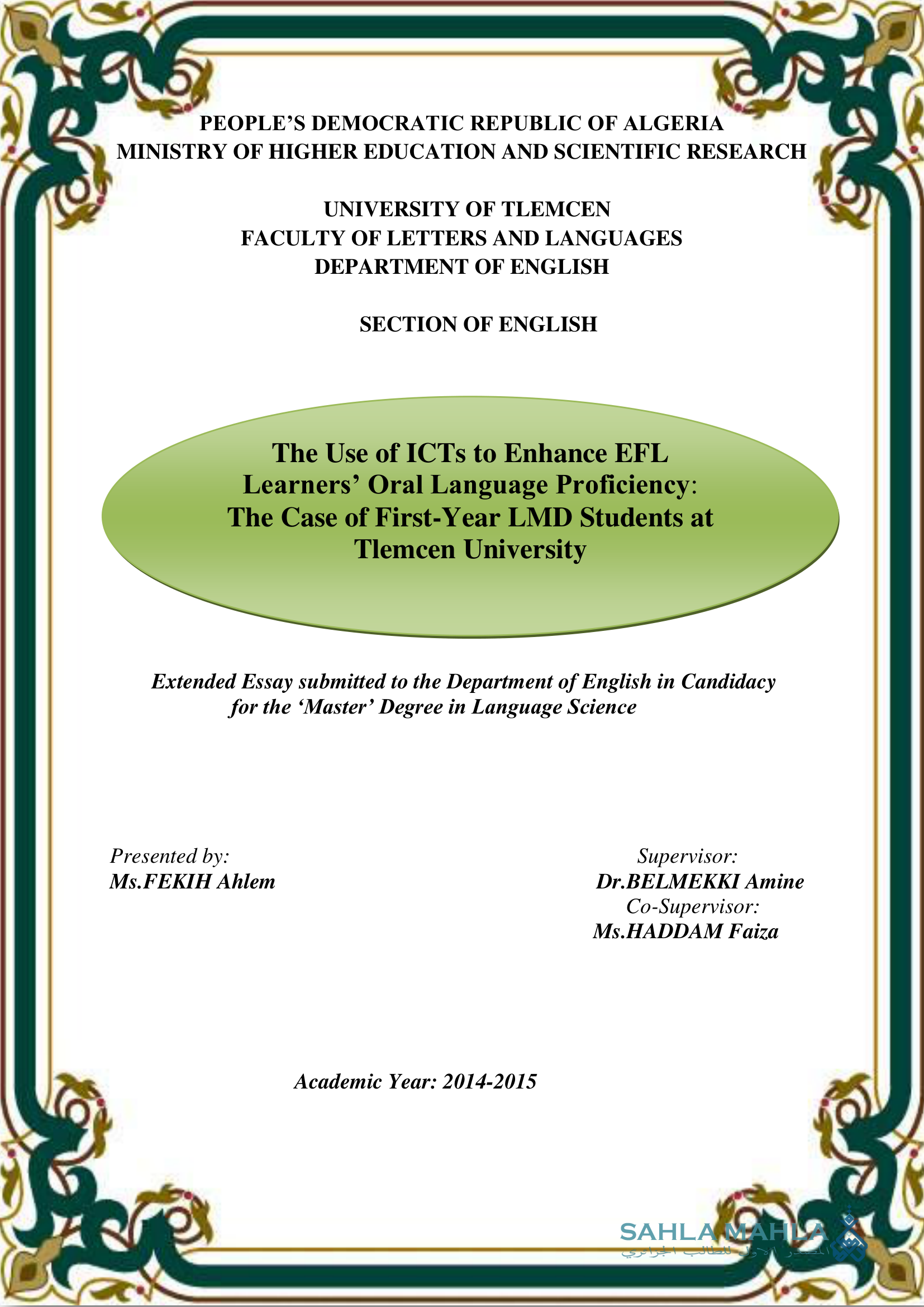
Outline:
Acknowledgment
General introduction
Chapter One: The Use of ICT in Oral Production Courses
1.1 Introduction
1.2 What is ICT?
1.2.1 Components of ICT.
1.2.1.1 Software
1.2.1.2 Hardware
1.2.2 The Evolution of Technology Use in Foreign Language Learning
1.3 ICT: New Tool for Education
1.3.1 Media and Technology.
1.3.2 Computers and Teaching
1.3.3The Use of ICT in Education.
1.4. What is Speaking Skill?
1.4.1 Types of Speaking Skill.
1.4.1.1 Imitative Speaking.
1.4.1.2 Intensive Speaking.
1.4.1.3 Responsive Speaking.
1.4.1.4 Interactive Speaking.
1.4.1.5 Extensive Speaking.
1.4.2The Significance of Speaking Skill.
1.5 Oral Production in EFL Classes
1.5.1 Oral Production Teaching Methods.
1.5.2ICT and the Teaching of Oral Production.
1.5.3Using ICT Techniques in the Classroom.
1. 5.4Evaluating the EFL Learners’ Performance.
1.6Conclusion
Chapter Two: Data Analysis and Interpretation
2.1 Introduction.
2.2 School in Algeria.
2.3 Algerian Education and ICT.
2.4 Research Methodolgy.
2.5 Data Collection.
2.5.1 Setting.
2.5.2 Participants’ Profile.
2.6 Research Instruments.
2.6.1 Teachers’ Interview.
2.6.2 Students’ Questionnaire.
2.7 Data Analysis and Interpretation.
2.7.1 Analysis of Teachers’ Interview.
2.7.2 Analysis of Students’ Questionnaire.
2.8 Discussion and Interpretation of the Main Results.
2.9 Conclusion.
Chapter Three: Suggestions and Recommendations
3.1 Introduction.
3.2 The Main Recommendations.
3.3 The Advantages of ICT Usage in Classrooms.
3.4 Designing a Speaking Lab-Based Course: Technology Integration.
3.4.1 Language Laboratory.
3.4.2 Mobile-Learning.
3.4.3 Using Interactive Whiteboard in EFL Speaking Classrooms.
3.4.4 Using Power Point Effectively in a Classroom Presentation.
3.5 Video Conferencing as a Source of Details and Facts.
3.5.1 Video Conferencing Performance.
3.5.2 Teachers and Learners as a Part of Video Conference.
3.6 Conclusion.
General Conclusion.
Bibliography
Download The Thesis:
For more
academic sources and references,
including theses and dissertations from Algerian universities,
, visit our main website.