


The Embodiment of Edgar Allan Poe’s Psychological State in “The Fall of The House of Usher” 1839
General Information:
Level |
Master |
Title |
The Embodiment of Edgar Allan Poe’s Psychological State in “The Fall of The House of Usher” 1839 |
Specialty |
Literature and Civilisation |
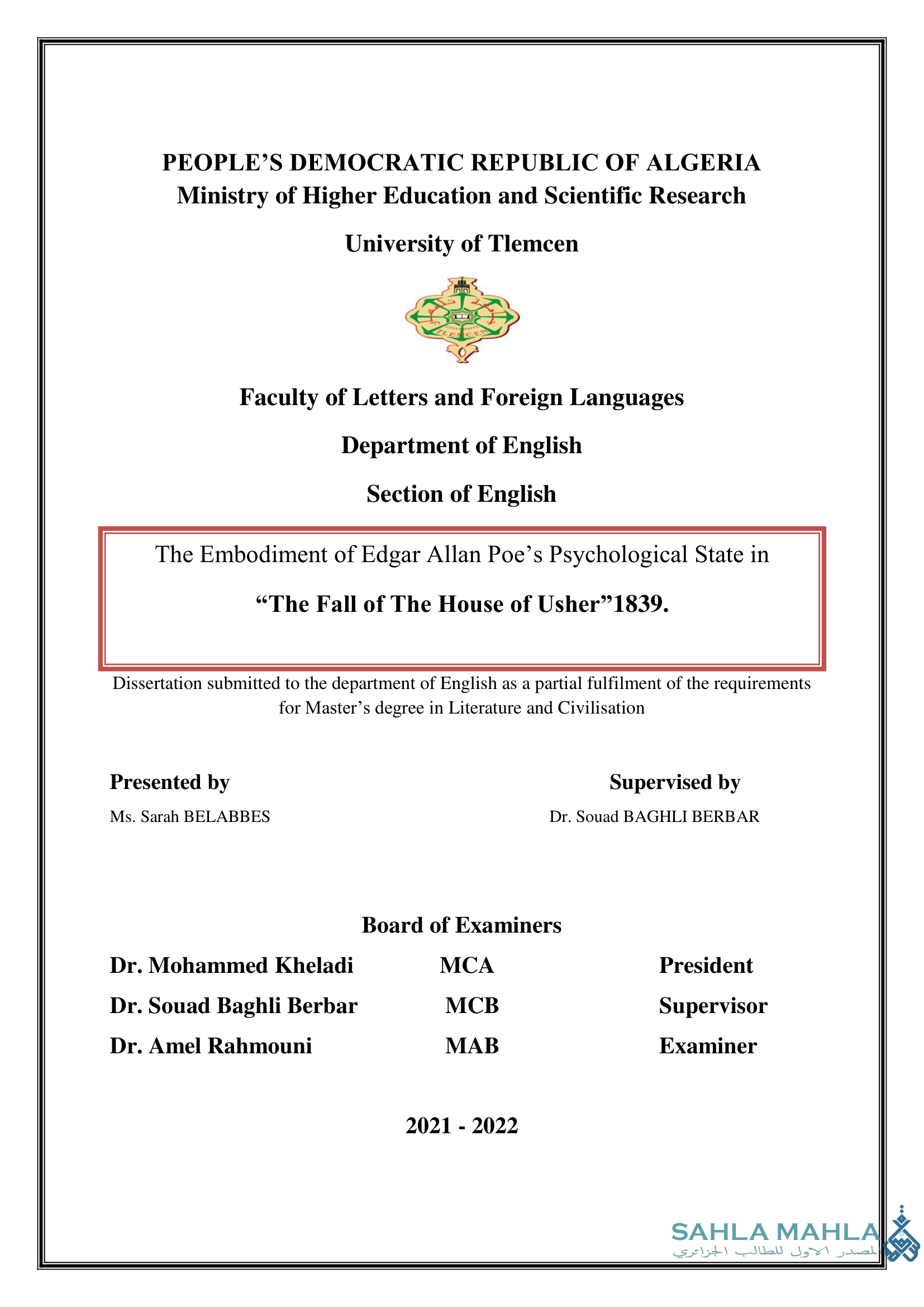
Cover Page:
Outline:
General Introduction
Chapter One: American Romanticism
1.1 Introduction
1.2 America in the Nineteenth Century
1.2.1 American society
1.3 Romanticism
1.3.1 Romanticism in Literature
1.3.2 American Romanticism
1.3.3 Characteristics of American Romanticism
1.3.3.1 Individuality
1.3.3.2 Nature
1.3.3.3 Imagination
1.3.3.4 Feelings and Intuition
1.4. American Gothic Literature
1.4.1 The Gothic Elements
1.4.1.1 An Atmosphere of Mystery and Suspense
1.4.1.2 Setting in the Castle
1.4.1.3 Supernatural or inexplicable events
1.4.1.4 Omens and Curses
1.4.1.5 Women in Distress
1.4.1.6 The Metonymy of Gloom and Horror
1.4.1.7 The Vocabulary of the Gothic
1.4.2 The Gothic Short Story
1.5 Psychoanalytic Literary Criticism
1.6 Conclusion
Chapter Two: Psycholoanalytic Literary Criticism of “The Fall of The House of Usher”
2.1. Introduction
2.2 Edgar Allan Poe
2.3 The Fall of The House of Usher
2.3.1 Summary
2.3.2 Figurative language
2.3.2.1 Personification
2.3.2.2 Metaphor
2.3.2.3 Simile
2.3.2.4 Hyperbole
2.3.2.5 Onomatopoeia
2.3.2.6 Doubling
2.4 Poe’s psychological illnesses
2.5 Psychoanalutic literary Criticism of the Fall of the House of Usher
2.6 Conclusion
General Conclusion
Bibliography Summary
Download The Thesis:
For more
academic sources and references,
including theses and dissertations from Algerian universities,
, visit our main website.