


Peer Observation as an Exploratory Task: A Model of Reflective Teaching for University Teachers
General Information:
Level |
PhD |
Title |
Peer Observation as an Exploratory Task: A Model of Reflective Teaching for University Teachers |
Specialty |
Applied Linguistics and TEFL |
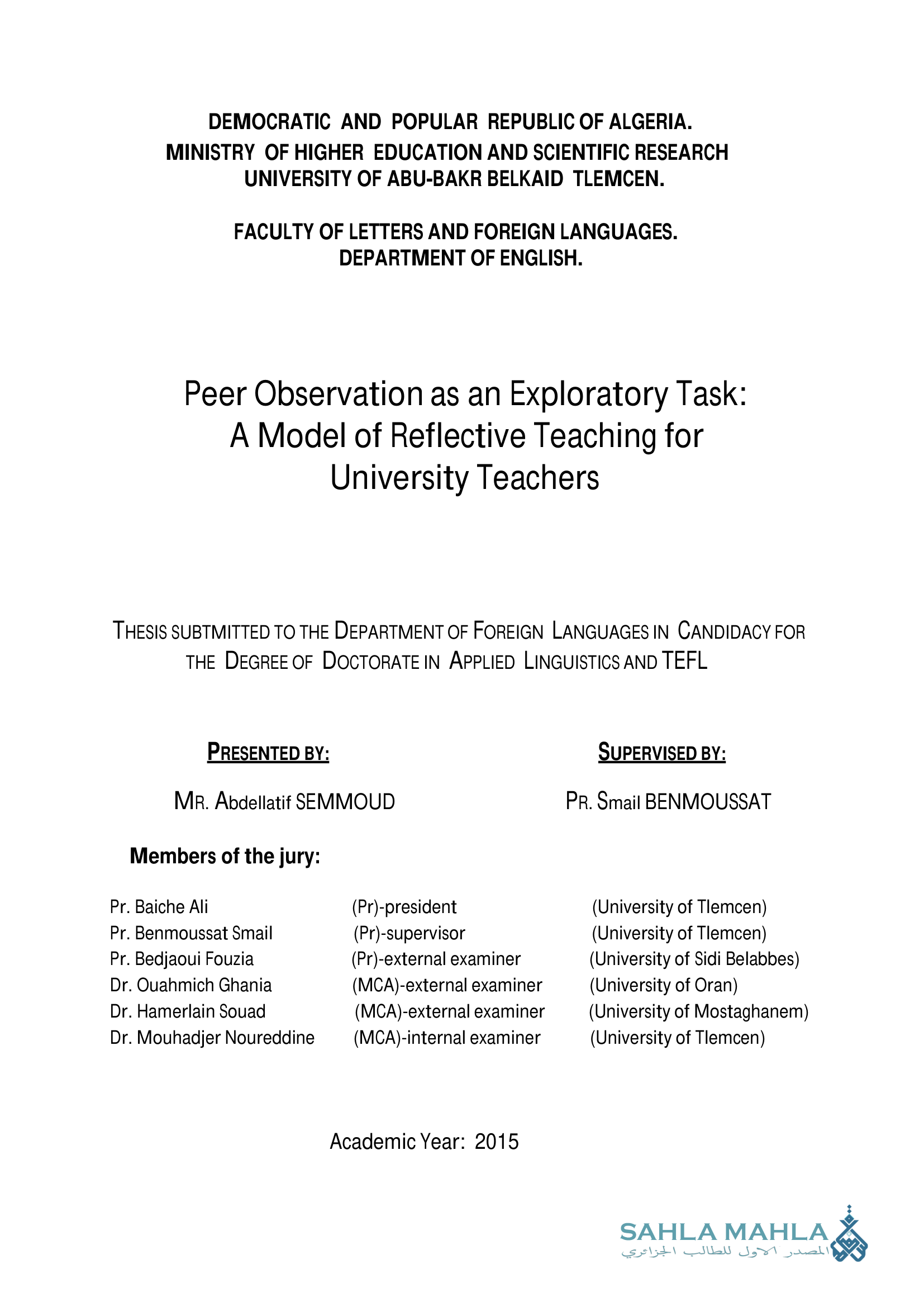
Cover Page:
Outline:
Chapter One: Theory of Teacher’s Pedagogical Preparation Sustainability
1.1. Introduction
1.2. Defining teaching
1.2.1Characteristics of Good Teaching
1.3. Defining learning
1.3.1. The Current Learning Process
1.3.2. Lecture
1.3.3. Active Learning
1.4. Teaching styles
1.4.1. Teacher-centred class
1.4.2. Learner Centeredness Perspective
1.4.3. Kinds of Learner Teachers
1.4.3.1. The Explainer
1.4.3.2. The Involver
1.4.3.3. The Enabler
1.5. The Need for Change
1.5.1. Teacher Education Development
1.5.2Development for Prospective and Experienced Teachers
1.5.3 Teacher Development Defined
1.5.4Background Factors Leading to TED
1.5.5. Core Characteristics of Teacher Development
1.5.6. Assumptions about Teacher Development
1.6.The Developing Teacher
1.6.1 Development as the process of growth
1.6.2Development as making the basic advanced
1.6.3.Development as a result of recent events
1.6.4.Models of Language Teacher Education
1.7.Teacher Inquiry
1.7.1 Characteristics of Teacher Inquiry
1.7.2.Engagement and Devotion
1.7.3.Reflection and Repetition
1.7.4.Investigation and Adaptation
1.7.5.Inquiry versus Reflection
1.7.6.Teachers as Researchers
1.8.Reflection as a key Component to Professional Development
1.8.1.Necessary Attitudes for Reflection
1.8.1.1.The Open-Minded Teacher
1.8.1.2.The Responsible
1.8.1.3.The Whole- Hearted
1.8.2.Reflection-in-action
1.8.3.Reflection on action
1.9.Investigative Procedures in Classroom Practice
1.9.1.Keeping a Diary
1.9.2.Lesson Report
1.9.3.Teacher’s Portfolios
1.9.4.Peer Observation
1.10.Models of Peer Observation
1.10.1.The Peer Review Model
1.10.2.Practical Advocacies of Peer Review
1.11.Conclusion
Chapter Two: Situation Analysis and Accountability
2.1.Introduction
2.2.ELT Situation in Algeria
2.2.1. Department of English at Tlemcen University
2.3. ELT and English Language Status
2.3.1. Reconsideration of English
2.4. Innovation Perspectives
2.4.1. Novelty of Pedagogy in Higher Education
2.4.2. Innovation: A Fundamental Questions
2.4.2.1.Competitiveness
2.4.2.2. The ELT Professionals and Practitioners
2.4.2.3. The Quality Dimension
2.4.2.3.1. Teaching Quality Criteria
2.5. The Teaching Situation
2.5.1. LMD Implementation in the Algerian University
2.5.2. The LMD in the English Department
2.5.3.The Current Ranking of the Algerian University
2.6. Investing Where Investment is most Efficient
2.6.1. Mastery of language among Algerian Teachers
2.7. Pedagogy vs. English Language Proficiency
2.8.Principles of Effective Professional Development
2.8.1.The Conceptions and Beliefs of University Teachers
2.8.2.The current State of Professional Development
2.8.3.Teachers as Inquirers in the University
2.9.Teacher Training Vs. Teacher Development
2.9.1.Models of Language Teacher Education
2.9.2.Teacher Training and Teacher Development Complementary
2.9.3.Types of In-Service Training Programme
2.9.3.1.Initial In-Service Training
2.9.3.2.In-Service Training for Refresher Purposes
2.9.3.3.In-Service Training for Curriculum Reorientation
2.9.4.Pre-Service Training: the University
2.10.Continuous Professional Development
2.10.1.Main Perspectives of CPD
2.10.2.Seminars/ Study days
2.11.Teacher’s Academic Ranks
2.12.Observation the Ultimate Concept of Development in the University
2.12.1.Conferences and Seminars on Teacher Education
2.13.Conclusion
Chapter three: Peer Review under Investigation
3.1.Introduction
3.2. Multiple Approach Analysis
3.2.1.Teachers’ Questionnaire
3.3.Aim of the Research
3.4. Analysis of the Questionnaire
3.5.Teachers Bio-data and Qualifications
3.5.1.Training as a Pre-requisite Item for Teaching
3.5.2.Teachers’ Knowledge about Professional Development
3.5.3.Teaching is Growing Cynical and Inertial
3.5.5.Epistemological Beliefs of Teachers on Teaching
3.5.6.Some Teachers Do their Job Better than Others
3.5.7.Inquiries about other teachers’ ways of dispensing lectures
3.5.8.Teachers’ Participation in Professional Development Programmes
3.5.9.Change in the Teaching Practices
3.5.10. Teachers’ Educational and Institutional Inquiry
3.5.11.Collaborative Teaching in the University
3.5.12. University’s Impact on the Command of English
3.5.13. Improvement from Experience
3.5.14. Collaborative Reflection
3.5.15. Keeping Journal
3.5.15.1. Nature of the Journal
3.5.16. Lesson Report
3.5.17.Peer Observation as a Blueprint
3.5.18. The Debriefing Meeting
3.5.19. Holistic Evaluation of the Peer’s Performance
3.5.20. Frequency of PO Arrangement
3.5.21. Constraints Hindering Development
3.5.22. Language of Lectures Dispensing
3.5.23. Application of Training Strategies
3.6.Classroom Practices under Research
3.6.2.The Classroom Observation
3.7.Students’ Interview
3.7.1.Analysis of the Interview
3.8.Results and Interpretive Investigation
3.9. Teachers’ Suggestion
3.10. Results Interpretation
3.11. The Interview with the Dean
3.11.1.Results Interpretation
3.12.Conclusion
Chapter Four: Suggestions and Recommendations
A Model of Reflective Teaching
4.1.Introduction
4.2.Teacher Change in Professional Development
4.2.1.Peer Observation’ as a Reflective Teaching Model
4.2.2.Identification of an Observation’s Focus
4.2.3.Principles of peer observation
4.3.Peer Review: The Model
4.3.1.Overview of Models
4.3.2.Observation: Advantages
4.3.3.Stages of feedback
4.3.3.1.Feedback language
4.3.3.2.Handling Effective Feedback
4.4. Who is responsible for teacher development?
4.4.1.The Process of Teacher Development
4.4.2.Models of Teacher development
4.4.2.1.The Deficit Model
4.4.2.2.The Science Model
4.4.2.3.The theory philosophy model
4.4.2.4.The art-craft Model
4.4.2.5.Reflective Teaching
4.4.2.6.Teacher Learning as Personal Construction
4.4.2.7.Using Role Models
4.5.Factors Hindering Teacher Development
4.5.1.Attitudes
4.5.2.Colleagues
4.5.3.Stress and anxiety
4.5.4.The Institution
4.6.The Five Circles of Development
4.6.1.Covey’s Model for Development
4.6.2.Steps to Development
4.7.2.Teacher’s Professional Knowledge
4.7.2.1.The Professional Teacher
4.7.3.Qualities of an effective teacher
4.7.3.1 An effective teacher is devoted to his profession
4.7.3.2.An effective teacher is proactive, not only reactive
4.7.3.3.An effective teacher seeks perfection
4.7.3.4.An effective is an excellent communicator
4.7.3.5.Knowledge and methodology
4.7.3.6.Catering for students’ learning styles
4.7.3.7.Generating interest/motivator
4.7.3.8.Encouraging autonomy
4.7.3.9.Strategies for better classroom management
4.7.3.10.Firmness
4.7.3.11.Consistency and Fairness
4.7.3.12.Learning from Other Teachers
4.8.Conclusion
GeneralIntroduction
Download The Thesis:
For more
academic sources and references,
including theses and dissertations from Algerian universities,
, visit our main website.