


Analyzing the Discourse of Negotiating Meaning Through Cross-linguistic and Cross Cultural Interferences. Case of International Language Institute RIHI (Tiaret-Algeria)
General Information:
Level |
Master |
Title |
Analyzing the Discourse of Negotiating Meaning Through Cross-linguistic and Cross Cultural Interferences. Case of International Language Institute RIHI (Tiaret-Algeria) |
Specialty |
TEFL Didactics |
Cover Page:
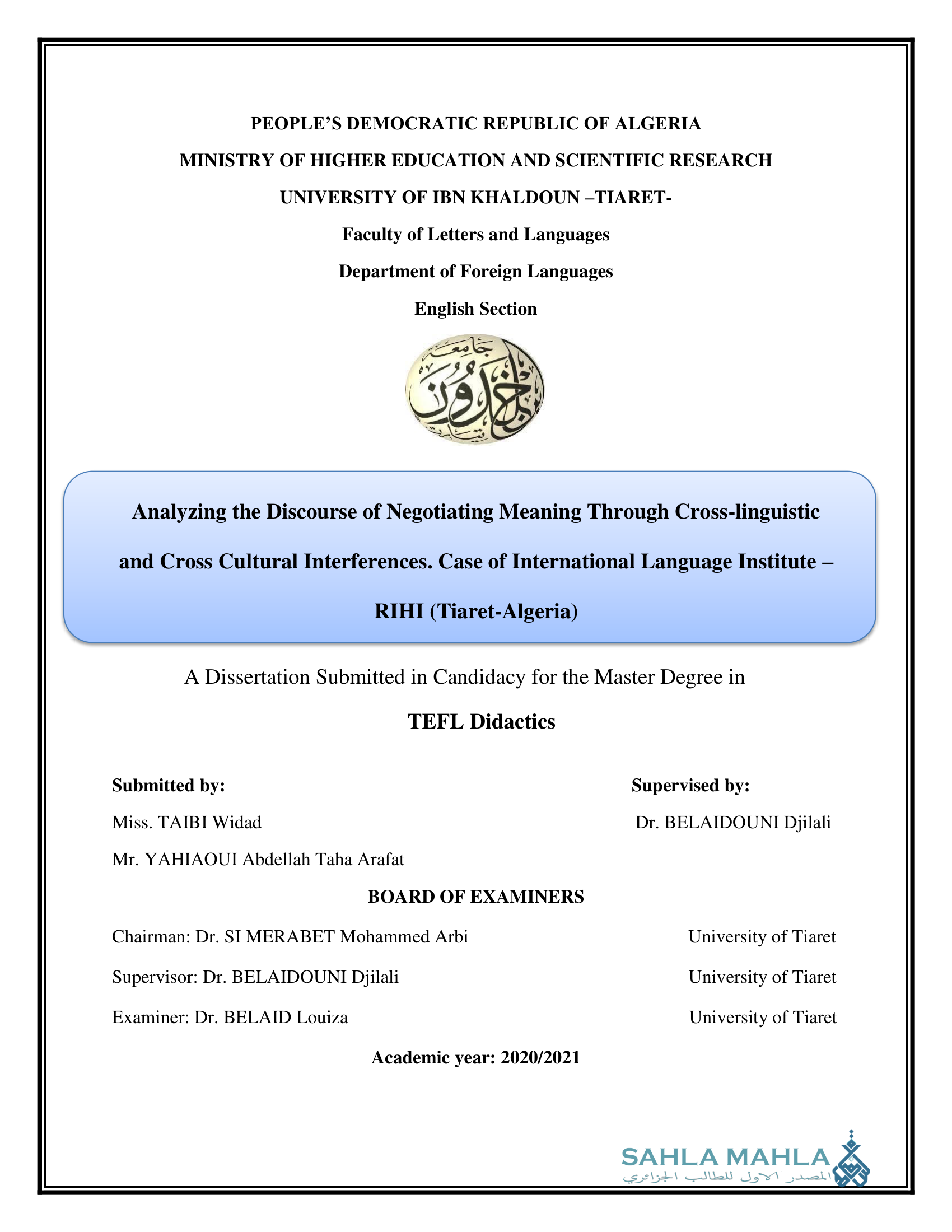
Outline:
11. General Introduction
CHAPTER ONE LITERATURE REVIEW
1. Introduction
1.1 Classroom Discourse Analysis
1.1.1 Discourse
1.1.2 Discourse analysis
1.1.3 Classroom Discourse Analysis
1.2 The Effect of the Cultural Background on Foreign Language Learning
1.3 Learners Interpretation of Cultural Concepts
1.4 Negotiation of Meaning
1.4.1 Concept Awareness in Negotiating Meaning
1.4.2 Competences Development in Negotiating Meaning
1.4.3 Perception Integration in Negotiating Meaning
1.4.4 Negotiating Meaning Effect on the Receptive Skills
1.4.5 Negotiating Meaning Effect on the Productive Skills
1.5 Adult Learners
1.5.1 The Notion of Adult Learners
1.5.2 Concept Transfer in Adult Negotiation of Meaning
1.5.3 Adult learners’ Ability in Decoding and Encoding Verbal Responses Induced by Negotiation of Meaning
1.6 Languages Similarities
1.6.1 Sister Languages
1.6.2 The Cross-linguistic Similarity Between L1 and the Target Language
1.6.3 Mutually Intelligible Target Languages
1.6.4 Awareness About the Systems in the Target Language
1.6.5 Learning a Distant Language
1.7 Linguistic Transfers
1.7.1 Types of Cross-linguistic Transfers
1.7.2 Levels of Cross-linguistic Transfer
1.7.3 Linguistic Interdependence Hypothesis
CHAPTER TWO RESEARCH CONTEXTUALIZATION
2. Introduction
2.1 The Location
2.2 Aim of the Research
2.3 Research Methods
2.3.1 Research Methods a Description of the Data Collection Methods
2.4 Sampling
2.5 Data Analysis Techniques
CHAPTER THREE DATA COLLECTION, LAYOUT AND INTERPRETATION
3. Introduction
3.1 Analysis of the Observations
3.1.1 Observation of Negotiations Using Arabic (L): Frequency and Rate Analysis
3.1.2 Observation of Negotiations using H Arabic: Frequency and Rate Analysis
3.1.3 Observation of Negotiations Using French: Frequency and Rate Analysis
3.1.4 Observation of Negotiations using English: Frequency and Rate Analysis
3.1.5 Observation of Negotiations of Meaning: Frequency and Rate Analysis Comparison
3.1.6 A representation to the Frequency of Negotiations across Sessions
3.2 Analysis of the Interview
3.2.1 Item 01: How do you assess your proficiency level in basic English?
3.2.2 Item 02: Other than Arabic what languages do you speak?
3.2.3 Item 03: What languages or varieties you prefer to use in negotiating new concepts?
3.2.4 Item 04: Does the language you prefer act as a facilitating agent in learning?
3.2.5 Item 05: Can we inquire about the reasons that lead you to use the language you feel most comfortable with?
3.2.6 Item 06: Is it possible for you to use English when negotiating meaning?
3.2.7 Item 07: Are you open to Western culture (theater, music, history, and cinema)? Please clarify.
3.2.8 Item 08: Do you find easy in associate the concept back to your mother tongue?
3.2.9 Item 09: Is it easy for you to retain the newly acquired concepts?
3.2.10 Item 10: How do you negotiate cultural concepts in general?
3.3 Analysis of the Quasi-experiment
3.3.1 Observation of Negotiations
3.4 General Discussion and Findings
General Conclusion
REFERENCES
Download The Thesis:
For more
academic sources and references,
including theses and dissertations from Algerian universities,
, visit our main website.