


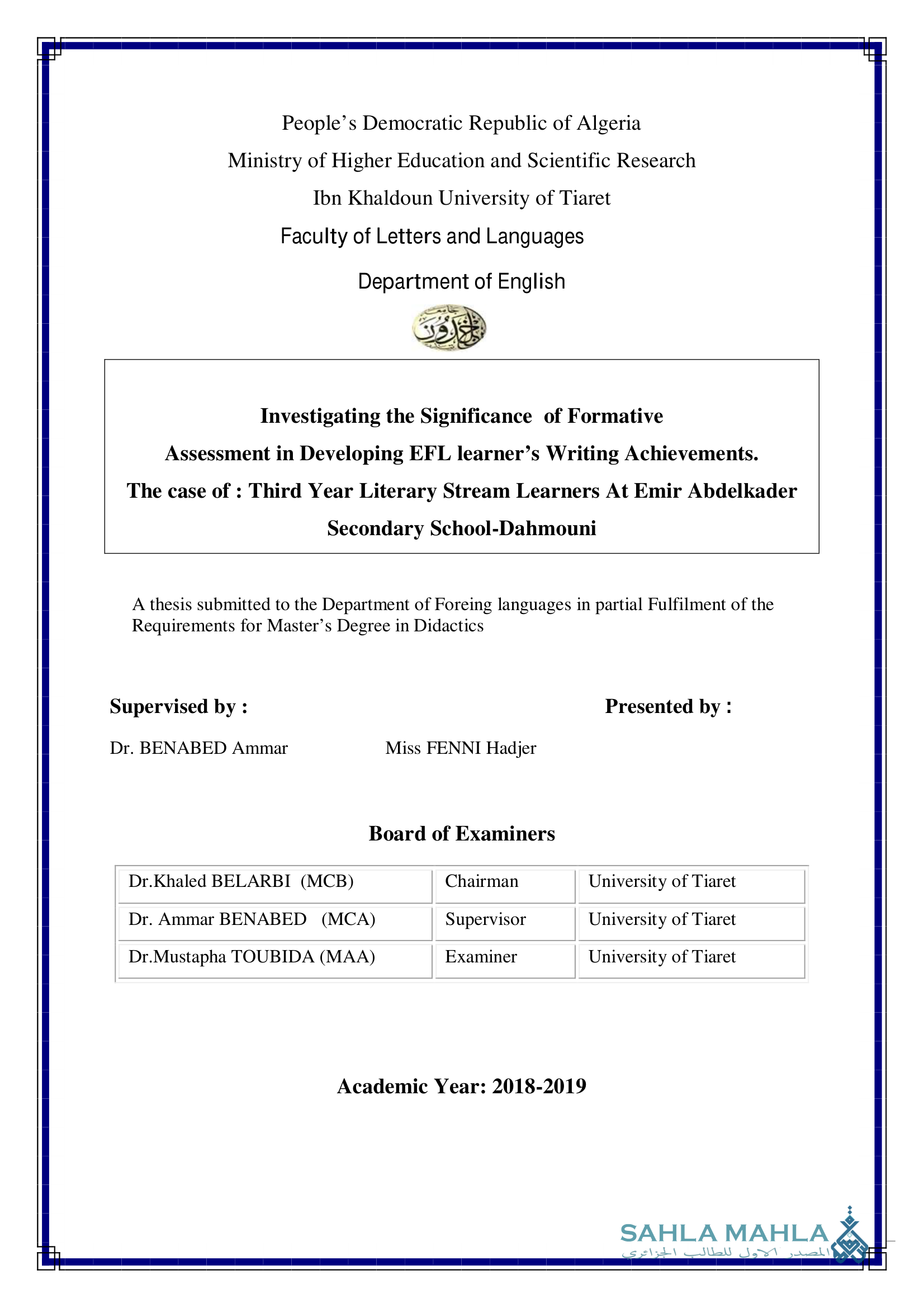
Investigating the Significance of Formative Assessment in Developing EFL learner’s Writing Achievements. The case of: Third Year Literary Stream Learners At Emir Abdelkader Secondary School-Dahmouni
General Information:
Level |
Master |
Title |
Investigating the Significance of Formative Assessment in Developing EFL learner’s Writing Achievements. The case of: Third Year Literary Stream Learners At Emir Abdelkader Secondary School-Dahmouni |
Specialty |
Didactics |
Cover Page:
Outline:
General Introduction
Chapter One
Litterature Review
Introduction
1.1.A Succinct History of Assessment
1.2. Assessment Pillars
1.3. Assessment and Evaluation
1.4. Types of Assessment
1.4.1. Diagnostic Assessment (DA)
1.4.2. Formative Assessment (FA)
1.4.3. Summative Assessment (SA)
1.4.4. Informal vs Formal Assessment
1.5.Importance of Assessment in the Classroom
1.6. Definition of Formative Assessment
1-6.1. Features of Formative Assessment
1.6.1.1. Practicality
1.6.1.2. Validity
1.6.1.3. Reliability
1.6.1.4. Authenticity
1.7. Stages of Formative Assessment
1.7.1. Pre-Instruction Formative Assessment
1.7.2. While-Instruction Formative Assessment
1.7.3. Post-Instruction Formative Assessment
1.8. Importance of Formative Assessment
1.8.1. Importance for Teachers
1.8.2. Importance for Learners
1.8.2.1.Teachers’ and Learners’ Roles in Formative Assessment
1.8.2.1.2. Teacher’s Role
1.8.3. Learner’s Role
1.9. Formative Feedback
1.9.1. Definition of Formative Feedback
1.10. Types of Feedback
1.10.1. Teacher – Learners Conferences
1.10.2. Peer Feedback
1.10.3. Written Feedback
1.10.4. Commentary
1.10.5. Rubrics
1.10.6. Minimal Marking
1.10.7. Taped Commentary
1.10.8. Electronic Feedback
Conclusion
Chapter Two
The Writing Skill
Introduction
2.1. Definition of Writing
2.2. Writing and other Language Skills
2.2.1. Writing and Reading
2.2.2. Writing and Speaking
2.2.3. Relation between Writing and Reading
2.3. Reasons of Teaching Writing Skills
2.3.1. Reinforcement
2.3.2.Language Development
2.3.3. Learning Style
2.3.4. Writing as a Skill
2.4. Benefits of Learning the Writing Skills
2.5. Approaches to the Teaching of Writing
2.5.1. The Product-based Approach
2.5.1.1. Familization
2.5.1.2. Controlled Writing
2.5.1.3. Free Writing
2.6.The Process-based Approach
2.6.1.The Creative-based Writing Approach
2.6.2.The Genre-based Approach
2.7.Importance of Teachers’ Written Feedback
Conclusion
Chapter Three
Fieldwork, Data Collection and Analysis
Introduction
3.1. Methodology
3.2. Research Design
3.3. Sample
3.4. Population Sampling
3.5. Data Collection Instruments
3.5.1. Description of the Questionnaire
3-5-2.Results of Responden’s feedback Questionnaire
3.6. Qualitative Data
3.6.1.Aims of the Classroom Observation
3.6.2. Description and Analysis of the Observation
3.6.3. Analysis and Discussion
Conclusion
Limitations of the Study
Implications and Suggestions
General Conclusion
Bibliography
Download The Thesis:
For more
academic sources and references,
including theses and dissertations from Algerian universities,
, visit our main website.