


Investigating the Effect of Formative Assessment on Algerian Third Year Secondary School Pupils’ Text Comprehension
General Information:
Level |
PhD |
Title |
Investigating the Effect of Formative Assessment on Algerian Third Year Secondary School Pupils’ Text Comprehension |
Specialty |
English Language and Education |
Cover Page:
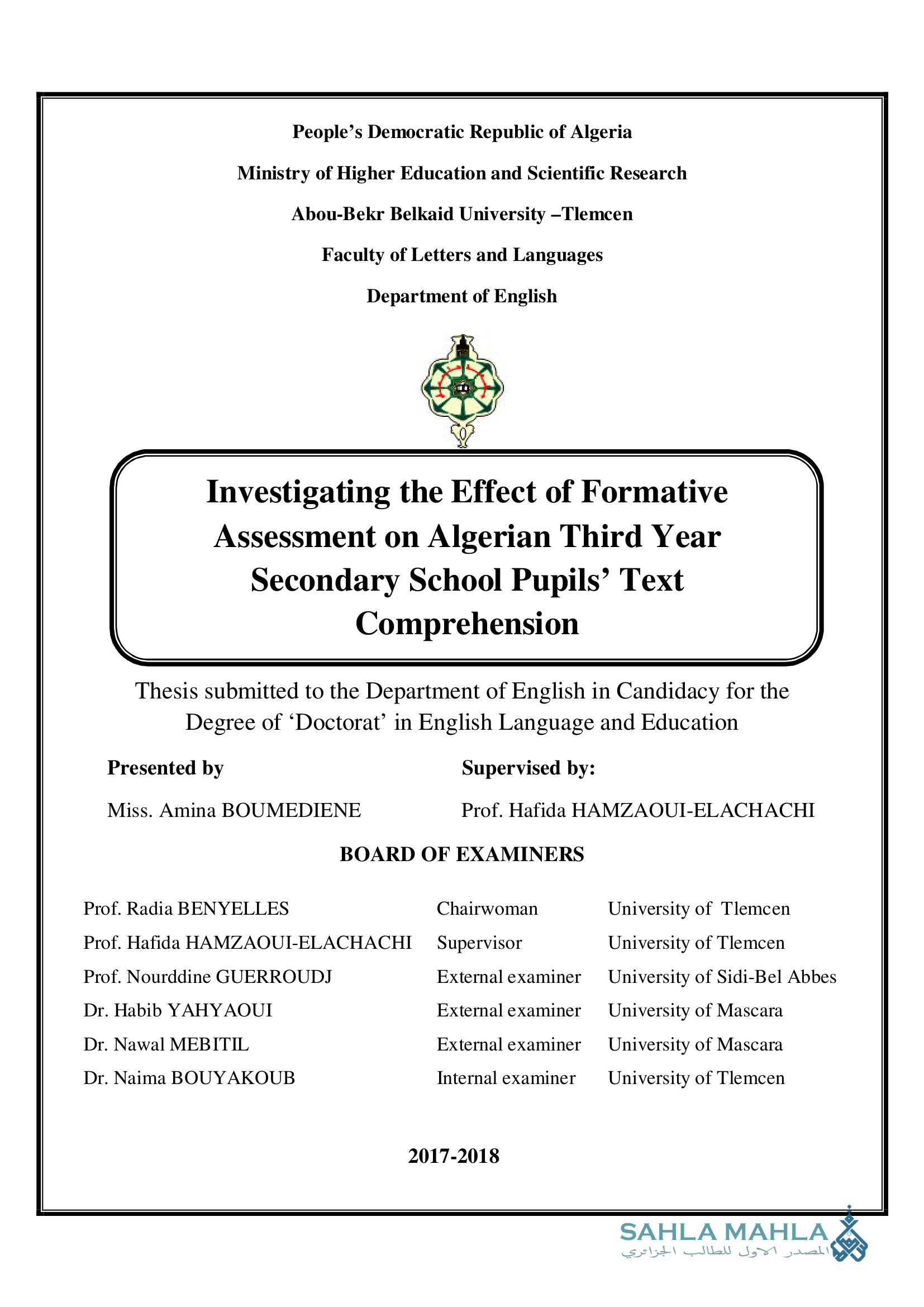
Outline:
GENERAL INTRODUCTION
CHAPTER ONE: Formative Assessment
1.1. Introduction
1.2. Assessment, Testing and Evaluation
1.3. Assessment
1.3.1. A brief History of Assessment
1.3.2. Pillars of Assessment
1.3.3. Importance of Assessment in the Classroom
1.4. Types of Assessment
1.4.1. Informal Vs. Formal Assessment
1.4.2. Summative Vs. Formative Assessment
1.4.2.1. Summative Assessment
1.5. Features of Formative Assessment
1.6. Research on Formative Assessment
1.7. Importance of Formative Assessment
1.7.1. Importance for Students
1.7.2. Importance for Teachers
1.8. Using Formative Assessment in the Classroom
1.8.1. Before Instruction
1.8.2. During Instruction
1.8.3. After Instruction
1.9. The Role of Feedback in Formative Assessment
1.10. Teacher’s Role in Formative Assessment
1.11. Students’ Role in Formative Assessment
1.11.1.Self-Assessment
1.11.2.Peer Assessment
1.12. Conclusion
CHAPTER TWO: The Reading Skill and Text Comprehension
Reading Defined
2.1. Introduction
2.2. Reading
2.2.1. Purposes of Reading
2.2.2. Reading in the Foreign Language teaching
2.3. Reading in the Different teaching Methods
2.3.1. Importance of Reading
2.4. Historical Overview and Reading Models
2.4.1. Bottom-Up Model
2.4.2. Top-Down Model
2.4.3. The Interactive Approach
2.5. Teaching Reading
2.6. Text Comprehension
2.6.1. Lower Level Processes
2.7. Reading Strategies
2.6.2. Higher Level Processes
2.8. Factors Affecting Text Comprehension
2.8.1. Background/ Prior Knowledge
2.8.2. Vocabulary and Linguistic Complexity
2.8.3. Goal Setting
2.8.4. Strategy Use
2.8.5. First Language Deficiency
2.8.6. Lack of Practice
2.8.7. Rhetorical Patterns
2.9. Text Comprehension Competences
2.9.1. Chomsky’s Model
2.9.2. Canale and Swain’s/ Canale’s Model
2.9.3. Bachman and Palmer’s Model
2.9.3.1. Individual Characteristics
2.9.3.2. Strategic Competence
2.9.4. Bachman and Palmer’s Model Applied to Reading
2.9.4.1. Individual Characteristics in Reading
2.9.4.2. Strategic Competence in Reading
2.10. Conclusion
CHAPTER THREE: Situation Analysis and Research Design
3.1 Introduction
3.2 Situation Analysis
3.2.1. ELT in Algeria
3.2.1.1. ELT Approach
3.2.1.2. ELT Objectives
3.2.2. ELT in the Secondary School
3.2.2.1. Time and Coefficient Distribution
3.2.2.2. Textbook Design “New Prospects”
3.2.2.3. Reading in “New Prospects”
3.2.3. Assessment in the Secondary School
3.2.3.1. Formative Assessment in the Algerian Secondary School
3.2.3.2. The “Bacalaureat” Exam
3.3. Research Design
3.3.1. Research Objectives
3.3.2. Type of Research
3.3.3. Research Instruments
3.3.3.1. The Questionnaire
3.3.3.2. The Interview
3.3.3.3. The Tests
3.3.4. Sample Population
3.3.4.1. Pupils’ Profile
3.3.4.2. Teachers’ Profile
3.3.5. Research Procedure
3.3.6. Data Analysis
3.3.6.1. Qualitative Analysis
3.3.6.2. Quantitative Analysis
3.4. Conclusion
CHAPTER FOUR: Data Analysis and Discussion
4.1 Introduction
4.2 Pre-intervention phase
4.2.1. Pupils’ Pre-intervention Questionnaire
4.2.1.1. Results
4.2.1.2. Interpretation
4.2.2. Teachers’ Interview
4.2.2.1. Results
4.2.2.2. Interpretation
4.2.3. Pretest
4.2.3.1. Results
4.2.3.2. Interpretation
4.3 The Intervention Phase
4.4 The post-intervention Phase
4.4.1. Pupils’ Post-intervention Questionnaire
4.4.1.1. Results
4.4.1.2. Interpretation
4.4.2. Posttest
4.4.2.1. Results
4.4.2.2. Interpretation
4.5 Discussion of the Main Results
4.6 Conclusion
CHAPTER FIVE: Suggestions and Recommendations
5.1. Introduction
5.2. Implementing Formative Assessment in the Algerian Classroom
5.2.1. Teacher’s Role
5.2.1.1. Goal Setting
5.2.1.2. Students’ Involvement
5.2.1.3. Increasing Motivation
5.2.1.4. Guided Instruction
5.2.1.5. Providing Feedback
5.2.2. Students’ Role
5.2.2.1. Peer Assessment
5.2.2.2. Self Assessment
5.2.3. The Process of Formative Assessment
5.2.3.1. Feed-up
5.2.3.2. Feedback
5.2.3.3. Feed-forward
5.2.4. Criteria for Effective Formative Assessment
5.3. Developing Text Comprehension through Formative Assessment
5.3.1. Regular Practice
5.3.2. Guided Instruction
5.3.3. Raising Students’ Motivation
5.3.4. Goal Setting
5.3.5. Extensive Reading
5.3.6. Developing Strategic Competence (Explicit Instruction)
5.3.7. Designing Reading Tasks
5.4. Developing Language Competences through Formative Assessment
5.4.1. Grammatical Competence
5.4.2. Textual Competence
5.4.3. Functional Competence
5.4.4. Sociolinguistic Competence
5.5. Further Pedagogical Implications
5.5.1. Classroom Management for Effective Assessment
5.5.2. Time Load, Syllabus Length and Class Size
5.6. Conclusion
GENERAL CONCLUSION
BIBLIOGRAPHY
Download The Thesis:
For more
academic sources and references,
including theses and dissertations from Algerian universities,
, visit our main website.