


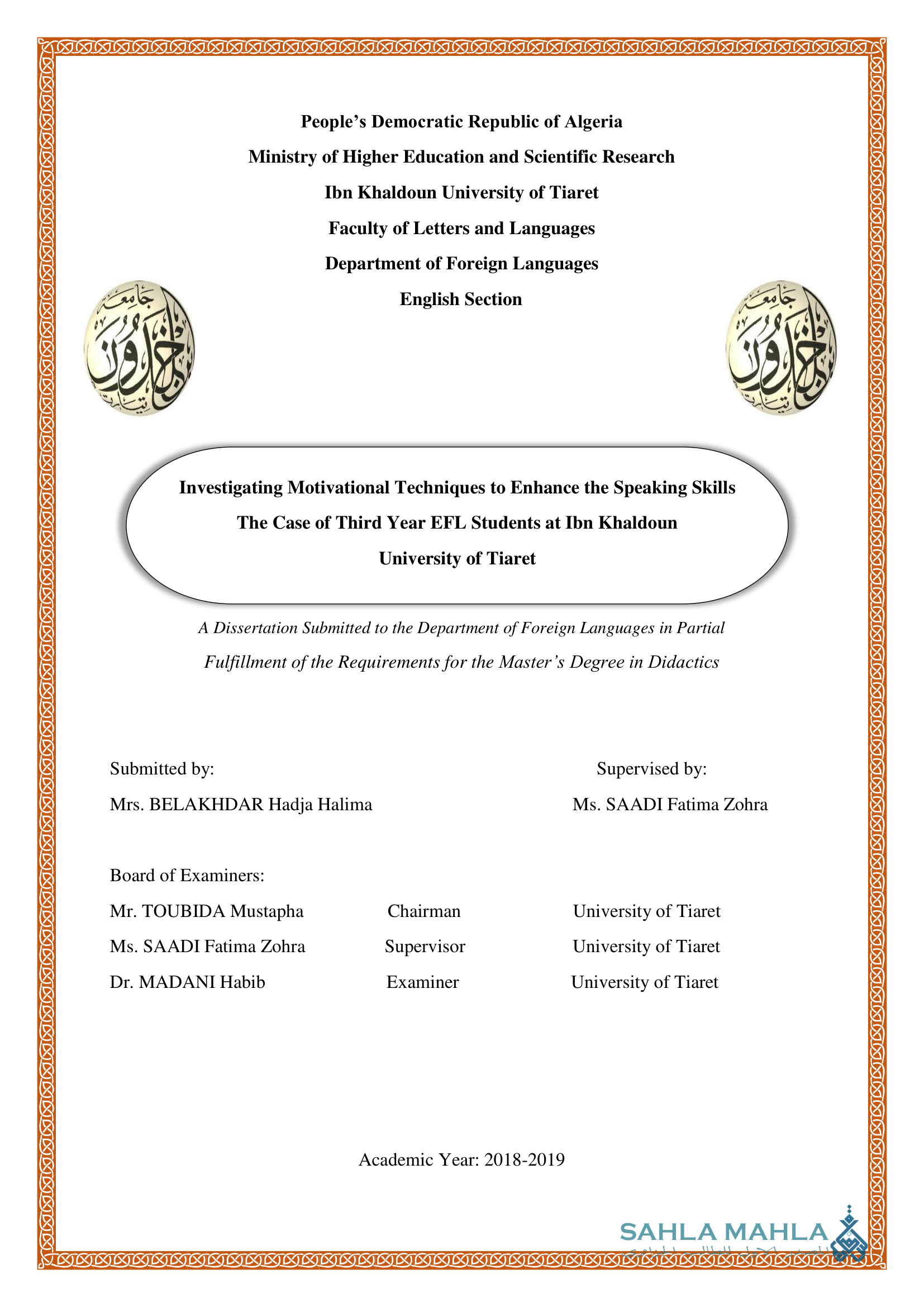
Investigating Motivational Techniques to Enhance the Speaking Skills The Case of Third Year EFL Students at Ibn Khaldoun University of Tiaret
General Information:
Level |
Master |
Title |
Investigating Motivational Techniques to Enhance the Speaking Skills The Case of Third Year EFL Students at Ibn Khaldoun University of Tiaret |
Specialty |
Didactics |
Cover Page:
Outline:
ACKNOWLEDMENT
RESUME
GENERAL INTRODUCTION
1. Introduction
2. Aims of the Study.
3. Significance of the Study
4. Statement of the Problem
5. Research Questions
6. Hypotheses
7. Methodology of the Study
8. The Structure of the Study
1.1.Introduction
CHAPTER ONE:
GEENERAL OVERIEW OF SPEAKING SKILLS
1.2.Language as a Means of Communication 1.3.The Components of Spoken Language. 1.4.Definitions of Speaking 1.4.1. Features of Spoken Language.
1.5. The Concept of Speaking Skills 1.6. The Aspects of Speaking Skills. 1.6.1. Accuracy
1.6.2. Fluency.
1.7.The Importance of Speaking
1.8. What Communicative Competence
1.9. Teaching Oral Communication.
1.10. The Significance of Teaching Speaking Skills.
1.11. Aims of Teaching Speaking
1.12. Notion of Learning Anxiety
1.13. Factors that Cause Speaking Difficulties to EFL Learners
1.13.1. Aural Medium
1.13.2. Socio-Cultural Factors
1.13.3. Affective Factors
1.13.4. Affective Factors
1.14. Motivation
1.15. Learners’ Communication Strategies for EFL Speaking Performance .26 1.15.1. Achievement Strategies
1.15.1.1. Guessing Strategies
1.15.1.2. Paraphrasing Strategies.
1.15.1.3. Co-operative Strategy.
1.15.2. Reduction Strategy
1.15.3. Avoidance Strategies
1.16. Teachers’ Roles.
1.16.1. Controller
1.16.2. Organizer
1.16.3. Assessor.
1.16.4. Prompter. 1.16.5. Participant.
1.16.6. Resource.
1.16.7. Tutor
1.16.8. Observer
1.17. Techniques and Activities that Promote Speaking Skills.
1.17.1. Information Gaps.
1.17.2. Communication Games.
1.17.3. Role Play.
1.17.4. Discussions.
1.17.5. Storytelling. 1.17.6. Interview.
1.17.7. Simulation
1.17.8. Dialogue.
1.18. Conclusion
CHAPTER TWO:
RESEARCH METHODOLOGY
2.1.Introduction
2.2.Research Design
2.3.The Research Sample Population
2.3.1. Learners’ Profile.
2.3.2. Teachers’ Profile
2.4.The Research Instruments
2.5.Data Analysis
2.6.Learners’ Questionnaire.
2.6.1. Data Analysis of Learner’s Questionnaire
2.6.2. Data Interpretation of Learner’s Questionnaire
2.7.Teacher’s Questionnaire
2.7.1. Data Analysis of Teacher’s Questionnaire.
2.7.2. Data Interpretation of Teacher’s Questionnaire
2.8.Discussion of the Results
2.9. Conclusion
CHAPTER THREE:
SUGGESTIONS AND RECOMENDATION
3.1. Introduction
3.2. Suggestions and Recommendations
GENERAL CONCLUSION.
BIBLIOGRAPHY.
Download The Thesis:
For more
academic sources and references,
including theses and dissertations from Algerian universities,
, visit our main website.