


Teachers’ Gender Awareness on Students’ Classroom Interaction
General Information:
Master |
Level |
Teachers’ Gender Awareness on Students’ Classroom Interaction |
Title |
Didactics |
Specialty |
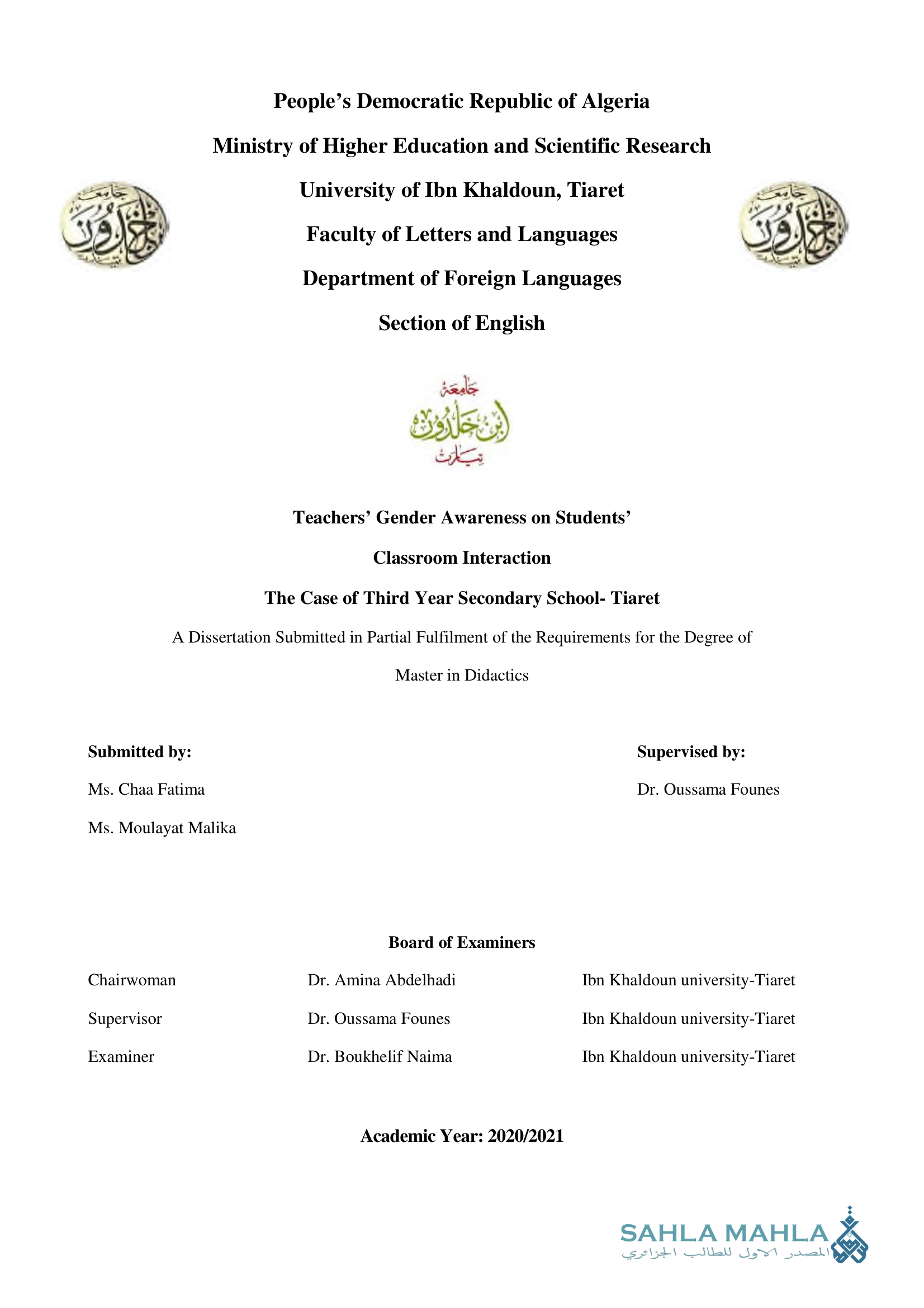
Cover Page:
Outline:
Fatima’s Dedications
Malika’s Dedications
General Introduction
1. Statement of the Problem
2. Focus of the Study
4. Research of Methodolgy
5. Structure of the Dissertation
Introduction
Chapter One: Gender in the EFL Context
1. Constructing, deconstructing and reconstructing gender
1.2. Gender and Sex: The Use of Terminology
1.2.2 Gender and Language
1.2.3 Gender and Ideology
1.2.4. Definition of Gender Biased
2. Gender Equity in Education: Meanings and Practices
2.1 Gender in Language Classrooms
2.2 Masculinity in Education
2.3 The Changing Masculinities
3. Studies of Gender in Education: The Non- Language Classroom
4. Strategies for Reducing Gender Bias in Education
4.1 Complementing Traditional Teaching Materials
4.2 Taking a Critical Stance
4.3 The Effectiveness of Distributing Talk
4.4 Placement of students’ Desks
4.5 New Curriculum Design and New Academic Orientations
Conclusion
Chapter two: the Impact of Teachers’ Gender on Classroom Interaction
Introduction
SectionOne: EFL Classroom Interaction
1. Definition of Classroom Interaction
2. The Interactionist Hypotheses
2.1 Oral Interaction and its Development
2.2 Krashen’s Comprehensible Input Hypothesis (1981)
2.3 Long’s Interaction Hypothesis Theory (1981 and updated 1996)
2.4 The Socio-cultural Theory (Vygotsky in 1963-1978)
3. Challenges in Classroom Practice: Factors affecting speaking performance in Foreign Language Learning
3.1 Inhibition
3.2 Nothing to Say
3.3 Low Chances of Participation
3.4 Mother Tongue Use
4. Teacher Talk and Classroom Interaction
4.1 Amount and type of teacher talk
4.2Three Major Issues Related to teacher Questions
4.2.1 Wait Time
4.2.2 Distributions of Questions
4.2.3 Display and Referential Questions
4.2.4 Open-ended vs. Closed-ended Questions
4.3. Learners’s Performance and Feedback
Section Two: The Heterogeneous Effect of Gender in the EFL classroom
1. The Intersection between Class and Gender and its Impact on Student’s Achievement
1.1 Teacher-Students’ Punishment
1.2 Gender Bias in EFL Materials
1.3 Gender Bias in Distribution of Talk
Conclusion
Field Work: Investigating Teacher- Gender Awareness on Classroom Interaction
Introduction
Part one: The Research Design and Methodology
1. Research Design
2. Population and Sampling
3- Research Approach
3.1 Mixed Method Research to Collect Data
Part two: Data analyses and Overall Proceeding
1. Questionnaire Defined
2. Learners’ Questionnaire
2.1 Description of the Questionnaire
2.2 Analysis of the Pupils’ Questionnaire
2.3 General Interpretation of Findings
3. Teachers’ Questionnaire
3.1 Description of the Questionnaire
3.2 Analysis of the Teachers’ Questionnaire
3.3 General Interpretation of Findings
4. Observation
4.1 Aim of observation Grid
4.2 Description of the Observation
4.3 Analysis of the Observation
4.4 General Interpretation of Findings
Conclusion
5. The Limitation in the Methodology
6. Recommendations
For Teachers
For Students
For Syllabus Designers
General Conclusion
Works cited
الملخص
Download The Thesis:
For more
academic sources and references,
including theses and dissertations from Algerian universities,
, visit our main website.