


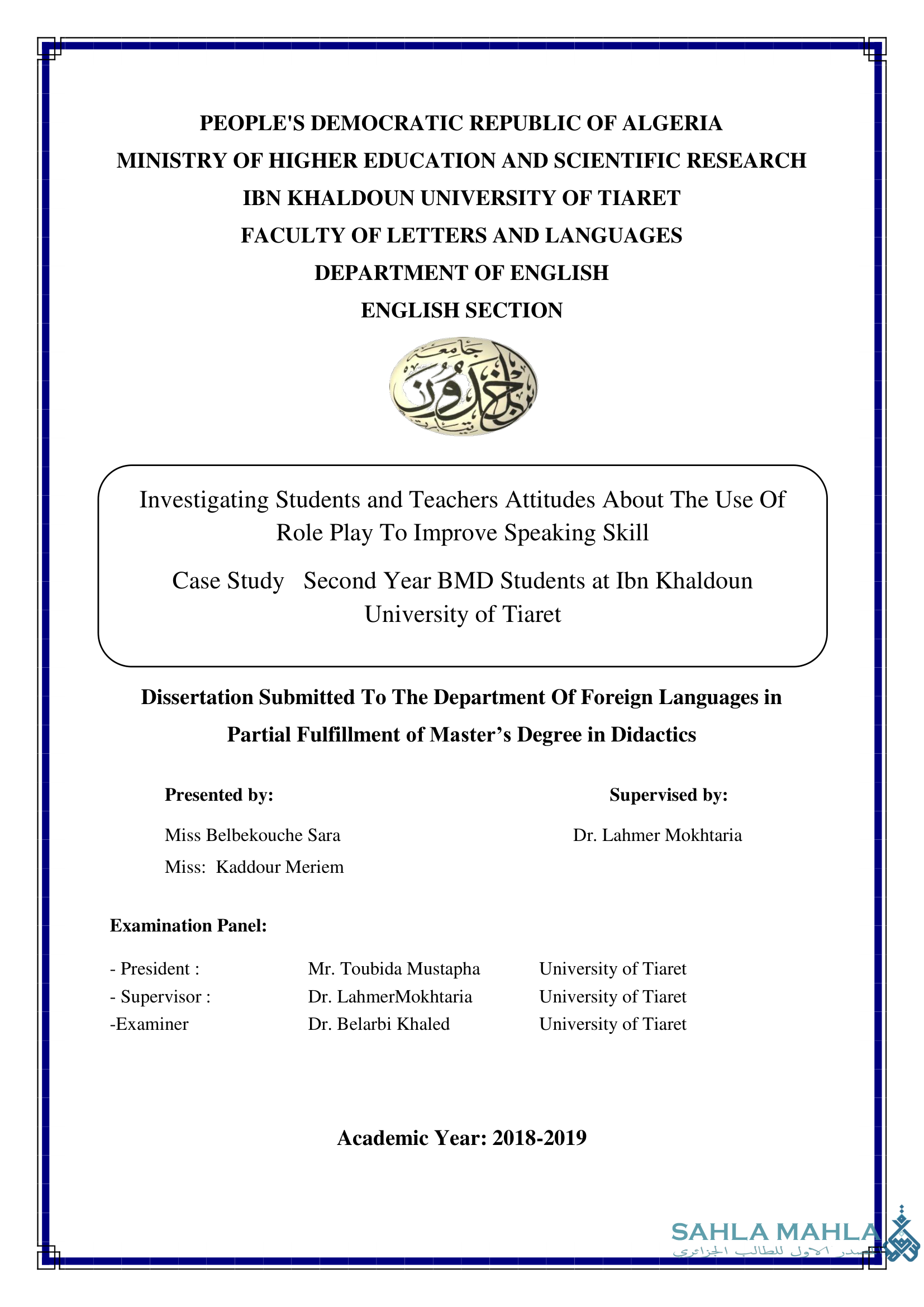
Investigating Students and Teachers Attitudes About The Use Of Role Play To Improve Speaking Skill Case Study Second Year BMD Students at Ibn Khaldoun University of Tiaret
General Information:
Master |
Level |
Investigating Students and Teachers Attitudes About The Use Of Role Play To Improve Speaking Skill Case Study Second Year BMD Students at Ibn Khaldoun University of Tiaret |
Title |
Didactics |
Specialty |
Cover Page:
Outline:
Acknowledgment
General Introduction
Statement of problem
Research questions
Research hypotheses
Aim of the study
Structure of the study
Significance of the study
THEORETICAL PART
CHAPTER ONE: SPEAKING SKILL IN EFL CLASSROOM
Introduction
1.1 Definition of speaking
1.2 The importance of speaking skills
1.3 Characteristics of speaking performance
1.3.1 Accuracy
1.3.2 Fluency
1.3.3 Grammar
1.3.4 Vocabulary
1.3.5 Pronunciation
1.4 The Relationship between speaking and listening
1.5 Speaking difficulties in foreign language learning
1.5.1 Lack of motivation/interest
1.5.2 Inhibition
1.5.3 Nothing to say
1.5.4 The use of mother language
1.5.5 Lack of confidence
1.6 Teaching speaking
1.7 The goal of teaching speaking
1.8 Speaking activities in the EFL classroom
1.8.1 Discussion
1.8.2 Debates
1.8.3 Interview
1.8.4 Information gap
1.8.5 Simulation
1.8.6 Story completion
1.8.7 Role play
1.9 Roles of teachers during speaking activities
1.10 Types of classroom speaking activities
Conclusion
SECTION TWO: ROLE PLAY AS TEACHING TECHNIQUE
Introduction
2.1 Definition of Role play
2.2 Importance of Role play
2.3 Types of Role lay
2.3.1 Scripted role play
2.3.2 Unscripted role play
2.4 Role-Play And Simulation
2.5 Implementing role play
Step 1 – A Situation for a role play
Step 2 – Role play design
Step 3-Linguistic preparation
Step 4- Factual preparation
Step 5 – Assigning the roles
Step 6- Follow-up
2.6 The teacher’s role in role play
2.7 Advantages of role play
2.8 Disadvantages of role play
Conclusion
CHAPTER TWO: STUDY CONTEXT AND RESEARCH DESIGN
Introduction
2.1 The situation of ELT in Algeria
2.2 ELT in Algerian universities
2.3 The situation of speaking in Algeria
2.4 Research design
2.4.1 The sample population
2.4.1.1 Teachers’ profiles
2.4.1.2 Learners’ profiles
2.5 Research instruments
2.5.1 Questionnaire
2.5.2 Interview
Conclusion
PRACTICAL PART
CHAPTER THREE: DATA ANALYSES AND RECOMMENDATIONS
Introduction
3.1 Analysis and Interpretation of Students’ Questionnaire
3.2 Interview Analysis and Interpretation
3.3 General discussion of findings
3.4 Suggestions and Recommendations
Conclusion
General Conclusion
Bibliography
Download The Thesis:
For more
academic sources and references,
including theses and dissertations from Algerian universities,
, visit our main website.