


The Impact of Arabic and French Languages on The Skill of Writing in English (Fourth-Year Middle School Learners at Ghazaouet and Beni Snous)
General Information:
Master |
Level |
The Impact of Arabic and French Languages on The Skill of Writing in English (Fourth-Year Middle School Learners at Ghazaouet and Beni Snous) |
Title |
Applied Linguistics |
Specialty |
Cover Page:
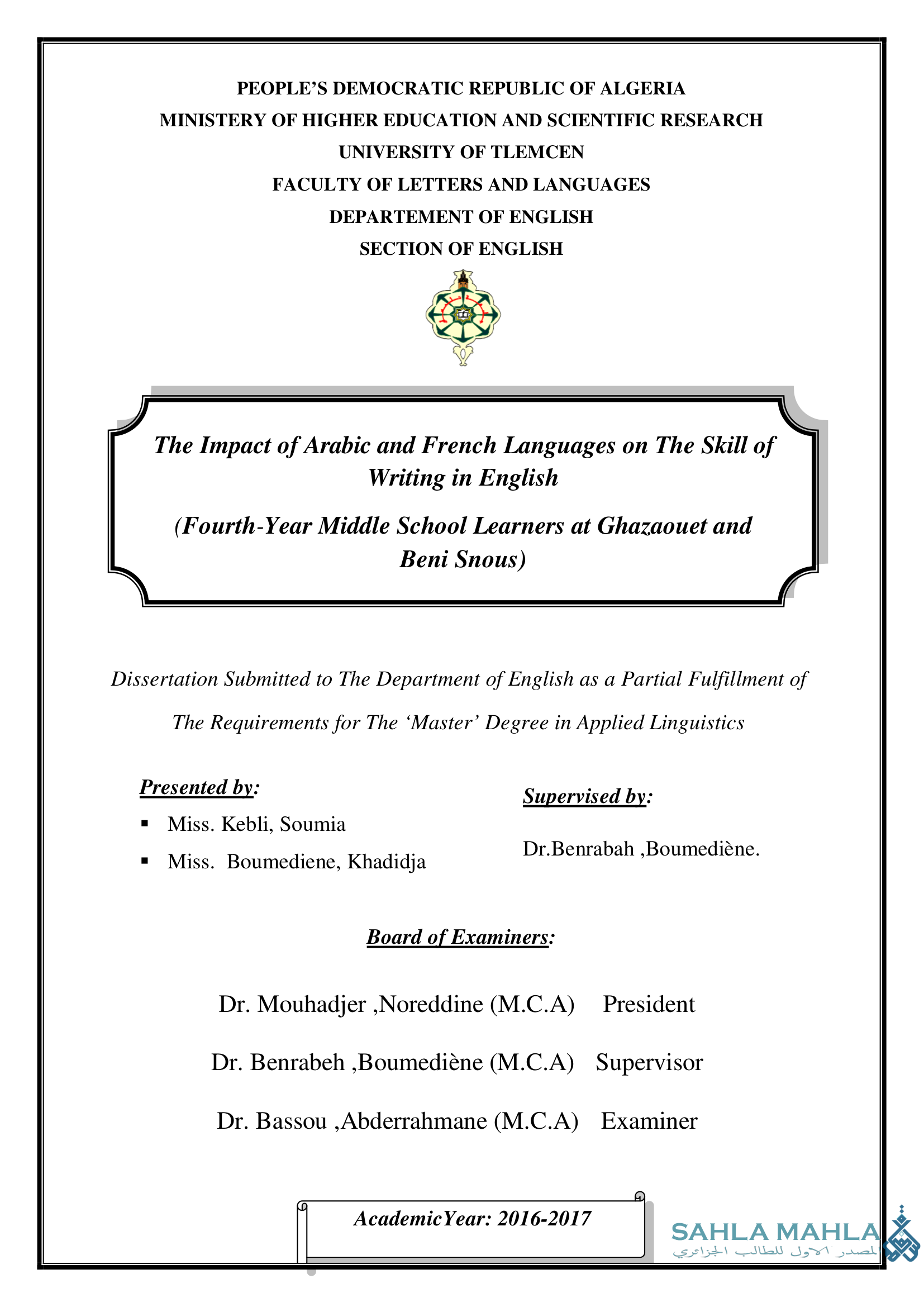
Outline:
DEDICATIONS, Acknowledgments, ABSTRACT, Table of Contents, List of Acronyms, List of Figures, GENERAL INTRODUCTION, Chapter One: The Linguistic Situation and Languages Contact, Introduction, 1.2. The Linguistic Situation in Algeria, 1.2.1. Before Independence, 1.2.2. After Independence, 1.2.3. The Process of Arabization, Languages Status in Algeria, 1.3.1. The Arabic Language, 1.3.1.1. Standard Arabic (MSA), 1.3.1.2. Algerian Arabic (AA), 1.3.2. The French Language, 1.3.3. The English Language, Language Interference, 1.4.1. Contrastive Analysis and Language Transfer Theory, 1.4.2. Strong Version vs Weak Version, 1.6.2.1. Strong Version, 1.6.2.2. Weak Version, 1.4.3. Criticism to Contrastive Analysis Hypothesis (CAH), 1.5. From Contrastive Analysis to Error Analysis, 1.5.1. Definition of Errors, 1.5.2. Definition of Mistakes, 1.5.3. Sources of Errors, 1.5.4. Models of Error Analysis, 1.5.5. Error Analysis Criticism, 1.6. The Interlanguage Approach, 1.6.1. Learning Strategies in Creating Interlanguage, 1.6.2. Language Transfer, a. Positive Transfer, b. Negative Transfer (Interference), C. Avoidance, d. Over-Use, e. Overgeneralization, f. Simplification, 1.7. Levels of Interference from Arabic to English, *Grammar, *Tense, * Present/ Past Perfect vs. Simple present/ Past Tense, * Agreement, *Articles, Prepositions, * Vocabulary, *Syntax, *Word Order, *The Absence of Copula, *Coordination, * Orthography (Spelling), 1.8. Levels of Interference from French to English, * Vocabulary, *Phonetics/phonology, Spelling and pronunciation, *Grammar, 1.9. Conclusion, Chapter Two: Research Background Methodology and Data Analysis, 2.1. Introduction, 2.2. Sample Population, 2.2.1 Learners’ Profile, 2.2.2 Teachers’ Profile, 2.3. The Research Instruments, 2.3.1. Learners’ Test, 2.3.2. Teachers’ Questionnaire, 2.4. Data Collection and Analysis, 2.4.1 Learners’ Test Analysis, 2.4.2 Teachers’ Questionnaire Analysis, 2.5. Conclusion, Chapter Three: Data Interpretation and Suggestopedia, 3.1. Introduction, 3.2. Interpretation of Language Proficiency Test (L.p.t), 3.3. Auxiliary “To be” Errors, Word Order Errors, Prepositions Errors, ❖ Articles Errors, Tenses Errors, Semantic Errors, Agreement Errors, ❖ False Friends Errors, ❖ Morphological Errors, Lexical Errors, 3.4. Interpretation of the Questionnaire, 3.4.1 Practical Recommendations, 3.4.1.1. Motivation, 3.4.1.2. Integrating the Reading Skill with Writing, 3.4.1.3. Strategies for Correcting Errors, 3.4.1.4. Text book Elaboration, 3.4.1.5. Writing and Technology, 3.4.2 Methods for Teaching the Writing Skill, 3.4.2.1. The Controlled-to- Free Approach, 3.4.2.2. The Free-Writing Approach, 3.4.2.3. The Paragraph-Pattern Approach, 3.4.2.4. The Grammar -Syntax -Organization Approach, 3.4.2.5. The Communicative Approach, 3.4.2.6. The Process-Approach, 3.4.3. Extra Classroom Activities, 3.4.3.1. Teaching of Capitalization and Learning Difficulties, 3.4.3.2. Teaching Looking Similar Words, 3.4.3.3. Treating Difficulties in The Structure of English, 3.4.3.4. Teaching Pupils to Structure Paragraphs, 3.4.3.5. Teaching Comparison between Two Elements (Similarity and Difference), 3.4.3.6. Teaching Cohesion, 3.4.3.7. Teaching How to Reveal Attitudes, 3.4.3.8. Teaching Learners to Suppose, 3.5. Conclusion, BIBLIOGRAPHY, APPENDICES, APPENDIX A, APPENDIX B
Download The Thesis:
For more
academic sources and references,
including theses and dissertations from Algerian universities,
, visit our main website.