


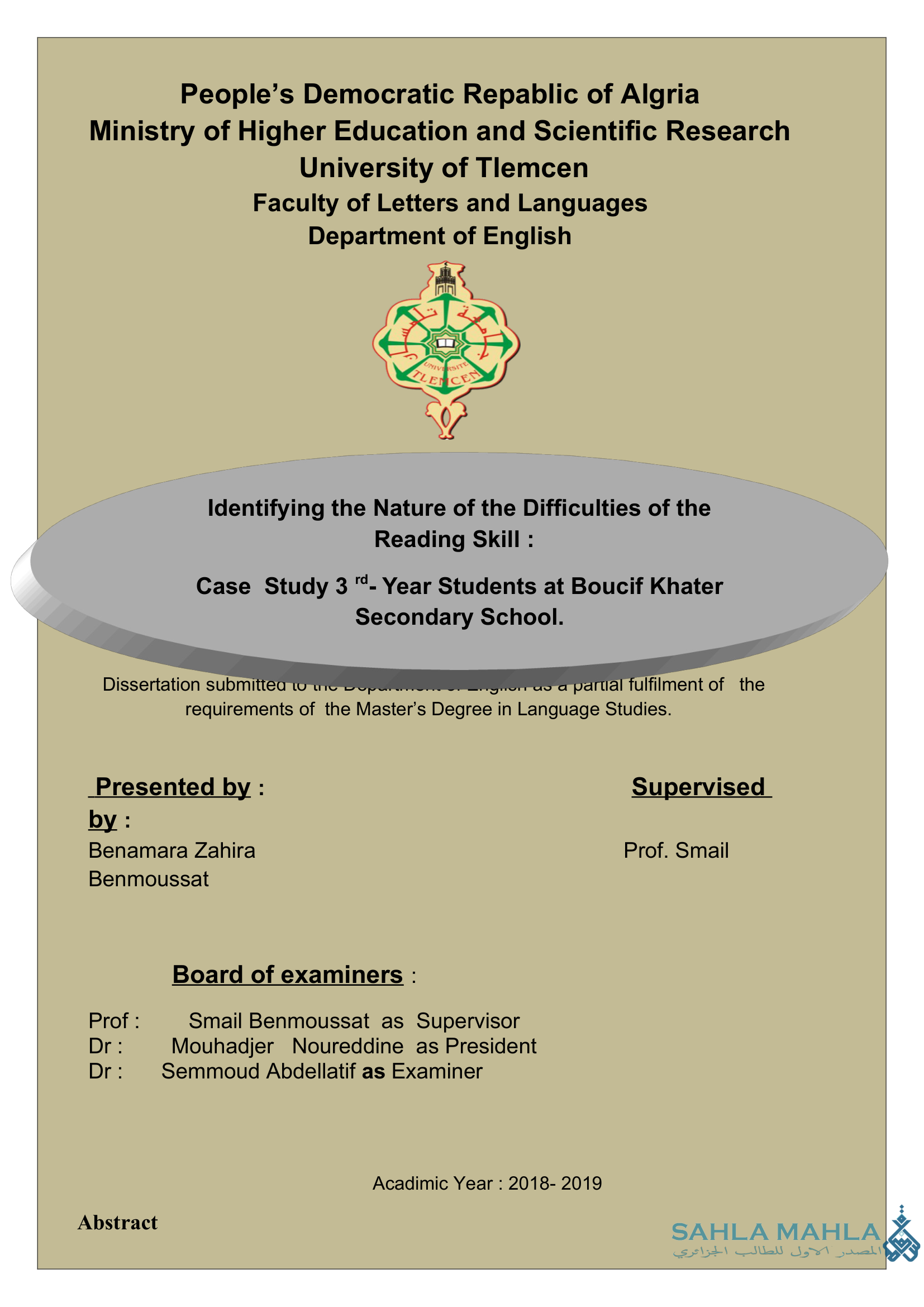
Identifying the Nature of the Difficulties of the Reading Skill: Case Study 3rd-Year Students at Boucif Khater Secondary School.
General Information:
Master |
Level |
Identifying the Nature of the Difficulties of the Reading Skill: Case Study 3rd-Year Students at Boucif Khater Secondary School. |
Title |
Language Studies |
Specialty |
Cover Page:
Outline:
General Introduction
Chapter One: The Reading Skill
1.1. Introduction
1.2. Definition of Reading
1.3. Types of reading
1.3.1. Extensive reading
1.3.2. Intensive reading.
1.3.3. Receptive reading
1.3.4. Interactive reading
1.4. Reality of reading
1.5. Purposes of reading
1.6. Features of reading
1.6.1. Reading as an interactive process
1.6.2. Reading as a purposeful process
1.6.3. Reading as a critical process 1.7. Conclusion
Chapter Two: Reading Difficulties
2.1. Introduction
2.2. The reading difficulties
2.3. Types of reading difficulties
2.3.1. Decoding difficulty
2.3.2. Comprehension difficulty
2.3.3. Language difficulty
2.3.4. Topic genre difficulty
2.3.5. Negative expectation difficulty.
2.3.6. Fluency difficulty.
2.4. Improving students reading difficulties
2.4.1. Phonological awareness
2.4.2. Syntactical awareness
2.4.3. Extensive reading
2.4.4. Authenticity
2.4.5. Choose the right topics
2.4.6. Create interest.
2.4.7. Testing and teaching in certain times.
2.4.8. Manufacturing success
2.4.9. Agreeing on a purpose
2.5. Reading strategies
2.6. Benefits of reading strategies
2.7. Characteristics of good language reader
2.7.1. Fluent
2.7.2. Efficient
2.7.3. Comprehensible
2.7.4. Interactive
2.7.5. Flexible
2.7.6. Learning
2.7.7. Critical
2.7.8. Linguistic
2.7.9. Strategic
2.8. Conclusion
Chapter Three: Data Analysis
3.1. Introduction
1) The aim of teacher’s questionnaire
2) Description of teacher’s Questionnaire
3) Analysis of teacher’s Questionnaire
3.2. Introduction
1) The aim of student’s questionnaire
2) The description of student’s questionnaire
3) Analysis of student’s questionnaire
4) General results
3.3. Conclusion
3.4. Recommendations for teachers
3.5. Recommendations for students
General Conclusion
Bibliography
• Table 01: Teacher’s Qualification
• Table02: Teacher’s attending training programs
• Table03: The most important skill ⚫Table04: Teaching reading skill
• Table05: The Involvement of reading in the syllabus
⚫Table06: Teaching Reading Skill
⚫Table07: Types of reading that students should do ⚫Table08: Following particular models in teaching reading
• Table09: The role of the teacher in the reading classroom Table10: The difficulties that hinder the teacher in teaching reading
Table 11: The affectation of teacher’s reading difficulties on students language learning
Table12: Gender
Table13: Age
• Table14: Stream
Table15: Classification of the skills in terms of importance
• Table16: Student’s Description of L1 Reading
• Table17: Student’s Description of L2 Reading
Table18: The relationship between reading and other skills
Table19: The skill(s) that strongly related to reading.
Table20: Student’s view on the importance of reading in EFL classes
Table 21: Students attitudes towards practicing reading in class
Table22: Student’s reading ability
Table23: Student’s difficulty skill
Table24: Student’s Competency skill.
• Table25: The consideration of L2 Reading
•Table 26: Frequency of watching or listening to the native readers
•Table27: Student’s use of reading strategies
• Table 28: Kinds of reading that students practice
• Table29: The explanation of the misunderstanding of written language
• Table 30: Student’s reading difficulties
EFL: English as a forging language
L1: First language
L2: Second language
Download The Thesis:
For more
academic sources and references,
including theses and dissertations from Algerian universities,
, visit our main website.