


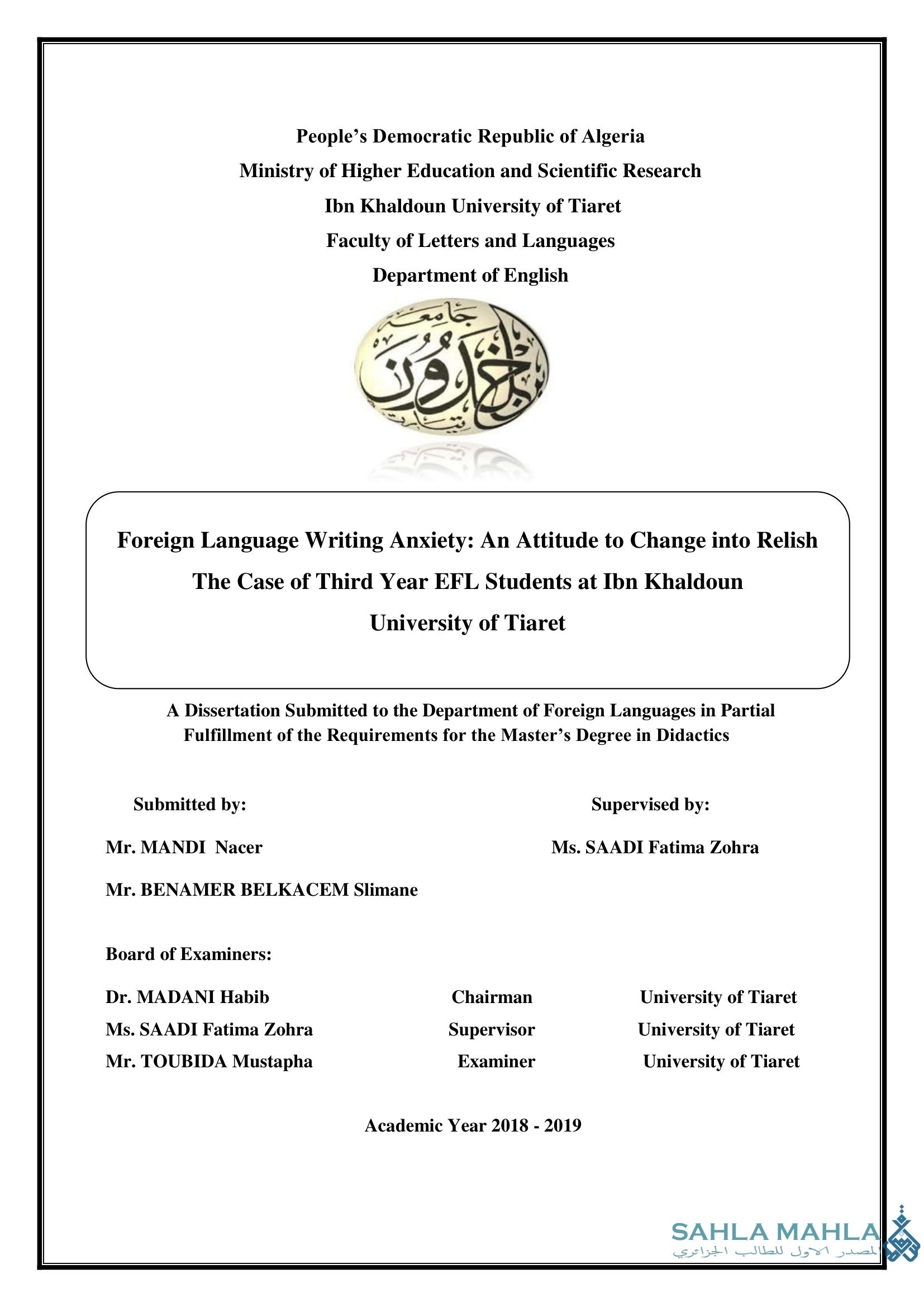
Foreign Language Writing Anxiety: An Attitude to Change into Relish. The Case of Third Year EFL Students at Ibn Khaldoun University of Tiaret
General Information:
Master |
Level |
Foreign Language Writing Anxiety: An Attitude to Change into Relish. The Case of Third Year EFL Students at Ibn Khaldoun University of Tiaret |
Title |
Didactics |
Specialty |
Cover Page:
Outline:
Acknowledgments
General Introduction
1.1 Introduction
1.2 Anxiety
Chapter One
Theoretical Background
1.2.1 Types of Anxiety
1.2.1.1 Trait Anxiety
1.2.1.2 State Anxiety
1.2.1.3 Situation-Specific Anxiety
1.2.1.4 Facilitating vs. Debilitating Anxiety
1.2.1.4.1 Debilitating Anxiety
1.2.1.4.2 Facilitating Anxiety
1.3 Definition of Foreign Language Anxiety
1.3.1 Types of Foreign Language Anxiety
1.3.1.1 Communication Apprehension
1.3.1.2 Fear of Negative Evaluation
1.3.1.3 Test Anxiety
1.3.1.4 Writing Anxiety
1.4 Types of Writing Anxiety
1.4.1 Cognitive Anxiety
1.4.2 Somatic Anxiety
1.4.3 Avoidance Anxiety
1.5 Causes of Writing Anxiety
1.5.1 Fear of Negative Evaluation and Fear of Test
1.5.2 Time Pressure / Factor
1.5.3 Lack of Self-Confidence
1.5.4 Insufficient Writing Techniques
1.5.5 Language Difficulties
1.5.6 Lack of Topical Knowledge
1.5.7 Lack of Experience or Insufficient Writing Practice
1.5.8 Pressure for Perfect Work
1.5.9 Fear of Lacking Bright Ideas
1.5.10 Fear of Inability to Choose a Good Topic
1.5.11 Fear of Inability to Gather Relevant Evidence
1.5.12 Fear of Inability to Formulate a Sound Thesis Question
1.5.13 Fear of Inability to Write in a Logical Manner
1.5.14 Fear of Inability to Analyse and Interpret Results
1.5.15 Fear of Having Grammatical Errors and Poorly Constructed Sentences
1.5.16 Fear of Success
1.5.17 Fear of Failure
1.6 The Impact of Foreign Language Writing Anxiety on Students’ Performance
1.7 Strategies for Overcoming FLWA
1.7.1 Learning Strategies
1.7.1.1 Meta Cognitive Strategies
1.7.1.2 Cognitive Strategies
1.7.1.3 Affective Strategies
1.7.2 Teaching Strategies
1.8 Conclusion
Chapter Two
Data Analysis and Research Results
2.1 Introduction
2.2 The Research Setting
2.3 The Course of Writing at the English Department of Ibn Khaldoun University
2.4 The Sample Population
2.4.1 Students’ Profile
2.4.2 Teachers’ Profile
2.4.3 Data Collection Instruments
2.4.3.1 Student-addressed Questionnaire
2.4.3.2 Teacher-addressed Interview
2.5 Data Collection Procedure
2.6 Limitations of the Study
2.7 Student-addressed Questionnaire Results
2.8 Teacher- addressed Interview Results
2.9 Interpretation of the Results
2.9.1 Questionnaire’s Interpretation
2.9.2 Interview’s Interpretation
2.10 Discussion of the Main Results
2.11 Conclusion
Chapter Three
Suggestions and Recommendations
3.1 Introduction
3.2 Learning Strategies
3.2.1 Think Positively by Putting Positive Thinking into Practice
3.2.2 Overcoming the Fear of Inability to Choose a Good Topic
3.2.3 Overcoming the Fear of Inability to Generate Ideas
3.2.3.1 Brainstorming
3.2.3.2 Drafting
3.2.3.3 Revising and Editing
3.2.3.4 Rewriting
3.2.3.5 Publishing
3.2.4 Strategies to Improve Writing in English
3.2.4.1 Expand your Vocabulary
3.2.4.2 Master English Spelling
3.2.4.3 Read Extensively
3.2.4.4 Improve Your Grammar
3.3 Teaching Strategies
3.3.1 Helping Students to Overcome Their Fear of Negative Evaluation
3.3.1.1 Simple Ways to Assess Writing Skills
3.3.1.2 Teacher’s Feedback
3.3.2 Helping Students Overcome Their Fear of Peer’s Insult
3.3.3 Create a Productive Learning Atmosphere
3.3.4 Prepare Students for Writing
3.3.5 Scaffolding
3.3.6 Using Technology
3.3.7 Journal of Writing
3.3.8 Awareness Raising
3.3.9 Freewriting
3.3.10 Pair and Group Work
3.3.11 Motivate Students to Write
3.3.11.1 Provide Different Types of Writing
3.3.11.2 Bring Writing to Life
3.3.11.3 Create Interesting Contests
3.4 Conclusion
General Conclusion
Bibliography
Download The Thesis:
For more
academic sources and references,
including theses and dissertations from Algerian universities,
, visit our main website.