


Towards Flow… When Learning English Becomes Enjoyable
General Information:
Master’s Degree |
Level |
Towards Flow… When Learning English Becomes Enjoyable |
Title |
Didactics of EFL |
Specialty |
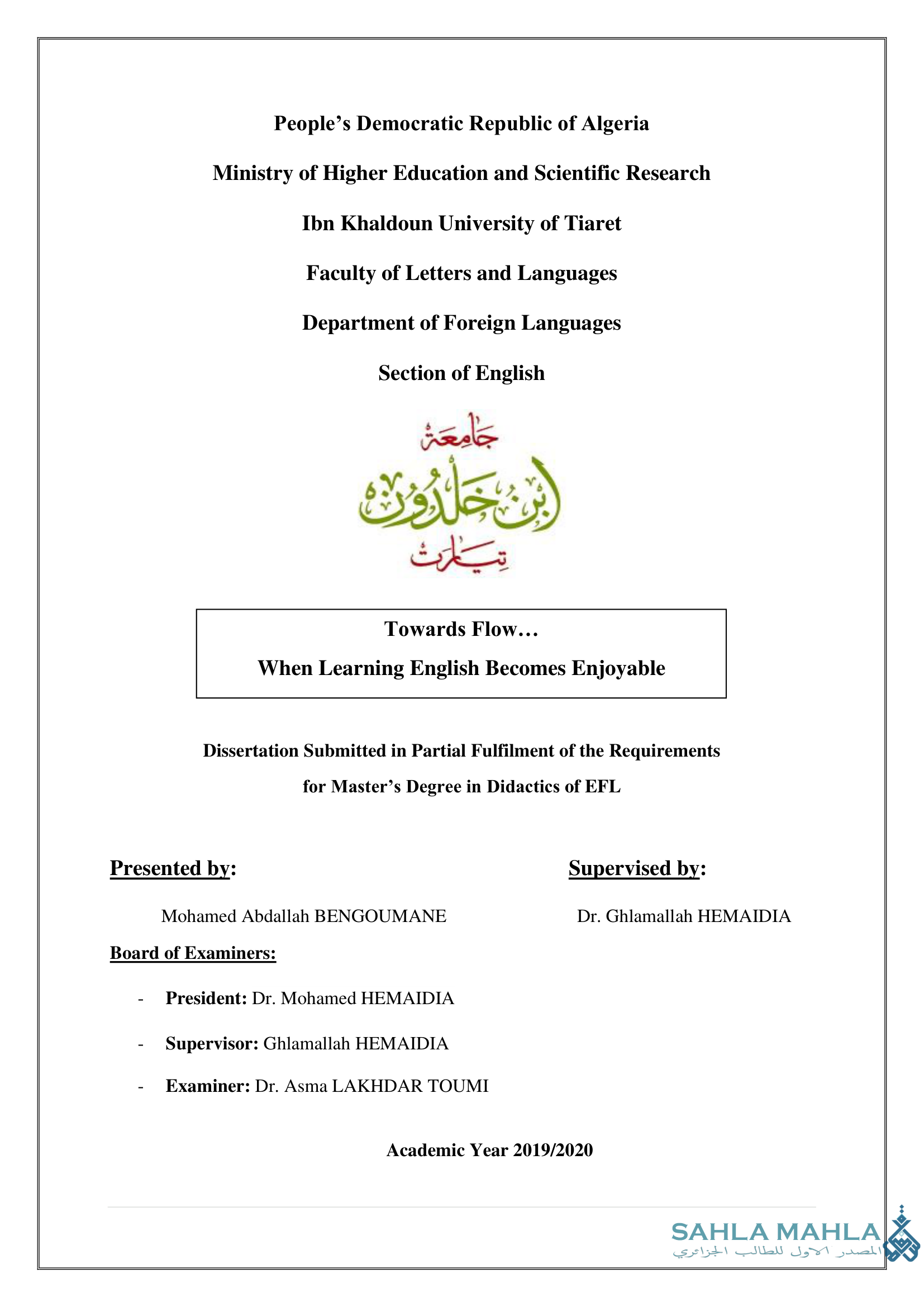
Cover Page:
Outline:
General Introduction Chapter One: Learning and Flow 1.1 Introduction 1.2 Learning 1.2.1 Learning in the Different Theories 1.2.1.1 Learning in Behaviourism 1.2.1.2 Learning in Cognitivism 1.2.1.3 Learning in Constructivism 1.2.1.4 Learning in Humanism 1.2.2 Distinctive Considerations of the Humanistic Notion of Learning 1.2.2.1 Holism 1.2.2.2 Self-actualization 1.2.2.3 Affect 1.2.3 Affect in Learning 1.2.3.1 Affective Traits 1.2.3.1.1 Motivation 1.2.3.1.1.1 Intrinsic versus extrinsic motivation 1.2.3.1.1.2 Integrative versus instrumental motivation 1.2.3.1.2 Attitudes 1.2.3.1.3 Self-esteem 1.3 Flow 1.3.1 Flow in learning 1.3.1.1 Flow and Affect 1.3.1.2 Flow and Motivation 1.3.1.3 Flow and Attitude 1.3.1.4 Flow and Self-esteem 1.3.2 Characteristics of Flow-Caught Learners 1.3.2.1 One-Pointedness of The Mind 1.3.2.2 Feeling of Ecstasy 1.3.2.3 Clear Goal Design 1.3.2.4 Feedback 1.3.2.5 Feeling of Mastery 1.3.2.6 Alteration of Time 1.3.3 Conditions of Flow 1.3.3.1 Setting Goals 1.3.3.2 Feedback 1.3.3.3 Sufficient Skills 1.3.4 Barriers to Flow 1.3.4.1 Amotivation 1.3.4.2 Absence of Amore Fate 1.3.4.3 Unawareness 1.4 Conclusion Chapter Two: Field Work 2.1 Introduction 2.2 Aim of the Study 2.3 Methodology 2.3.1 Student-addressed Questionnaire 2.3.1.1 Questionnaire in Details 2.3.1.2 Questionnaire Sample 2.3.1.3 Pilot Study 2.3.1.4 Questionnaire Results 2.3.1.5 Preliminary Readings in the Questionnaire Results 2.3.2 Teacher-addressed Interview 2.3.2.1 Interview in Details 2.3.2.2 Interview Sample 2.3.2.3 Interview Results 2.3.2.4 Preliminary Readings in the Interview Results 2.4 Conclusion Chapter Three: Recommendations and Practical Suggestions 3.1 Introduction 3.2 Working on Learner Affect 3.2.1 Empowering Motivational feelings 3.2.1.1 Intrinsic motivational feelings 3.2.1.2 Extrinsic motivational feelings 3.2.2 Ensuring Positive Attitudes 3.2.2.1 Attitudes towards the Content 3.2.2.2 Attitudes towards the Teacher 3.2.2.3 Attitudes towards the Peers 3.2.2.4 Attitudes towards the Environment 3.2.3 Enhancing Self-Esteem 3.2.3.1 Providing Positive Psychological Support 3.2.3.2 Building Positive Relationships 3.3 Enhancing Learners’ Skills 3.3.1 Matching Challenges and Skills 3.3.2 Setting Goals 3.3.3 Providing Feedback 3.4 Conclusion General Conclusion References Appendices
Download The Thesis:
For more academic sources and references, including theses and dissertations from Algerian universities, , visit our main website.