


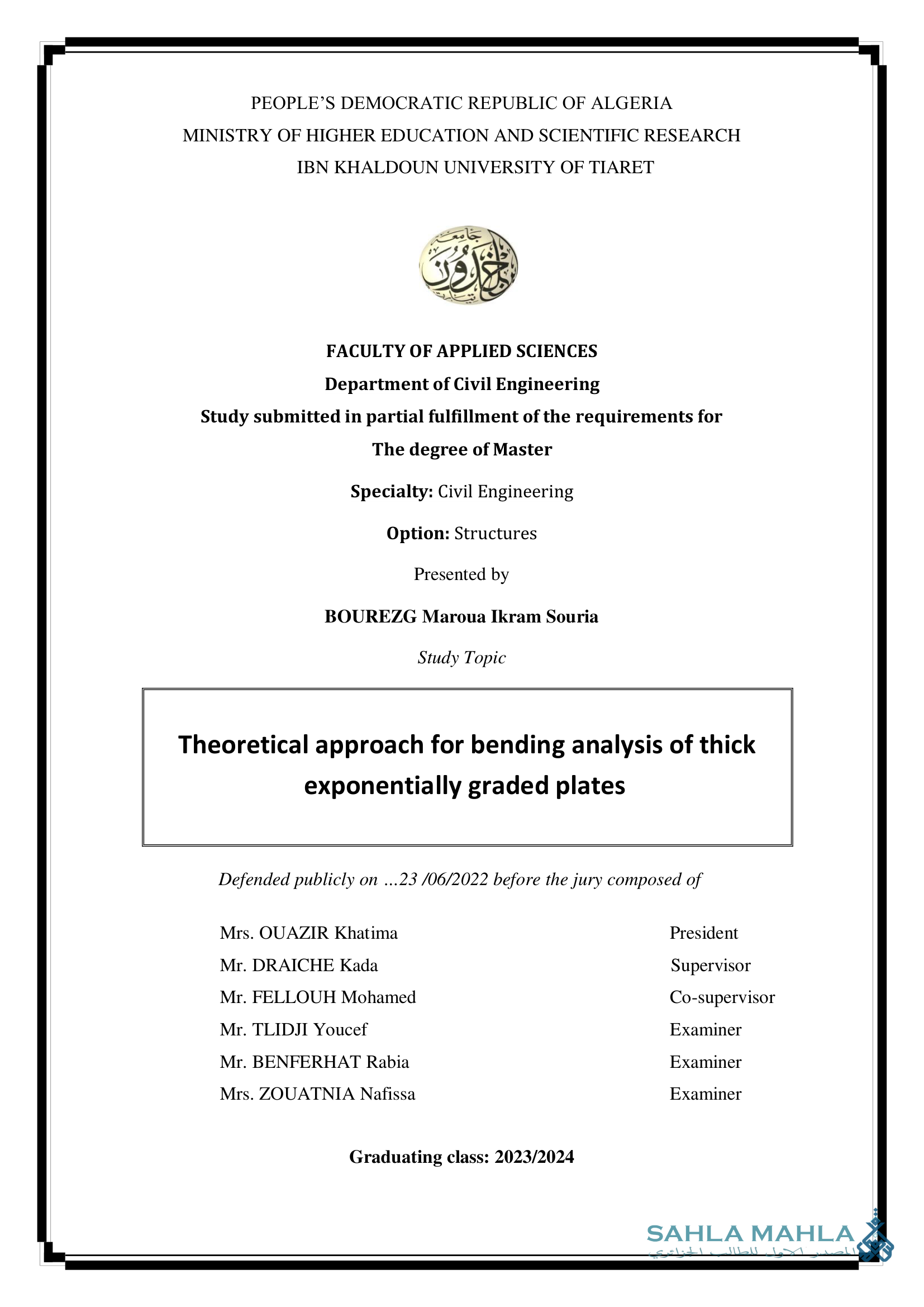
Theoretical approach for bending analysis of thick exponentially graded plates
General Information:
Master |
Level |
Theoretical approach for bending analysis of thick exponentially graded plates |
Title |
Structures |
Specialty |
Cover Page:
Outline:
General Introduction Chapter I General information on FGM I.1. Introduction I.2. Literature review I.3.History of the development of FGM materials I.4.Manufacturing technique for FGM I.4.1.Bulk FGM manufacturing technique (Conventional techniques) 1.4.1.1.Powder metallurgy I.4.1.2.Dry compaction o powders I.4.1.3.Centrifugal casting 1.4.1.4.Slip casting I.4.1.5.Tape casting (strip casting) 1.4.1.6.Plasma projection I.4.2.Thin FGM manufacturing techniques (advanced technique) 1.4.2.1.Vapor deposition I.4.2.2.Ion beam-assisted deposition I.4.2.3.Electro- deposition 1.5. Classification of FGMs 1.5.1.Classification based on FGM structure 1.5.2.Classification based on FGM gradient type I.6.Comparison of FGM Materials and Traditional Materials I.7. Governing laws of the material properties variation of FGM plate I.7.1. Material properties of P-FGM plate I.7.2. Material properties of S-FGM plate I.7.3. Material properties of E-FGM plate I.8. Application Area 1.8.1. Thermal barrier I.8.2. Defense I.9.Advantages and disadvantages of functionally graded materials I.9.1. Advantages of Functionally graded materials I.9.2. Disadvantages of FGMs I.10.Conclusion Chapter II The different theories of FGM plates II.1.Introduction II.2.Definition of the plates II.3. Different types of plates II.3.1.Isotropic plates II.3.2.Orthotropic plates II.3.3.Anisotropic plates II.4.Application Area II.5. Different types of theories II.5.1.Bi-dimensional theories II.5.1.1.Classical plate theory (CPT) II.5.1.2.First shear deformation theory (FSDT) II.5.1.3.High-order shear deformation theory (HSDT) II.5.1.4.Refined plate theory (RPT) II.5.1.5. Higher-order shear and normal deformation theory (qausi-3D) II.5.2. Three-dimensional theory (3D) II.6. Layered approach II.6.1. Zig-zag approach II.6.2. Discreet layer models II.7. Conclusion Chapter III Theoretical approach for bending analysis of thick exponentially graded plates III.1.Introduction III.2.Mathematical formulation of present approach III.2.1.Exponentially graded plate model III.2.2. Theoretical formulation assumptions III.2.3.kinematic and constitutive relations III.3.Governing differential equations III.4.Analitycal solution for EG plates III.5.Conclusion Chapter IV Numerical results and discussion IV. 1. Introduction IV.2. Numerical results and discussion IV.2.1. Validation study IV.2.2.Parametric study IV.3.Conclusion General conclusion Bibliographic references
Download The Thesis:
For more academic sources and references, including theses and dissertations from Algerian universities, , visit our main website.