


THE PURPOSE OF DEEP LEARNING MODEL USING EMBEDDING TECHNIQUE IN ARABIC SENTIMENT ANALYSIS
General Information:
Doctorate |
Level |
THE PURPOSE OF DEEP LEARNING MODEL USING EMBEDDING TECHNIQUE IN ARABIC SENTIMENT ANALYSIS |
Title |
Computer science |
Specialty |
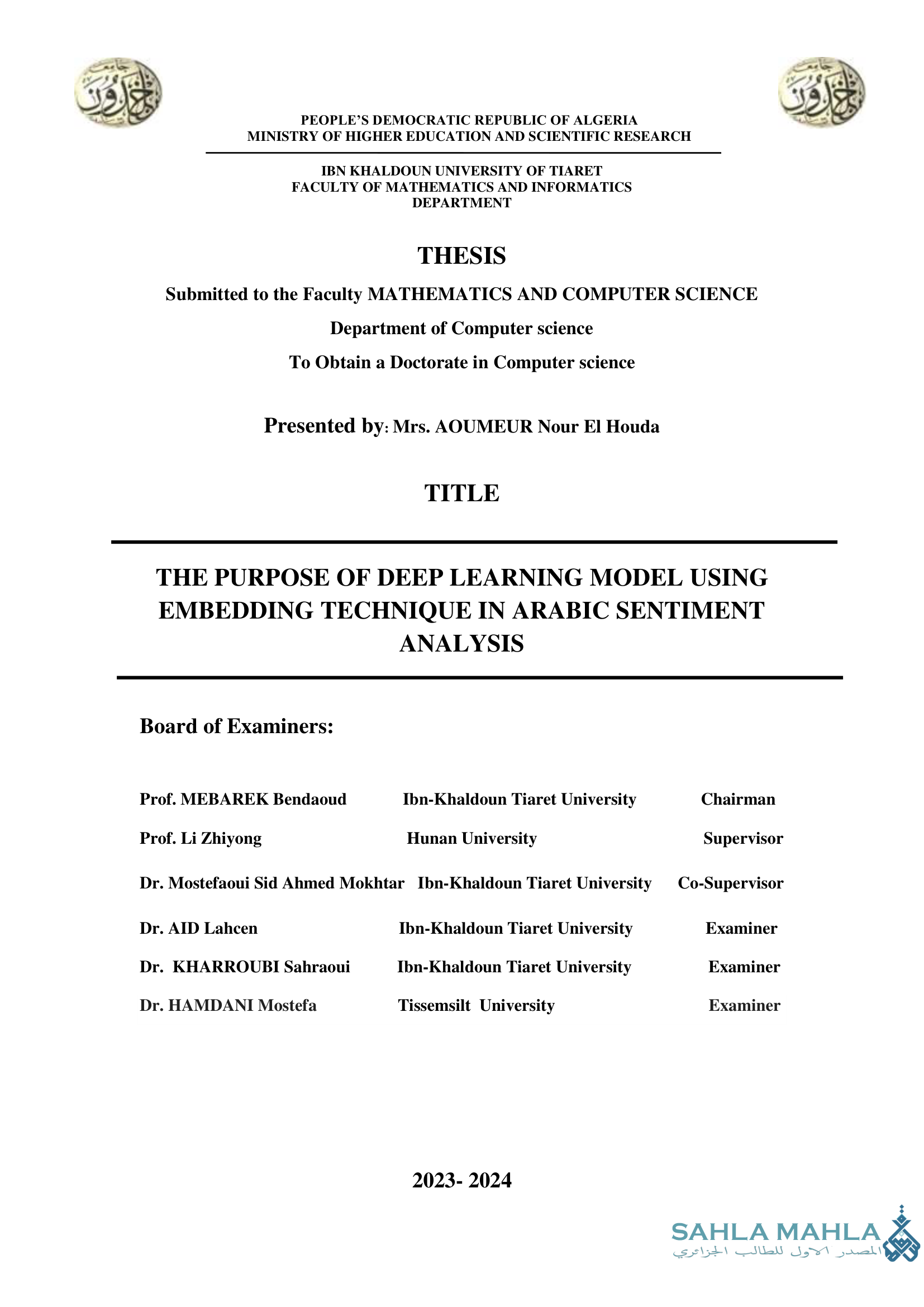
Cover Page:
Outline:
General Introduction Chapter 1 Background & Literature Review Introduction Sentiment Analysis (SA) Sentiment Analysis Level Document level Sentence level Aspect level Type of Sentiment Analysis Sentiment Analysis Methods Sentiment Analysis Challenges Sentiment Analysis Approaches Sentiment Analysis Applications Conclusion Chapter 2 Machine Learning and Deep Learning for sentiment analysis Introduction Machine learning approaches for sentiment analysis Machine Learning Applications Machine learning methods Supervised Learning Unsupervised Learning Reinforcement machine learning Machine learning algorithm Support Vector Machine (SVM) K-Nearest Neighbor Algorithm (KNN) Naive Bayes Algorithm (NB) Latent Dirichlet Allocation (LDA) Logistic Regression (LR) Classification and Regression Trees (CART) Performance Metrics in Machine Learning Performance Metrics for Classification Accuracy Confusion Matrix Precision Recall or Sensitivity F-Score AUC (Area Under the Curve) ROC Performance Metrics for Regression Deep learning approaches for sentiment analysis Types of Deep Learning Networks Deep Learning Methods Deep Learning Applications Deep learning in Natural Language Processing (NLP) Word embedding Word2vec Doc2vec Term Frequency-Inverse Document Frequency (TF-IDF) Glove Fast Text Bidirectional Encoder Representations from Transformer (BERT) XNET Conclusion Chapter 3 Arabic Sentiment Analysis (ASA) Introduction Arabic language Challenges with Arabic Language Sentiment Analysis Arabic Sentiment Analysis Types Document Level Sentence Level Aspect Level Conceptual Level Arabic sentiment resources Corpora foundations Arabic Sentiment Analysis Designed Corpora Arabic Sentiment Analysis Approaches Corpus-based Approach Pre-processing Feature extraction Machine learning-based Sentiment classification Deep learning-based Sentiment classification Lexicon-based Approach Hybrid Approach Arabic Sentiment Analysis of Applications Limitations of Arabic Sentiment Analysis Conclusion Chapter 4 Evaluation and Result Introduction Dataset Data Collection CASAD Preprocessing Tokenization Stemming Part of Speech Tagging (POS) Stop Word Filtering TFIDF Feature Extraction Word2vec Feature Extraction Machine Learning Training Experimental Discussion and Analysis Results Multi class Experiments Binary-Class Experiments Conclusion General Conclusion References
Download The Thesis:
For more academic sources and references, including theses and dissertations from Algerian universities, , visit our main website.