


Investigating the Benefits of Integrating Translation in Learning English as a Foreign Language – A Case of Study Master One Linguistics Students of English at university of Ibn khaldoun
General Information:
Master’s Degree |
Level |
Investigating the Benefits of Integrating Translation in Learning English as a Foreign Language – A Case of Study Master One Linguistics Students of English at university of Ibn khaldoun |
Title |
Linguistics |
Specialty |
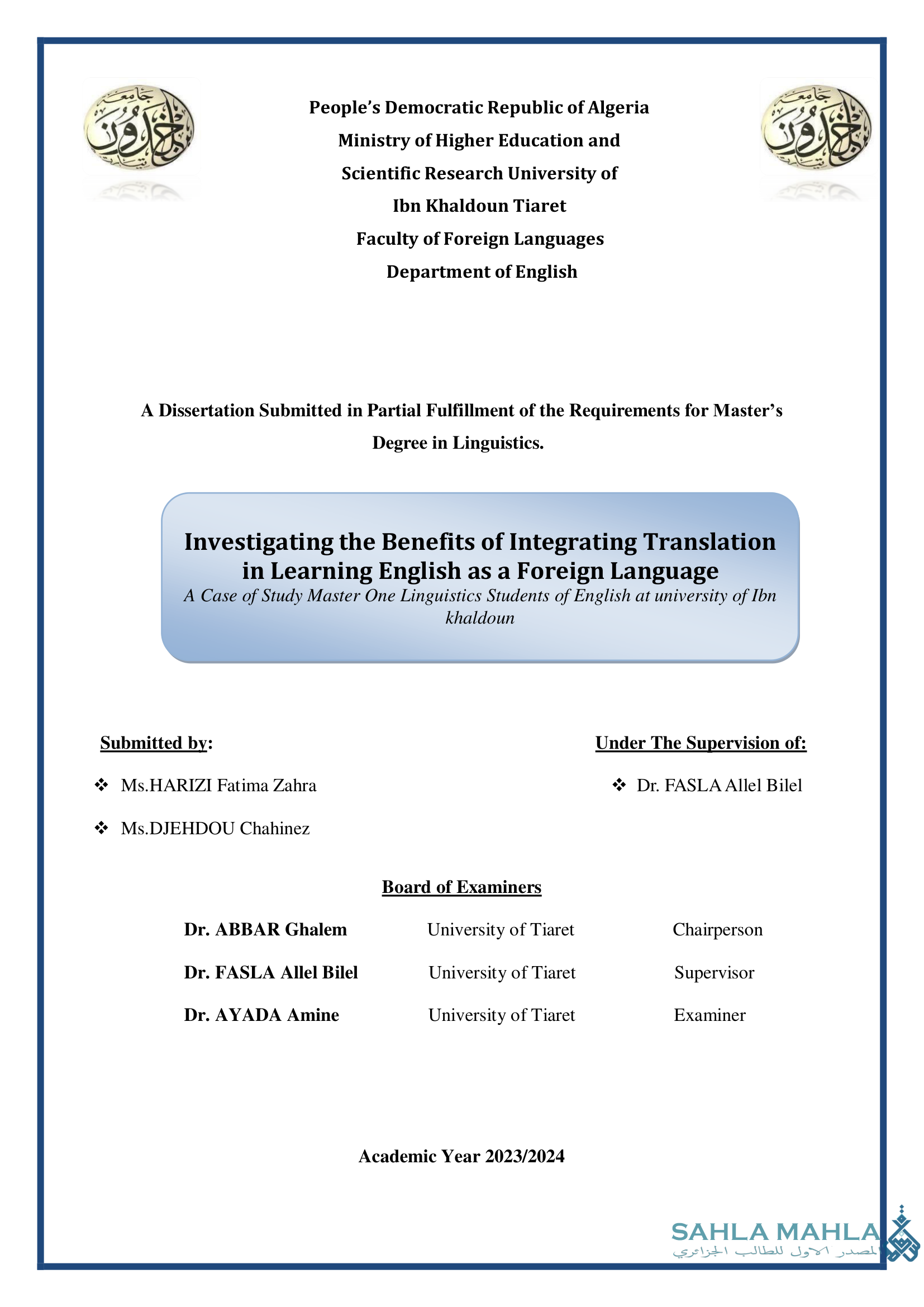
Cover Page:
Outline:
GENERAL INTRODUCTION CHAPTER I: WHAT IS TRANSLATION? Introduction 1.1. The Definition of translation 1.2. Types of Translation 1.2.1 Literal Translation 1.2.1.1 Literal Translation of Words 1.2.1.2 One to One literal Translation 1.2.3.1 Bound Free Translation 1.2.3.2 Loose Free Translation 1.3 Translation Strategies 1.4 Translation as strategy and activity in EFL class 1.5 The significance of cultural knowledge in translation studies 1.6. Professional Translation VS Pedagogical Translation 1.7. The Role of Translation in Teaching and Learning foreign languages 1.8. Translation as Fifth Skill in Language Learning 1.9. Objectives of Translation Process 1.10 The use of translation as teaching method 1.11. Reasons for Using First language in EFL classrooms for Teachers and Students 1.11.1 Teachers’ reasons 1.11.2 Students’ reasons Conclusion CHAPTER II: LANGUAGE LEARNING 2.1. A basic definition of the learning process 2.1.1 Key characteristics of the learning process 2.2. Learning foreign languages 2.2.1 Key components of foreign language learning 2.2.2 The Benefits of learning foreign languages 2.2.3. How does language enhance local and global job opportunities for graduates 2.3. Mechanisms of Learning a Foreign Language 2.3.1 Exposure and Input 2.3.2 Attention and Focus 2.3.3 Processing and Storage 2.3.4 Practice and Output 2.3.5 Motivation and Affect 2.4. Advantages of Learning English 2.4.1 Personal Advantages 2.4.2 Professional Advantages 2.5. The Importance of Learning Foreign Languages 2.5.1 Personal Benefits 2.5.2 Cultural Benefits 2.7. Learning Styles in Language Learning 2.8. The Factors influencing language learning Conclusion CHAPTER III: PRACTICAL PART 3.1.Introduction 3.2. Description of the participants 3.3. Research Method and Data Collection Tools 3.5. Recommendations Conclusion General conclusion
Download The Thesis:
For more academic sources and references, including theses and dissertations from Algerian universities, , visit our main website.