


Improving English as Foreign Language Students’ Translation Quality Using Artificial Intelligence – Case Study: 3rd Year English Students at the Department of English Ibn Khaldoun University-Tiaret
General Information:
Master |
Level |
Improving English as Foreign Language Students’ Translation Quality Using Artificial Intelligence – Case Study: 3rd Year English Students at the Department of English Ibn Khaldoun University-Tiaret |
Title |
Didactics |
Specialty |
Cover Page:
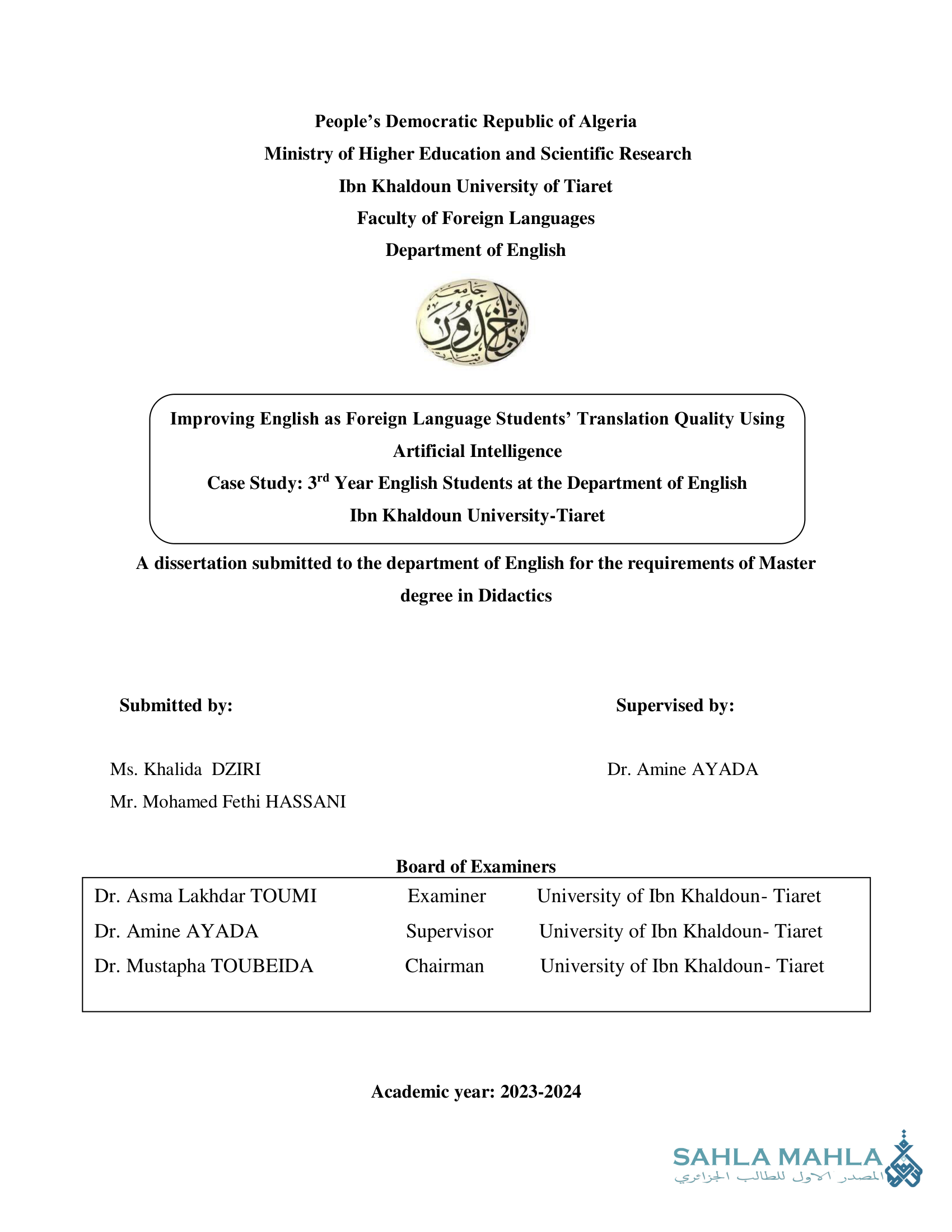
Outline:
General Introduction I. Chapter One: Concepts in Translation Introduction I.1. Overview of Translation I.1.1. Definition of Translation I.1.2. The Process of Translation I.1.3. The Aims, Importance, and Benefits of Translation I.2. Types of Translation I.2.1. Intra-lingual Translation I.2.2. Inter-lingual Translation I.2.3. Inter-semiotic Translation I.3. Other Types of Translation I.3.1. Pragmatic Translation I.3.2. Aesthetic-poetic Translation I.3.3. Ethnographic Translation I.3.4. Linguistic Translation I.4. Procedures of Translation I.4.1. Transliteration I.4.2. Borrowing I.4.3. Calque I.4.4. Transposition I.4.5. Modulation I.4.6. Reduction and Expansion I.4.7. Adaptation I.4.8. Additions, notes and glosses I.5. Modern Vs Traditional Translation I.5.1. Artificial Intelligence and Machine Translation I.5.2. Definition of Machine Translation I.5.3. Effectiveness of Machine Translation I.6. Translation as a Pedagogical tool for English as a language/” class=”tat-p” style=”color:#0073aa;font-weight:bold;”>Foreign Language (EFL) I.7. Translation as Writing Process Conclusion II. Chapter Two: Writing Skill Introduction II.1. The Four Skills II.1.1. The Importance of Communication in Language Evolution II.1.2. The Evolution of Language Skills: Perspectives and Divisions II.1.3. Historical Development of Language Skills II.1.4. Scholars’ conceptualizations of the four skills II.1.5. The Importance of the Four Skills II.2. Definition of Writing II.3. Types of writing II.3.1. The Four Major Types of Writing II.3.1.1. Expository Writing II.3.1.2 Narrative Writing II.3.1.3. Persuasive Writing II.3.1.4. Descriptive Writing II.3.1. Additional Types of Writing II.4. Importance of Writing II.4.1. Writing as a Means to Express One Self II.4.2 Written Communication II.4.3 Writing in the Educational Context II.4.4 Writing in the Professional World II.4.5 Writing: A Bridge to the Past II.4.6 Beyond Classroom: Writing for Fun II.5 Writing in EFL Classes II.5.1. Importance of Teaching Writing for EFL Students II.5.2. Challenges of Teaching Writing to EFL Students II.5.3. Types of Tasks to Teach II.5.4. The Instructor’s Role II.5.5. The Lesson Content II.6. Improving Writing Skills II.6.1. Characteristics of a Good Writer II.6.2. Struggles That Writers Face II.6.3. Tips to Improve Writing Skills II.6.4. Human Vs Machine Writing II.6.5. Definition of Machine Writing II.6.6. How Does Machine Writing Work II.6.7. Strengths of Human Writing II.6.8. Challenges of Using AI Writing Conclusion III. Chapter Three: Research Methodology and Data Analysis Introduction 1. Research Design 2. Research Methodology 3. Population and Sample 3.1. Student’s Profile 3.2. Teachers’ Profile 4. Data Collection Tool 4.1. Questionnaire 4.2. Semi- Structured Interview 5. Data Analysis 5.1. Questionnaire 5.2. Analysis of Teachers’ Interview 6. Discussion of the Findings Conclusion General Conclusion
Download The Thesis:
For more academic sources and references, including theses and dissertations from Algerian universities, , visit our main website.