


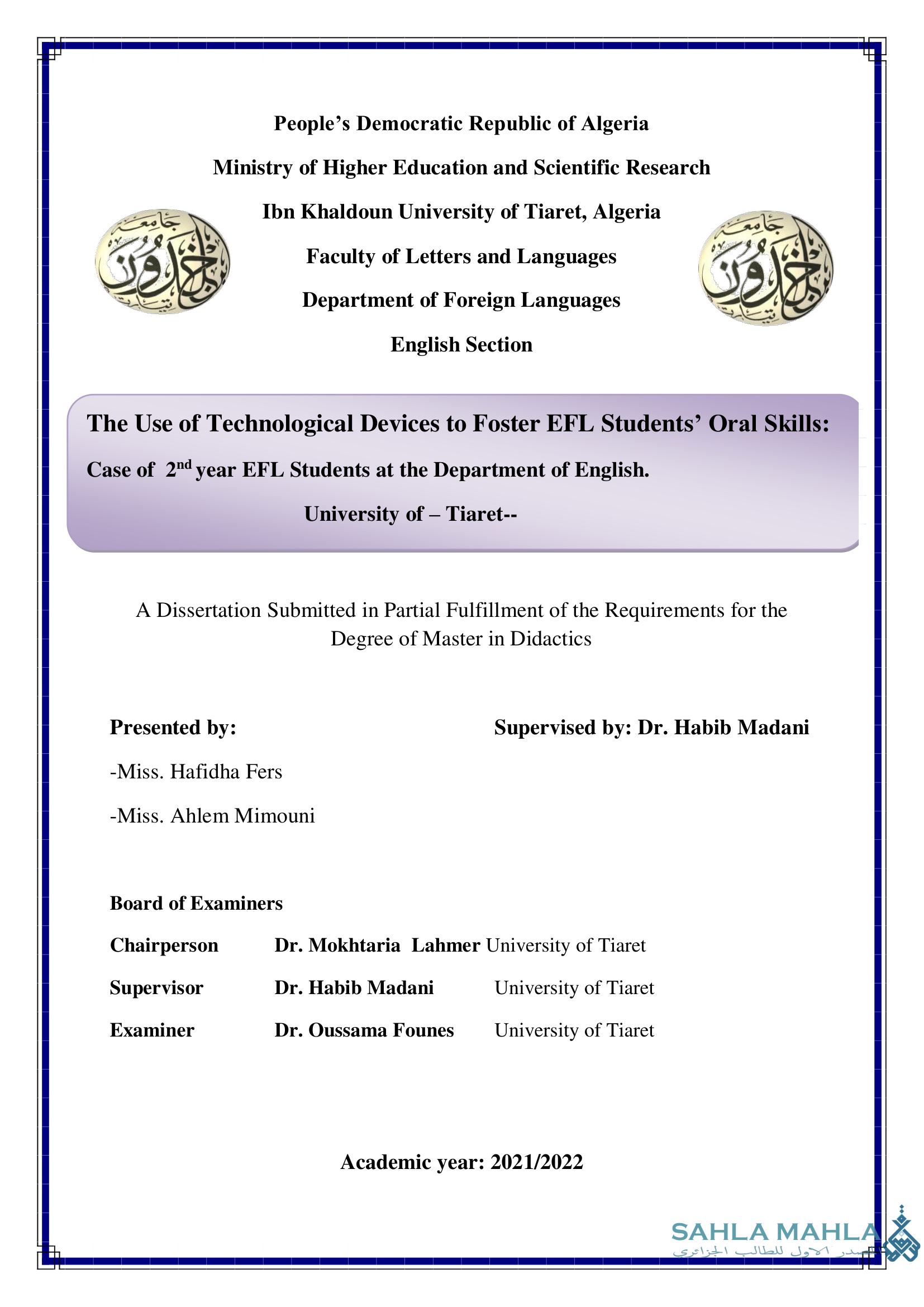
The Use of Technological Devices to Foster EFL Students’ Oral Skills: Case of 2nd year EFL Students at the Department of English. University of Tiaret-
General Information:
Master |
Level |
The Use of Technological Devices to Foster EFL Students’ Oral Skills: Case of 2nd year EFL Students at the Department of English. University of Tiaret- |
Title |
Didactics |
Specialty |
Cover Page:
Outline:
General Introduction 1.1 Introduction 1.2Section one: The Speaking skill 1.2.1. The Speaking Skill Defined 1.2.2. Importance of Speaking Skill 1.2.3 Types of Speaking 1.2.3.1. Imitative Speaking 1.2.3.2.Intensive Speaking 1.2.3.3. Responsive Speaking 1.2.3.4. Interactive Speaking (dialogues) 1.2.3.5. Extensive speaking (monologue) 1.2.4.FeaturesofSpeaking Proficiency 1.2.4.1. Fluency 1.4.4.2.Accuracy 1.2.4.3.Vocabulary Retention 1.2.4.4.Flexibility 1.2.5. Speaking Difficulties 1.2.5.1.Inhibition 1.2.5.2.Lack of Topical Knowledge 1.2.5.3.Low or Uneven Participation 1.2.5.4. Mother Tongue Interference 1.2.6.Speaking Strategies 1.2.6.1.Improvising 1.2.6.2.Discarding 1.2.6.3.Foreignising 1.2.6.4.Paraphrasing 1.2.7.Speaking Activities 1.2.7.1. Awareness 1.2.7.2.Appropriation 1.2.7.3. Autonomy 1.2.8.Stages of Speaking Lesson 1.2.8.1. Pre-communicative stage 1.2.8.2. During- communicative stage 1.2.8.3. Post-communicative stage 1.2.9.Foreign language anxiety 1.2.9.1. Communication Apprehension 1.2.9.2. Fear of Negative Evaluation 1.2.9.3. Test Anxiety 2.3. Section Two: TheListening Skills 2.3.1. Definitionsof Listening 2.3.2. Hearing vs. Listening 2.3.3. The Importance of Listening 2.3.4. Processes Involved in Listening 2.3.5. Listening Difficulties 2.3.6.Steps of Listening Process 2.3.7. Listening and Speaking Relationship 2.1 Introduction 2.2 Technological Devices Defined 2.3 History of Technological Devices 2.4 Types of Technological Devices 2.5 Teachers’ Role when Using Technological Devices in Classroom 2.6 Technological Devices in Speaking and Listening 2.6.1 Listening 2.6.2 Speaking 2.7 Aims and Advantages of Technological Devices in EFL Classrooms 2.7.1 Projector 2.7.2 Videos 2.7.3 Computers 2.8 Visual Media 2.9 Sound and Audio Media 2.10 Social Media and Audiovisual Platforms 2.11 E-Learning 2.12 Approaches to Multimedia Technological devices and Language Acquisition 2.12. 1Mayer’s Cognitive Multimedia Learning Theory (CMLT)(2001) 2.12.2 The Cognitive Approach to Multimedia Learning 2.12. 3 StepenKrashen’s ‘The Importance of the Input’ (1981) 2.12.4. Allan Paivio’s ‘The Dual-Coding Theory’ (1971) 2.12.5. Mark Johnson’s ‘The Image Schemas Theory’ (1987) 2.13Conclusion 3.1 Introduction 3.2Methodology 3.3Participants 3.4Research Instruments 3.5Research Procedures 3.6 Description of Students’ Questionnaire 3.6.1Section One: General Information 3.6.2 Section two: Speaking Skills 3.6.3 Section Three: Aural Skills 3.6.4 Section Four: Technological Devices 3.7Description of Teachers’ Questionnaire 3.7.1 Section one: General Information 3.7.2 Section two: Teaching Speaking 3.7.3 Section Three: The use of technological devices in classroom 3.8 Students’ Questionnaire Analysis 3.9Teachers’ Questionnaire Analysis 3.10 Interpretation and Discussion of the Main Findings 3.11 Suggestions and Recommendation 3.12Conclusion General Conclusion
Download The Thesis:
For more academic sources and references, including theses and dissertations from Algerian universities, , visit our main website.