


Scrutinizing the Textbook Content Suitability and its Impact on EFL Learners: the Case of Third Year Primary School English Textbook
General Information:
Master’s Degree |
Level |
Scrutinizing the Textbook Content Suitability and its Impact on EFL Learners: the Case of Third Year Primary School English Textbook |
Title |
Didactics |
Specialty |
Cover Page:
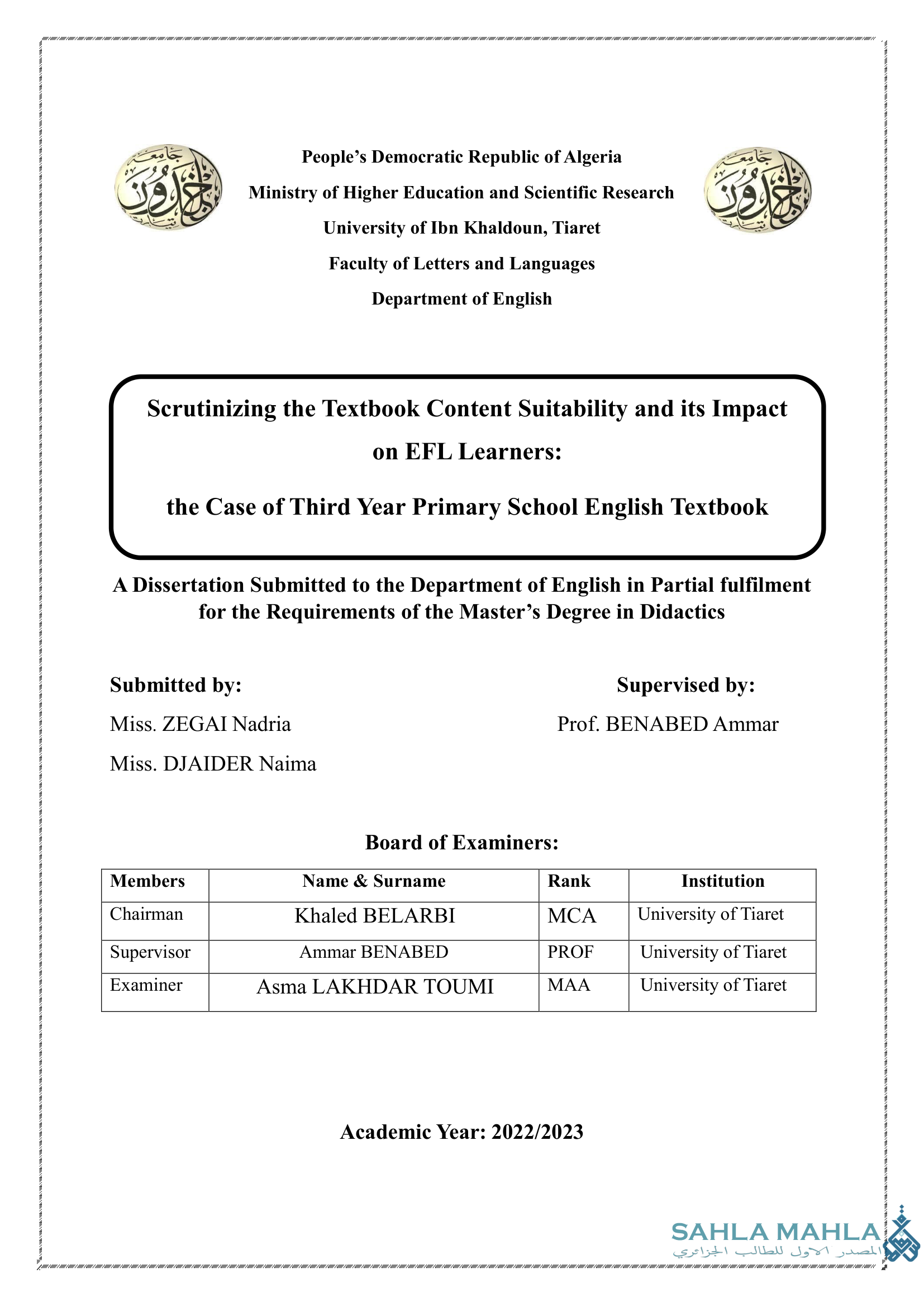
Outline:
General Introduction Chapter One: The Implementation of English language and its Textbooks within Primary School Education Introduction I.1.English as an International Language I.1.1. English as a Lingua Franca I.1.2. The Implementation of English Language in Algeria I.1.3. Algerian Educational Reforms I.1.4. Reasons behind Inserting English in Primary School I.1.5. Criteria of Curriculum Development 1.2. Textbooks: Multiple Definitions I.2.1. Advantages and disadvantages of using a Textbook 1.2.1.1. Textbook Advantages 1.2.1.2. Textbook Disadvantages I.2.2. Textbook Evaluation I.2.2.1. Reasons for Textbook Evaluation 1.2.3. Textbook Adaptation I.2.3.1. Reasons for Textbook Adaptation 1.2.3.2. Techniques of Textbook Adaptation I.2.4. Characteristics of good and bad Textbook (Qualities) 1.2.4.1. Bad Textbook I.2.4.2. Good Textbook 1.2.5. EFL Textbooks Conclusion Chapter two: Research Design and Methodology Introduction II.1. Case Study Approach II.2. Sampling Technique: Rationale II.3. Research Methodology II.3.1. Research Design II.3.2. Qualitative and Quantitative Methods II.3.2.1. Qualitative Method II.3.2.2. Quantitative Method II.3.3. Mixed Method II.3.4. Research Instruments II.3.4.1. The Questionnaire II.3.4.1.1. Description of the Questionnaire II.3.4.1.2. The Importance of Online Questionnaire II.3.4.2. The Interview II.3.4.2.1. Description of the Interview II.3.4.3. Textbook Description II.3.4.4. Checklist Description II.3.4.4.1 Description of Checklist II.3.5. Data Collection Procedures II.3.6. Triangulation II.3.7. Case of Study II.3.8. Participants II.3.8.1. Target Population II.3.8.2. Sample II.3.9. Sampling Procedure Conclusion Chapter Three: Data Collection and Analysis Introduction III. Data Analysis and Interpretation III.1. Questionnaire III.1.1. Section One :Informants’ Personal and Professional data III.2. Interview III.2.1. Interview Analysis III.3.Textbook Evaluation Checklist III.3.1. Checklist Data Interpretation III.3.1.1. Dimension I. Textbook Content Analysis III.3.1.1.1. Data Interpretation III.3.1.1.2. Target Language Culture III.3.1.1.3. The Reading Selections Authenticity III.3.1.2. Dimension II. Textbook Vocabulary and Grammar Analysis III.3.1.2.1. Grammatical Rules Presentation III.3.1.2.2. The New Vocabulary Words Presentation III.3.1.2.3. New Vocabulary Words Repetition III.3.1.2.4. Top-down Techniques for Learning New Vocabulary Words III.3.1.3. Dimension III. Textbook Exercises and Activities Analysis III.3.1.3.1. Interactive and task-based activities III.3.1.3.2. Instructions for Comprehension III.3.1.3.3. Facilitating Activities for grammar rules Use III.3.1.3.4. Text makes comprehension easier by addressing one new concept at a time III.3.1.4. Dimension IV: Attractiveness of the Textbook and Physical Make-up III.3.1.5. Dimension V. Context Conclusion Data Triangulation Suggestions and Recommendations Limitations General Conclusion
Download The Thesis:
For more academic sources and references, including theses and dissertations from Algerian universities, , visit our main website.